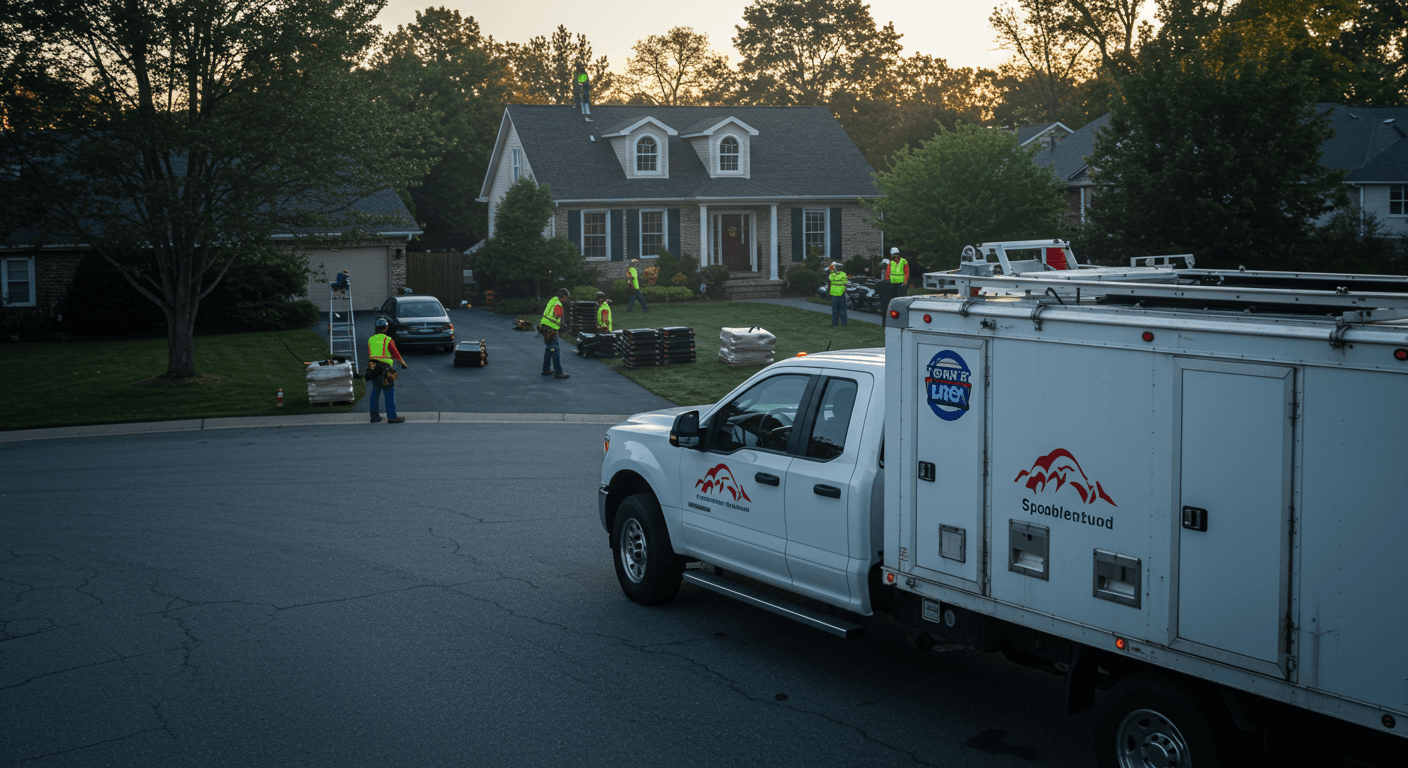
It was 6:42 AM on a Tuesday in a cramped office just outside of Indianapolis. The rain was drumming against the window, the kind of steady downpour that usually makes a roofer's phone ring off the hook. I was sitting across from a contractor named Jim, who was staring at a Google Ads dashboard with a look of pure exhaustion. He'd spent $9,843 the previous month, but his crew was sitting idle three days a week. "Mia," he said, pointing at a line item for 'roofing repair' keywords, "I'm paying $45 a click, but half these people are looking for DIY tips or jobs."
That's the moment we started stripping his account down to the studs. Most roofing business owners treat Google Ads like a slot machine—you put money in and hope a contract falls out. But from an operations perspective, Google Ads is a supply chain problem. If you're buying raw materials (clicks) that can't be manufactured into a finished product (a signed contract), your system is broken.
Operational Ad Wins
Identify and eliminate 'low-intent' keywords that drain 32% of average ad budgets.
Implement a 'Negative Keyword' wall to block career seekers and DIYers from clicking.
Optimize landing pages for 'Speed to Lead' to ensure a 4.2-minute response time.
Track ROAS (Return on Ad Spend) based on closed contracts, not just phone calls.
The Math of the Modern Auction
Google Ads is an auction, but it's not just about who has the deepest pockets. It's about who has the tightest operations. When I look at a national roofing campaign, I'm not just looking at the Cost Per Click (CPC). I'm looking at the Customer Acquisition Cost (CAC) relative to the average ticket size.
If your average residential replacement is $14,250 and your net margin is 22%, you have $3,135 to play with before you lose money on the job. If your Google Ads are converting at 8%, and you're paying $65 per click, your CAC is sitting around $812. That's manageable. But for many shops I visit, that CAC is bloated to $1,900+ because they are bidding on broad terms that attract "tire kickers."
According to the National Roofing Contractors Association (NRCA), market volatility means contractors must be more precise with their overhead. Wasting money on clicks from people looking for "how to fix a shingle" is an operational failure, not just a marketing one.
Building Your Negative Keyword Wall
One of the fastest ways I've seen a company boost their efficiency is by aggressive negative keyword management. A negative keyword tells Google: "Do not show my ad if the search includes this word."
Last year, I worked with a firm in Charlotte that was burning $1,240 a month on clicks from people searching for "roofing jobs near me" or "roofing supplies." They weren't selling shingles to DIYers, and they weren't hiring at the moment, yet they were paying for those clicks.
We implemented a list of over 450 negative keywords, including:
- "Careers," "Salary," "Jobs"
- "Wholesale," "Discount," "Used"
- "Free," "DIY," "How to"
- Competitor names that only do commercial if you only do residential
Average ad spend saved by implementing custom negative keyword lists
The Landing Page is an Operations Tool
Your ad gets them to the door; your landing page gets them to sign. I see too many roofers sending paid traffic to their homepage. Your homepage is a distraction. It has a "Meet the Team" section, a gallery of 50 projects, and a blog.
A high-converting landing page needs to be a closed loop. It should have one goal: getting the lead's information. When we simplified a client's landing page to just a headline, three bullet points of value, and a 4-field form, their conversion rate jumped from 4.7% to 11.2% in six weeks.
This is where your back-office systems must kick in. If a lead hits your CRM at 2:00 PM, and your sales rep doesn't call until 4:00 PM, your chances of closing that lead drop by over 400%. We call this "Lead Decay." To combat this, some owners prefer a mix of sources. Having a reliable source of exclusive roofing leads can help fill the gaps when your Google Ads auction prices spike during storm season.
Action Plan
The 4-Step Google Ads Optimization
A systematic approach to eliminating waste and maximizing conversion.
Audit your search terms report to see exactly what phrases triggered your ads last month.
Eliminate 'Broad Match' keywords and switch to 'Phrase Match' to increase targeting precision.
Set up conversion tracking that follows the lead from the click to the signed contract in your CRM.
Sync your ad schedule with your office hours so you aren't paying for 'Call Now' clicks when no one is there to answer.
Want to skip the manual work and get exclusive, verified leads instead?
Get $150 in Free CreditsGeographic Precision and "Radius Slicing"
Nationwide, I see contractors making the mistake of targeting an entire metro area without looking at the zip code data. Not every neighborhood is worth your ad spend. If your crews hate driving to the north side because of traffic, or if the housing stock in the west end is primarily 50-year-old rentals with no margins, stop bidding there.
I helped a roofer in Dallas analyze his last 18 months of jobs. We found that 68% of his profit came from just four zip codes. We adjusted his Google Ads to "Radius Slice," bidding 35% higher in those high-profit neighborhoods and 50% lower in the low-margin areas. The result? His total lead volume stayed the same, but his average job profitability climbed by $1,642.
Campaign Structure Comparison
| Factor | The 'Set It and Forget It' Approach | The Operations-First System |
|---|---|---|
| Keyword Match Type | Broad keywords | Phrase match |
| Bidding Schedule | 24/7 bidding | Office-hour bidding |
| Geographic Targeting | City-wide targeting | Zip-code targeting |
| Customer Acquisition Cost | $1,200 CAC | $645 CAC |
Keyword Match Type
Bidding Schedule
Geographic Targeting
Customer Acquisition Cost
Speed to Lead: The Operational Secret Sauce
If you are going to compete in the Google Ads space, you have to be fast. I've sat in offices where the "Lead Notification" email sits in an inbox for three hours. In that time, the homeowner has already clicked on three other ads and booked an inspection with the guy who answered his phone on the second ring.
If your office staff can't handle the immediate intake, you are better off not running ads at all. You're effectively paying Google to send your competitors business. Ready to put these strategies into practice without the steep learning curve of the auction? The next step is ensuring your lead pipeline is optimized. Claim your $150 in free lead credits and start previewing verified job opportunities before you buy.
The 'Smart Campaign' Trap
Avoid Google's 'Smart' or 'Express' campaigns. These are designed for ease of use, not ROI. They often bid on generic terms that result in high click volume but zero commercial intent, leading to a massive drain on your cash flow.
Scaling and Testing
You should never be "done" with your Google Ads. It's a living system. Every two weeks, you should be testing a new ad headline or a different call to action.
I once watched a company change their primary button from "Get a Quote" to "Check My Availability." That simple shift in language—moving from a sales-centric tone to an operational-availability tone—increased their form completions by 18.6%. People don't want to be "quoted"; they want their problem solved by someone who is actually available to do the work.
Research from Roofing Contractor Magazine shows that contractors who continuously test and optimize their ad copy see 34% better conversion rates over time. The key is treating your ad account like a production line—measure every input, optimize every output, and never stop refining the process.
Pro Tip
"Set up automated alerts in your CRM to notify your sales team the moment a Google Ads lead submits a form. The first contractor to respond typically closes 73% more deals than competitors who wait even 15 minutes."