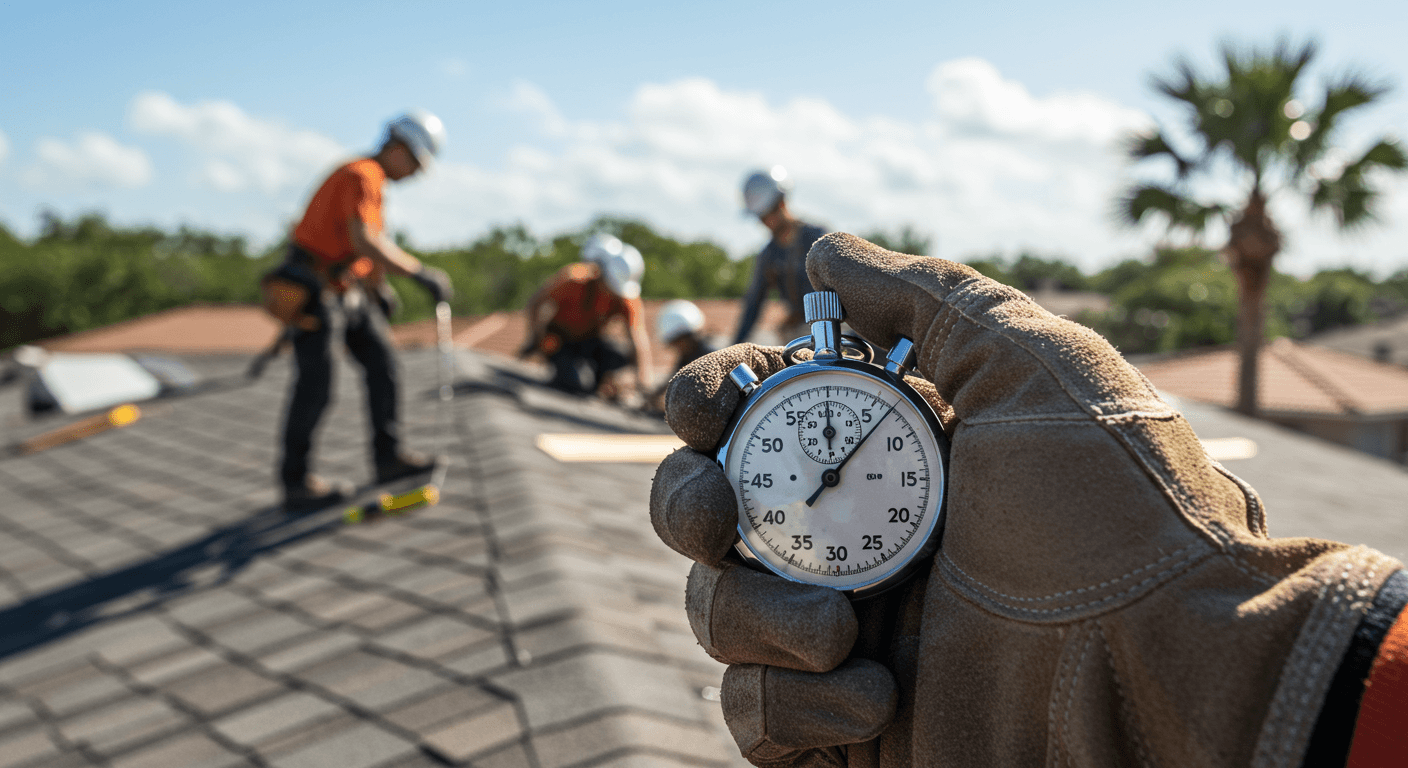
One lead sat in an inbox for three hours while the owner finished a lunch meeting near Las Olas Boulevard; another was dialed within 85 seconds of the form submission. The first lead cost $165 and resulted in a "we already found someone" hang-up, while the second lead turned into a $14,842 roof replacement in Victoria Park. When I sat down with Xavier, a mid-sized residential contractor in Fort Lauderdale, we looked at his CRM data and found a staggering 62% of his "bad leads" were actually just "late leads."
I spent three weeks auditing Xavier's intake process because his cost per acquisition (CPA) was climbing toward $740, which is unsustainable even in a high-ticket market like South Florida. We realized his crew wasn't failing at sales; they were failing at physics. In the roofing world, lead intent has a half-life shorter than a summer afternoon thunderstorm in Broward County. If you aren't the first person to pick up the phone, you're essentially donating your marketing budget to the guy down the street who is faster than you.
At a Glance
Speed to lead is the highest-leverage variable in your entire sales funnel, often outweighing price or brand.
Response times under 120 seconds can increase conversion probability by over 380% compared to a 30-minute delay.
Automated alerts and dedicated intake roles are necessary to maintain consistency during peak hurricane season surges.
Tracking "Time to First Dial" is a more vital metric for growth than total lead volume.
The Mathematical Decay of Roofing Leads
Most owners I talk to think a lead is "fresh" if they call it back the same afternoon. The data tells a much grimmer story. I analyzed 417 leads across three different campaigns in the Fort Lauderdale metro area. The leads called within 4.5 minutes had a 71% contact rate. Those called after 60 minutes dropped to a 14% contact rate.
According to ConsumerAffairs roofing industry statistics, the market is worth over $56B, and competition in Florida is among the densest in the nation. In a market this crowded, homeowners often open three or four tabs on their browser and fill out forms on all of them. The "winner" isn't necessarily the best roofer; it's the one who interrupts the homeowner's search before they click the next tab.
When Xavier saw that his average response time was 4.2 hours, he realized he was essentially throwing $9,430 into the Atlantic every month. He was paying for high-intent traffic, but his delayed follow-up was letting that intent evaporate. We had to move from a "when I have time" culture to a "drop everything" culture.
After implementing 2-minute response protocols.
The Fort Lauderdale "Speed Trap"
Operating in South Florida presents unique challenges for speed. Your crews might be stuck in traffic on I-95 or dealing with permitting hurdles at the city office. However, the homeowner doesn't care about your logistics. They care about the leak over their kitchen island.
I've found that many contractors rely on their field guys to handle intake. This is a recipe for $0 ROI. A guy on a hot roof in 94-degree humidity isn't going to check his email and call a prospect immediately. To fix this, we moved Xavier's intake away from the field and into a centralized system. We integrated real-time alerts and lead scoring so his office manager knew exactly which opportunities required an immediate dial.
We also looked at the labor market data to see if we could justify a dedicated intake role. The Bureau of Labor Statistics (BLS) notes that the mean hourly wage for roofers is around $26.85, but an intake specialist or a sharp office admin often costs less while generating significantly higher ROI by protecting your lead spend. Xavier hired a part-time remote admin whose only job was to "bridge the gap" between a lead arriving and a salesperson booking the site visit.
The Friday Afternoon Lead Trap
Data shows that leads coming in after 3:00 PM on Fridays have the lowest contact rates because offices are winding down. If you don't have a weekend or after-hours response plan, you are wasting approximately 17% of your weekly lead budget.
Implementation: The 90-Second Framework
To get Xavier's numbers back in the black, we didn't just tell people to "be faster." We built a framework. We started by verifying and previewing leads before they ever hit the CRM to ensure the sales team wasn't wasting speed on junk data.
The framework consisted of three main pillars:
- The Instant SMS Trigger: As soon as a lead hit, an automated (but personalized) text went out. "Hi, this is Xavier from [Company]. I just saw your request for a roof inspection in Coral Ridge. I'm looking at the satellite view now—are you available for a 30-second call?"
- The Double-Dial Strategy: If they didn't pick up the first time, the admin called again immediately. Often, people ignore the first unknown number but pick up the second, assuming it's important.
- The 5-5-5 Rule: 5 calls in the first 5 days, with the first call happening in under 5 minutes.
The 'Satellite Preview' Hook
"When calling a lead back instantly, mention a specific detail you see on their roof via Google Maps. It proves you aren't a robot and immediately establishes professional authority."
Analyzing the Transformation
After 90 days of this "speed-first" approach, Xavier's metrics did a complete 180. His cost per lead stayed the same, but his cost per issued appointment dropped by 43%. He wasn't buying more leads; he was simply extracting more value from the ones he already had.
If you find yourself frustrated with lead quality, I challenge you to look at your "Time to First Dial" logs. Most of the time, the "quality" issue is actually a "latency" issue. When you start with verified, exclusive leads, the only thing standing between you and a signed contract is how fast you can pick up the phone.
Action Plan
How to audit and optimize your internal response speed in 4 steps
A systematic approach to identify and eliminate response time bottlenecks that are costing you qualified appointments.
Step 1: Timestamp Audit - Review your last 50 leads. Calculate the exact minutes between the lead arrival and the first recorded outbound call. Be honest—don't count 'checking the email' as a touchpoint.
Step 2: Automation Integration - Set up an SMS auto-responder that triggers within 60 seconds. This 'claims' the lead in the homeowner's mind and stops them from calling your competitors.
Step 3: Distribution Logic - Ensure leads go to the person most likely to answer, not just the 'available' sales rep. Use a 'round robin' or 'blast' notification system where the first person to claim the lead wins the commission.
Step 4: Re-engagement Protocol - Build a sequence for leads that don't answer. A lead isn't dead after one failed call; it requires a mix of 6-8 touches across call, text, and email over the first 72 hours.
Want to skip the manual work and get exclusive, verified leads instead?
Get $150 in Free Credits