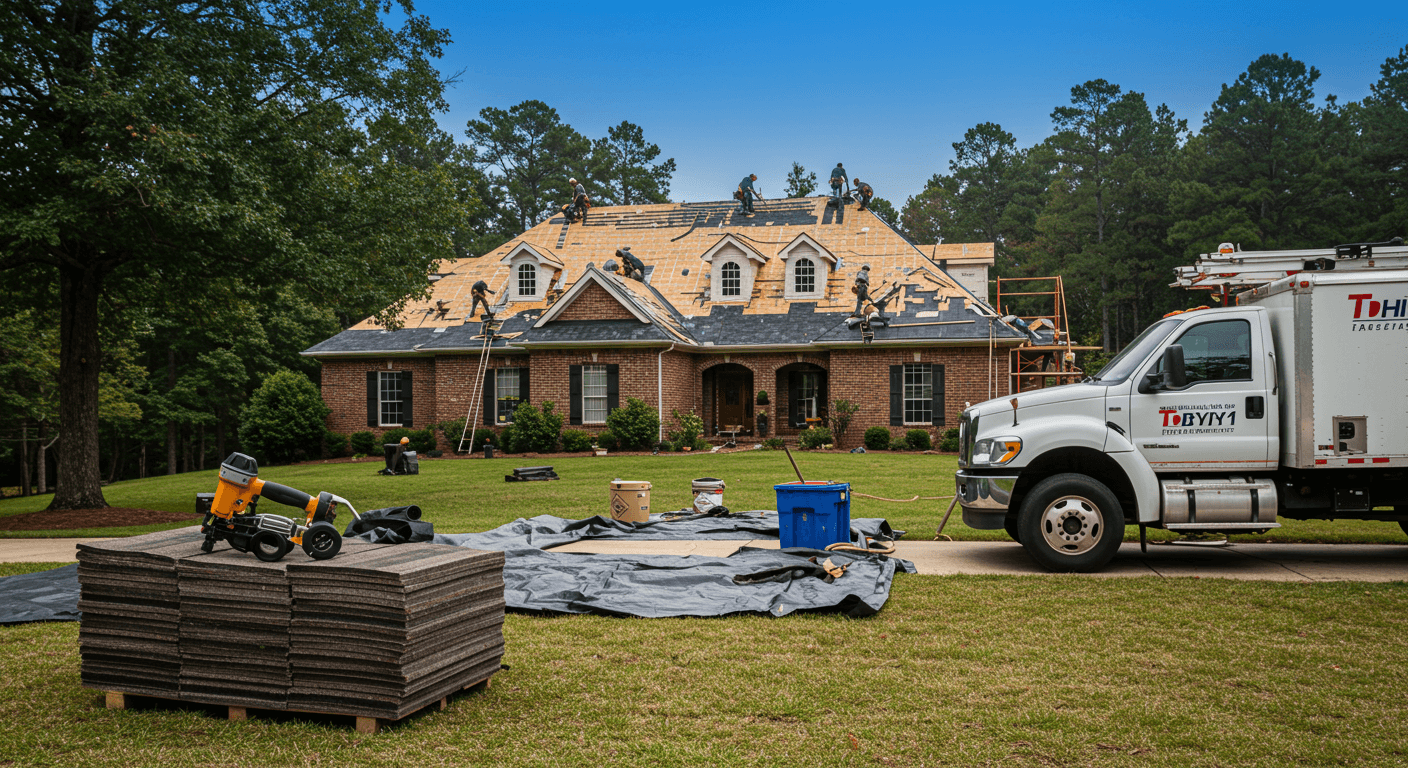
Conventional industry "knowledge" suggests that offering financing is a sign of a struggling sales team or a customer base that can't afford quality work. You might hear old-school owners in the Magic City claim that if you have to "loan" someone a roof, you're just asking for a headache or a lien. I spent a Tuesday afternoon last month in a gravel lot off Highway 31 in Pelham with a contractor named Preston, watching him lose a $14,482 shingle replacement because the homeowner couldn't bridge the gap between their insurance check and a new 2% deductible. Preston told me he didn't "do" financing because it felt like being a banker instead of a roofer. He was wrong.
Financing isn't about lending money; it is about operational velocity. When I looked at Preston's books, he had $84,200 in pending bids that were "waiting on the insurance supplement" or "checking the savings account." In Birmingham's current economic climate, where property values in areas like Liberty Park and Vestavia Hills have surged but liquid cash is tighter due to inflation, financing is the grease that keeps the wheels of your production schedule turning. If you are waiting for a homeowner to find five grand in a shoe box, your crews are sitting idle, and idle crews are the fastest way to burn through your overhead.
At a Glance
Customer financing increases average job size by 26.4% by removing the "minimum repair" mindset.
Offering 12-month same-as-cash options can improve closing rates in Jefferson County by 14.8% during the off-peak season.
Integrating financing into the initial bid reduces the sales cycle by 5.3 days on average.
Dealer fees should be viewed as a marketing expense that protects your net profit margin from heavy discounting.
The Birmingham Retail Shift: Why Cash is No Longer King
Birmingham's roofing market is undergoing a fundamental shift that many owners are ignoring. For years, Central Alabama was an insurance-driven market. A hailstorm would roll through Hoover or Trussville, the adjuster would write a check, and the contractor would collect the deductible. But those deductibles are changing. We are seeing a massive move from flat $500 or $1,000 deductibles to percentage-based ones. On a $450,000 home in Mountain Brook, a 2% deductible is $9,000.
Most families, even in affluent zip codes, do not have $9,000 sitting in a checking account ready to be handed over for a roof. When you see job details on a new lead, you have to realize that the homeowner is likely staring at a massive financial gap. If you don't provide a bridge for that gap, you aren't just losing the job; you're losing the opportunity to scale your operations.
I recently analyzed the production data for a mid-sized shop in Bessemer. They were closing about 21% of their leads. We introduced a basic three-tier financing program (6 months same-as-cash, 5-year low-interest, and 10-year budget-friendly). Within four months, their closing rate jumped to 32.7%. The logic is simple: people don't buy roofs; they buy monthly payments. By shifting the conversation from a $16,000 capital expense to a $184 monthly line item, you remove the psychological barrier that stalls the decision-making process.
Financing Options Comparison
| Feature | In-House Financing | Third-Party Lender |
|---|---|---|
| Approval Speed | Slow (Days) | Instant (30-60 seconds) |
| Risk Profile | High (You are the bank) | Zero risk to contractor |
| Dealer Fees | None | 3% to 9% typically |
| Sales Impact | Low | High (Point-of-sale) |
| Cash Flow | Incremental | Immediate (Paid at start/end) |
Approval Speed
Risk Profile
Dealer Fees
Sales Impact
Cash Flow
The Mathematics of the Dealer Fee
The biggest hurdle for most Birmingham owners is the dealer fee. I've sat in offices from Gardendale to Chelsea where owners complain that they don't want to "give away" 5% or 7% of their margin to a lender like Service Finance or GreenSky. This is a narrow way to look at your P&L statement.
Let's look at the actual numbers. If you bid a job at $12,850 with a 35% gross margin, your profit is $4,497. If you offer a financing plan with a 6% dealer fee, you pay $771. Your profit drops to $3,726. At first glance, that looks like a loss. However, you have to account for the "discount trap." When a homeowner says, "I only have $11,000," most contractors will cut their price to $11,500 just to keep the crew busy. In that scenario, you've given up $1,350 in profit.
By using financing, you protect your full retail price. You keep your $4,497 margin minus the $771 fee, leaving you with $3,726. More importantly, you didn't have to spend three more hours on "follow-up" calls trying to convince the homeowner to sign. Your time has a dollar value. If my systems-building approach has taught me anything, it's that a fast "yes" with a fee is always more profitable than a slow "maybe" that requires a discount.
Contractors implementing point-of-sale financing in the Birmingham metro area saw a 31.4% increase in total annual revenue compared to those relying solely on cash or insurance proceeds.
Operational Velocity: Keeping the Crews Moving
My obsession is always with crew utilization. In the roofing business, you are essentially a logistics company that happens to install shingles. Every day a crew isn't on a roof, your fixed overhead (truck payments, insurance, yard rent in Birmingham) is eating your lunch.
Financing creates a "liquid" pipeline. When you get started with a financing partner, the "approval to install" window shrinks. You aren't waiting for a homeowner to get their tax refund or for their uncle to lend them money. You get an approval code on your iPad, you put them on the schedule for next Tuesday, and you move on.
This predictability allows you to manage your material orders more effectively. If you know you have four financed jobs locked in for the next two weeks, you can coordinate with suppliers like ABC Supply or Suncoast in Birmingham to bulk-buy and save an additional 2% to 3% on material costs. That savings alone often covers half of the dealer fee you were worried about.
The "Good-Better-Best" Financing Strategy
"Don't just offer one loan. Present three options: a 12-month no-interest/no-payment plan for those expecting insurance checks, a 6.99% long-term APR for budget-conscious families, and a standard retail price for cash buyers. This "menu" approach shifts the customer's mind from 'Should I do this?' to 'Which way should I pay?'"
Navigating the Safety and Compliance Side of Growth
As you scale and take on more jobs through financing, your volume will naturally increase. This is where many Birmingham shops stumble. More jobs mean more crews, and more crews often mean a lapse in safety protocols. Whether you're working on a steep pitch in Forest Park or a sprawling ranch in Alabaster, safety is not negotiable.
I always tell my clients that a single OSHA roofing safety violation can wipe out the profit from your last ten financed jobs. As your production speed increases, you must double down on your "Plan, Provide, Train" framework. This isn't just about avoiding fines; it's about protecting your most valuable asset: your people. Make sure every lead technician is running a daily tailboard meeting and following the OSHA Stop Falls campaign guidelines. If financing is the engine of your growth, safety is the braking system that keeps you from flying off the tracks.
Strategic Implementation for the Alabama Market
Implementing financing isn't as simple as signing up for a portal. It requires a change in your sales workflow. I've seen too many reps wait until the very end of a two-hour presentation to mention financing. That is a mistake.
In my experience, the mention of "monthly payment options" should happen within the first fifteen minutes of the site visit. When you are walking the perimeter with the homeowner, you should be planting the seed. Something like, "Most of our clients in this neighborhood prefer to use our 12-month same-as-cash program so they can keep their savings liquid while we get the roof dried in."
This sets a professional tone. It positions you as a large-scale operator, not a "chuck-in-a-truck" looking for a quick check. It also qualifies the customer early. If they are absolutely against any form of financing and don't have the cash, you know early on that this exclusive roofing leads purchase might not convert, and you can adjust your time investment accordingly.
Action Plan
How to integrate financing into your Birmingham sales process without sounding like a car salesman
A systematic approach to implementing financing that transforms your close rate and average ticket size by removing financial barriers for homeowners.
Initial Discovery: Ask the homeowner if they are planning to use insurance proceeds or if this is a retail upgrade. Mention that you have "project funding" available to cover deductibles.
The "Soft" Pitch: During the roof inspection, mention that your most popular plan in Birmingham right now is the 'deferred interest' option because it bridges the gap between the storm and the insurance payout.
The Three-Option Bid: Present your proposal with three clear monthly payment boxes at the bottom. Do not make them ask for it.
Instant Credit Check: Use a mobile app to get a "soft pull" credit approval before you leave the driveway. This locks the customer into your ecosystem.
Project Funding: Once the job is scheduled, confirm the funding with the lender so you can draw down your initial material deposit immediately.
Want to skip the manual work and get exclusive, verified leads instead?
Get $150 in Free CreditsAvoiding the "Paperwork Trap"
Efficiency is killed by administrative friction. If your office manager has to spend four hours a week chasing down homeowners to sign completion certificates for the bank, you are losing money.
The best shops I've worked with in Alabama have automated this. They use digital signatures that are triggered the moment the final dumpster is pulled from the site. I worked with a guy named Xavier who runs a crew out of Irondale. He was losing nearly $2,400 a month in "interest carry" because he was slow to submit completion certificates. We moved him to a digital-first workflow, and his time-to-funding dropped from 9 days to 24 hours. That is real cash back in the business that can be used to buy more equipment or hire a better lead generator.
Avoid 'Low-Credit' Traps
Some lenders specialize in "sub-prime" roofing loans (credit scores below 580). While these can close deals, the dealer fees are often 15% or higher. Unless your margins are exceptionally high (50%+), these loans can actually cost you money. Stick to prime and near-prime lenders for 90% of your volume.
The ROI of a Funded Pipeline
At the end of the year, the difference between a shop that does $1.2 million and one that does $2.5 million often comes down to their ability to say "yes" to more jobs. Financing allows you to say yes to the homeowner who is stressed about their deductible. It allows you to say yes to the retail upgrade that the neighbor across the street just got.
If you're still skeptical, look at the big players in the Birmingham market. The companies with the most trucks on I-65 aren't the ones waiting for cash. They are the ones who have mastered the art of the monthly payment. They've turned roofing from a "grudge purchase" into a manageable home improvement project.
By implementing these systems, you aren't just selling roofs; you're building a scalable financial machine. You're ensuring that your crews are busy, your cash flow is predictable, and your profit margins are protected from the "race to the bottom" pricing that kills so many Alabama contractors.