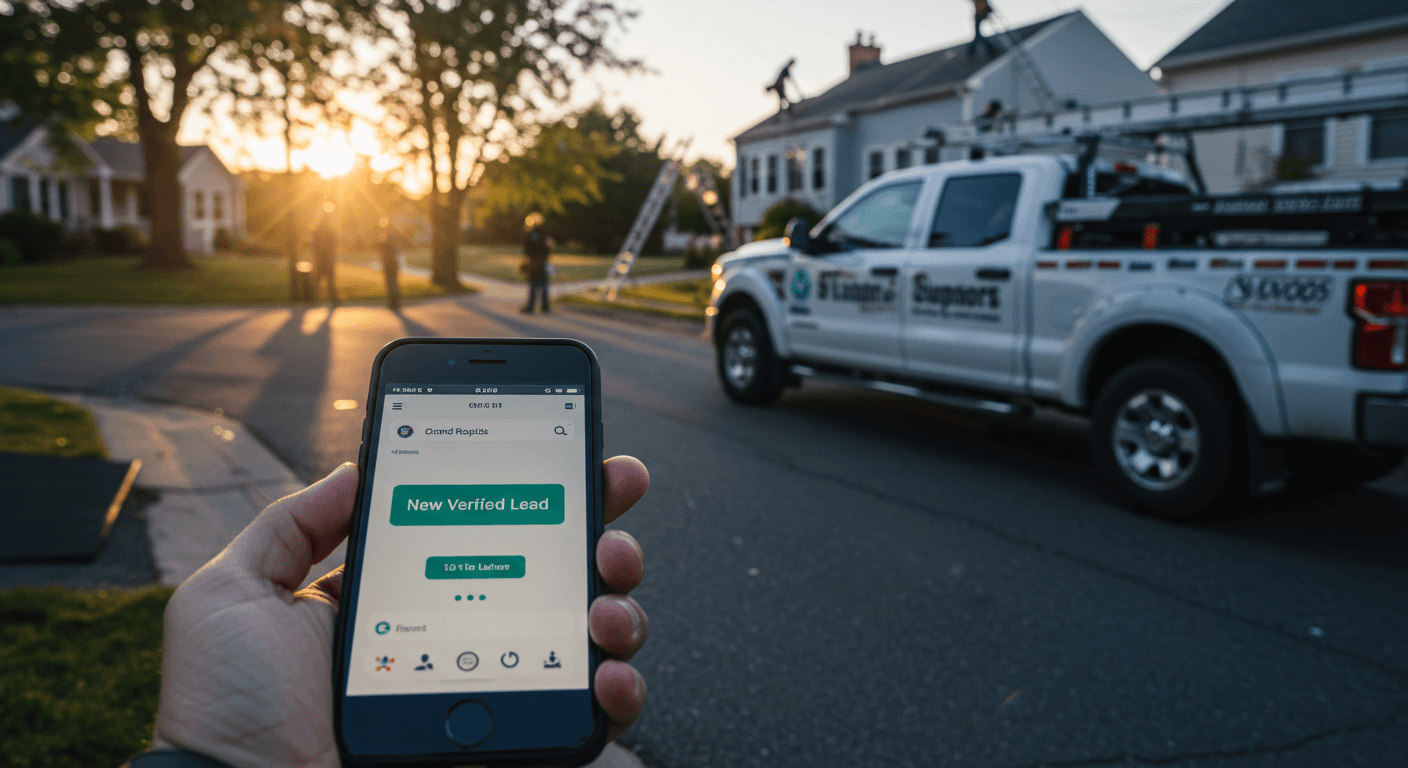
Walking past the humming server rack in Jaxon's Plainfield Avenue office, I watched his thumb hover over a "Decline" button on his buzzing iPhone. He was mid-sentence, explaining why his crew's schedule for the upcoming season in Heritage Hill was looking thin. That vibrating phone represented a $14,400 tear-off and replace opportunity in Cascade, but to Jaxon, it was just another interruption in a day filled with permit headaches and labor shortages. I stopped him right there. We pulled his CRM data from the last quarter, and the numbers were staggering. His average response time to a new inquiry was 44 minutes. In the hyper-competitive Grand Rapids metro, that might as well be 44 days.
The reality of the West Michigan roofing market has shifted aggressively over the last 18.5 months. We are no longer in an era where "getting back to them by the end of the day" is a viable business strategy. Homeowners from East Grand Rapids to the growing suburbs of Byron Center are conditioned by the "Amazon effect." They expect an immediate acknowledgment of their problem, especially when that problem involves a leaking roof during a heavy Lake Michigan-effect rainstorm. If you aren't the first to dial, you are essentially paying for your competitor's next vacation.
The decrease in lead conversion probability when waiting 30 minutes to call versus responding within the first 60 seconds.
At a Glance
Instant response creates an immediate psychological contract with the homeowner, making them less likely to answer subsequent calls.
Automated SMS follow-ups increase initial engagement by 47% when paired with a rapid outbound call strategy.
High-velocity shops use geographic routing to ensure the closest sales rep handles the inquiry for faster on-site arrival.
Consistent follow-up (6+ attempts) is required to capture the 34% of leads that don't answer the first ring.
The Kent County Compression: Why 5 Minutes is the New Hour
In my time analyzing lead flow for shops across the Midwest, I've tracked a specific metric I call the "Competitor Saturation Point." In a dense market like Grand Rapids, a homeowner who submits a request for a quote online will typically receive a follow-up from at least three different companies within 12 minutes. If your intake process relies on an office manager checking an email inbox every hour, you are fighting for the scraps.
We ran a test with a mid-sized shop near Alpine Avenue last spring. We split their leads into two groups. Group A was called within 2.5 minutes. Group B was called between 15 and 20 minutes later. The results weren't just slightly different; they were night and day. Group A had a 74% contact rate and a 31% appointment set rate. Group B? A dismal 22% contact rate. The homeowners hadn't changed their minds about their roofs; they had simply already booked an inspection with the guy who called while they were still holding their phones.
Automation vs. Human Touch in the 616 Area Code
One of the biggest mistakes I see owners make is assuming that automation can replace the human connection. While a text message that says "Hi, this is Jaxon from North Hill Roofing, I'm looking at your request right now" is great for stopping the lead from clicking the next result on Google, it doesn't close the deal. The goal of technology is to buy your sales team the 90 seconds they need to get on the phone.
The labor market in Michigan is tightening, and the cost of sales talent is rising. According to the Bureau of Labor Statistics (BLS), the mean hourly wage for roofers is $26.85, but your high-performing sales reps cost significantly more when you factor in commissions and overhead. You cannot afford to have these high-value assets chasing "cold" leads that have sat in a queue for two hours.
Modern shops are utilizing sophisticated stacks to bridge this gap. They use trigger-based systems where a new lead immediately rings the entire sales team's phones simultaneously. The first one to pick up wins the lead. This creates a healthy internal competition and ensures that the lead is engaged while their roof leak is still top-of-mind. To make this work, you need to ensure you are working with verified leads so your team isn't racing to answer spam or bot traffic.
Manual vs. High-Velocity Lead Response
| Metric | Old School (Manual) | High-Velocity (Automated + Human) |
|---|---|---|
| Avg. Response Time | 45-90 Minutes | Under 3 Minutes |
| Contact Rate | 24% | 68% |
| Lead-to-Appt Conversion | 11% | 33% |
| Cost Per Set Appointment | $412 | $138 |
Avg. Response Time
Contact Rate
Lead-to-Appt Conversion
Cost Per Set Appointment
Geographic Routing: Cutting Friction in the Grand Rapids Metro
Grand Rapids isn't just one big market; it's a collection of specific neighborhoods with different needs. A slate repair in the Heritage Hill district requires a different conversation than a new construction asphalt shingle job in Ada. I've seen a massive trend toward "Geographic Lead Routing."
Imagine a scenario where a lead comes in from a homeowner near Millennium Park. Instead of that lead going to a general pool, it is instantly routed to the estimator who is already finishing up a quote on Maynard Avenue. This rep can call the lead and say, "I'm actually two blocks away at another job site; I can be in your driveway in 10 minutes." That level of service is impossible to beat.
To execute this, your team needs to be untethered from the office. Using a mobile application that provides instant push notifications with all the job details (roof pitch, square footage, and photos) allows your reps to move with the agility required in today's market. When a rep can see the data and make the call while sitting in their truck, your conversion rates will skyrocket.
The Psychology of the "Instant Quote" Trend
We are seeing a surge in West Michigan homeowners demanding instant pricing. While you and I know that a "sight-unseen" quote is dangerous for margins, you have to acknowledge the desire for immediacy. The trend isn't about giving a final price; it's about providing a "ballpark" range or a "starting at" figure within the first 4 minutes of contact.
I worked with a contractor in Wyoming, Michigan, who started using satellite imagery to give a preliminary "Condition Report" over the phone during that first 3-minute call. He'd say, "I'm looking at your roof on my screen right now, and I can see some significant granular loss on the north-facing slope. Based on your square footage, most of our clients in this neighborhood see projects ranging from $11,400 to $16,800."
This immediate value-add builds massive trust. It positions you as the expert before the second contractor even picks up the phone. It's about moving the prospect from "searching" to "solved" in a single conversation.
The "Double-Dial" Technique
"If a lead doesn't answer your first call, hang up and dial again immediately. Statistics show that 42% of people who ignore a call from an unknown number will answer the second call, assuming it's urgent or someone they know."
Building a High-Velocity Sales Culture
Changing your speed to lead isn't just a software upgrade; it's a culture shift. You have to treat every lead like it's a $100 bill burning a hole in your pocket. I've seen owners implement "Lead Response Leaderboards" in their breakrooms, showing the average response time for each rep.
When you look at the Occupational Outlook Handbook, which projects a 6% growth in the roofing trade, it's clear that the demand for services isn't slowing down. However, the companies that will capture that 6% are the ones that treat their sales process with the same precision as their installations.
I recommend setting up a "Speed Premium" commission structure. If a rep closes a lead that they contacted in under 5 minutes, they get an extra 1.5% commission. If they took over 30 minutes to call, that lead's commission is capped. You have to align their financial incentives with the business's need for velocity.
Action Plan
The 5-Step Rapid Response Framework
Follow this sequence to maximize your lead-to-close ratio in the West Michigan market.
Instant SMS Hook: Send an automated, personalized text within 30 seconds of lead submission.
The 2-Minute Dial: Attempt the first phone call within 120 seconds. Use the double-dial method if they don't pick up.
Data-Backed Discovery: Use satellite data to mention a specific detail about their roof during the first call to build authority.
The "On-The-Way" Pivot: Try to book the inspection for the same day or the following morning while the homeowner is still engaged.
Automated Nurture: If they don't book, trigger a 4-day sequence of local testimonials and proof of insurance via email.
Want to skip the manual work and get exclusive, verified leads instead?
Get $150 in Free CreditsThe Impact of Seasonality on Response Times
In Grand Rapids, our weather is a major driver of lead volume. When a spring storm rolls through Kent County, your lead volume might jump from 5 a day to 45 a day. This is where most roofing companies fail. Their systems break under the weight of the volume, and response times slip to 4 or 5 hours.
The most successful shops I consult for have a "Storm Mode" protocol. They outsource their initial intake to a professional answering service or a specialized lead platform during peak volume to ensure that no call goes to voicemail. Even a 30-second "We received your request and an estimator is reviewing your satellite imagery right now" call is enough to keep that homeowner from calling the next roofer on the list.
If you are finding that your current team is overwhelmed by the volume of inquiries, or if you're tired of paying for leads that your team can't get to fast enough, it might be time to look at your acquisition strategy. Many contractors find that contacting our team helps them refine their internal processes to match the quality of the leads they are receiving.
Common Questions
Final Thoughts on Market Dominance
The Grand Rapids roofing landscape is becoming more sophisticated every year. The companies that are scaling past the $5M mark aren't necessarily the ones with the best shingles or the lowest prices; they are the ones with the most disciplined sales machines. Speed to lead is the foundation of that machine.
If you can consistently beat your competition to the phone, you are essentially choosing the best jobs in the market while they fight over the leftovers. It requires investment in technology, a shift in team culture, and a relentless focus on the first 180 seconds of a lead's life.