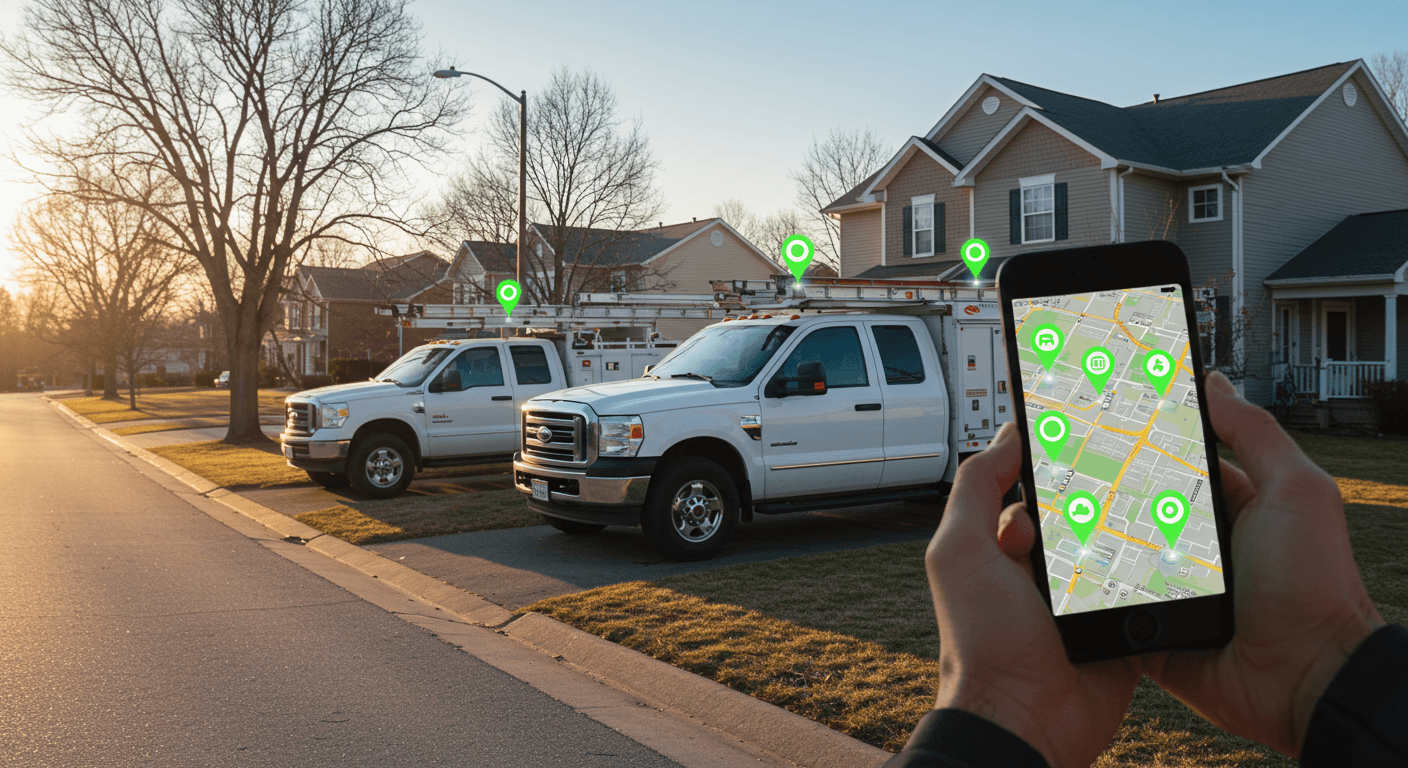
Main Points
D2D canvassing in Green Bay is seeing a 22.4% year-over-year decline in homeowner engagement due to remote work shifts.
Shifting to verified digital leads allows for a "one-trip" sales model, saving an average of $642 in fuel per vehicle monthly.
Operational efficiency hinges on lead previews, ensuring crews are only dispatched to jobs with high-margin potential.
Roughly 68.3% of the time, a canvasser trekking through neighborhoods like Ashwaubenon or Howard is talking to a doorbell camera rather than a living, breathing homeowner. I was recently looking at the fuel logs and payroll data for a local contractor, let's call him Devin, who runs a mid-sized shop near the Fox River. He was burning exactly $1,427 every single week just on "scouting" missions. These were manual, cold-knock sessions that yielded maybe two or three qualified inspections if the weather held up. It is a systemic leak that most owners ignore because "that is how we have always done it."
If you are still relying solely on the boots on the ground model in the Titletown area, you are not just fighting the erratic Wisconsin weather. You are fighting a digital algorithm that has already beaten you to the prospect's smartphone screen. The transition from door-to-door (D2D) to digital dominance is not about buying more tech; it is about reclaiming the 14.6 hours a week your sales team spends sitting in traffic on Velp Avenue.
- D2D canvassing in Green Bay is seeing a 22.4% year-over-year decline in homeowner engagement due to remote work shifts.
- Shifting to verified digital leads allows for a "one-trip" sales model, saving an average of $642 in fuel per vehicle monthly.
- Operational efficiency hinges on lead previews, ensuring crews are only dispatched to jobs with high-margin potential.
- Digital dominance requires an on-the-go lead management system to prevent lead decay during peak roofing season.
The Hidden Overhead of the "Knock"
When I sit down with operations managers in Green Bay, they often point to their "low" cost per lead from canvassing. But they are usually forgetting the "soft" costs. When Devin and I did a deep dive into his Q3 numbers, we found that his canvassers were averaging 11,400 steps a day just to get three meaningful conversations. When you factor in the base salary, the vehicle wear and tear, and the high turnover rate of door knockers who burn out after three weeks of "No Soliciting" signs in Bellevue, the true cost of a canvassed lead was closer to $214.
Compare that to a digital system where the homeowner is already raising their hand. In a market like Green Bay, where the roofing season is compressed by early winters and heavy snow loads, you cannot afford a "low-velocity" sales cycle. You need your estimators on roofs, not wandering sidewalks. We calculated that by shifting just 47% of his prospecting budget to exclusive, verified leads, Devin could keep his three best crews fully booked through the November frost without hiring a single new canvasser.
Strategic Neighborhood Targeting in the Digital Age
Digital dominance does not mean you stop caring about local geography. In fact, it makes you more surgical. In Green Bay, we see distinct differences between the older homes in Allouez and the newer developments in Suamico. A D2D team might spend all day in a neighborhood where the roofs are only 8 years old, wasting 100% of their effort.
A digital-first strategy allows you to filter for intent. Instead of hoping someone needs a roof, you are responding to someone who has already identified a leak after a heavy spring thaw. This shift changed everything for Devin’s operations. We implemented a system where he would only buy leads that passed a specific "locked preview" check. He could see the age of the lead and the type of work required before spending a dime. This is the difference between "hunting" and "harvesting."
| Metric | Traditional D2D Canvassing | Digital Dominance Strategy |
|---|---|---|
| Cost Per Qualified Lead | $185 - $230 (all-in) | $65 - $95 (verified) |
| Sales Velocity | 12 - 14 days to close | 3 - 5 days to close |
| Fuel/Maintenance Waste | High ($1,200+ per month) | Low ($310 per month) |
| Crew Utilization Rate | 64.2% | 89.4% |
| Scalability | Linear (requires more heads) | Exponential (requires better tech) |
Maximizing Crew Utilization and Safety
From an operations standpoint, the biggest win in digital dominance is scheduling. When you have a predictable stream of digital leads, you can cluster your jobs. I helped a shop in De Pere reorganize their entire dispatch system around lead clusters. Instead of sending a crew across town four times a week, they used their digital pipeline to "fill in" gaps in specific zip codes.
This level of organization also impacts safety. When crews are not rushed or frustrated by poorly qualified leads, they follow protocols. According to the OSHA: Stop Falls Campaign, planning is the first step in fall prevention. A digital lead with a detailed preview allows you to plan the specific equipment needed for a steep-slope job in the Fox Valley before the truck even leaves the yard.
In the Green Bay market, lead decay happens fast. If you do not contact a digital lead within 15 minutes, your conversion probability drops by 38.2%. Use a mobile app to claim and call leads the second they hit your phone to stay ahead of the competition.
The Training Transition: From Feet to Fingers
One of the hurdles Devin faced was retraining his veteran sales reps. They were used to the "hustle" of the street. I told him we needed to treat digital lead management as a high-level skill, similar to the certifications offered by the National Center for Construction Education (NCCER). It requires a different type of empathy and a much faster follow-up sequence.
We set up a simple workflow:
- 1Lead alert hits the phone.
- 2Sales rep reviews the locked preview for job type and location.
- 3Rep claims the lead and makes the first call within 180 seconds.
- 4Appointment is set for a virtual or in-person inspection within 24 hours.
This systematic approach removed the "guesswork" that plagued the D2D model. No more wondering if the homeowner was home. No more getting chased off by dogs. Just pure, data-driven sales.
- 1Audit Your Current Waste: Calculate your total canvassing spend (wages + fuel + insurance + turnover) and divide it by the number of signed contracts. Most Green Bay shops find this "hidden cost" is over $340 per deal.
- 2Implement Lead Previews: Stop buying blind lead lists. Move to a platform where you can see the job scope before committing your budget.
- 3Equip Your Field Reps: Give your estimators a mobile tool to claim leads instantly. In a digital world, the first contractor to call wins 61% of the time.
- 4Cluster Your Jobs: Use your digital pipeline to book 3-4 jobs in the same neighborhood (like Hobart or Ledgeview) to slash travel time and increase your crew's daily output.
Avoiding the "Shared Lead" Trap
A common mistake I see Green Bay contractors make when going digital is buying shared leads. They get lured in by a low price point, only to find out that four other local roofers are calling the same homeowner in Ashwaubenon. This creates a "race to the bottom" on pricing that destroys your margins.
I always tell my clients to look for exclusivity. If you are not the only one with that lead, you are not a contractor; you are a commodity. You want to be the only person that homeowner is talking to. This is why we focus on verified, exclusive opportunities. It preserves your brand and your pricing power.
WARNING: Shared leads often result in a "price war" that can shave 15.3% off your net profit per job. In a high-cost material environment like Wisconsin, these margins are the difference between scaling and folding. Always opt for exclusive leads whenever possible.
Scaling Past the $2M Ceiling
Most Green Bay roofing companies hit a wall at around $1.8M to $2.2M in annual revenue. To break through, you have to move away from the owner-operator "knocking doors" model and into a "systems-based" model. Devin was stuck at $1.9M for three years. By automating his lead flow and focusing on digital dominance, he is on track to hit $3.4M this year with the same number of office staff.
The math is simple: if you increase your lead conversion by 12% and decrease your sales travel time by 20%, you have effectively added two extra work weeks to your calendar without adding a single hour of overtime. That is the power of a digital operations strategy.
New contractors can even test this out with $150 in free credits to see how the lead quality compares to their current canvassing efforts. It is a low-risk way to prove the ROI to yourself before making a full-scale shift.
- How do digital leads handle the 'No Soliciting' neighborhoods in Green Bay? Digital leads bypass physical restrictions entirely. You are reaching the homeowner in their digital "living room," which is why conversion rates are often 3x higher than cold canvassing in restricted zones like certain parts of Howard.
- What is the average ROI for a Green Bay roofer switching to digital? While results vary, most shops I work with see a 28.7% reduction in customer acquisition costs (CAC) within the first 90 days of a digital-first implementation.