The invoice on the desk was for $12,482, but the rework photos on the tablet next to it told a different story. "Noah, I'm paying top dollar for these guys, and they're still missing the drip edge on 14% of the jobs," Javier told me. We weren't just talking about a bad day on the roof of a San Antonio ranch house; we were looking at a systemic breakdown of how Texas shops manage labor in a high-velocity market. That moment in Javier's office triggered a realization: the era of the "set it and forget it" subcontractor is dead.
If you are still treating your crews like a simple line item on a P&L, you are likely hemorrhaging margin you haven't even tracked yet. In the Lone Star State, where storm seasons are getting more unpredictable and labor is tightening in metros like DFW and Austin, the way we manage subs has to evolve from a "trust me" handshake to a data-driven partnership.
At a Glance
Transitioning from flat-rate payments to tiered performance incentives can recover up to 11.4% of lost project margin
Implementing real-time digital photo verification reduces the need for secondary inspections by 29.3%
Diversifying crew specialties allows for higher-volume throughput during peak Texas storm windows
Standardizing site-cleanup protocols through 'completion checklists' drastically reduces customer service callbacks
The Shift from Generalist to Specialist Crews
In the past, a roofing sub in Houston was expected to handle everything from a minor shingle repair to a full TPO commercial install. Those days are disappearing. What I am seeing across the most profitable Texas firms is a move toward hyper-specialization.
I recently analyzed the production data for a mid-sized shop in Plano. They were struggling with a 19.4% variance in their estimated vs. actual labor costs. When we dug into the numbers, the issue wasn't the crews' work ethic; it was their placement. They were sending "jack of all trades" crews to high-end architectural shingle jobs that required specific flashing expertise.
By restructuring their sub-base into "Core Installers" and "Technical Specialist" teams, they didn't just fix the quality issue. They actually increased their daily completion rate by 8.7% because the crews were working within their primary strengths every single day.
The Data Gap: What Your Subs Aren't Telling You
A major trend impacting the Texas market is the "accountability lag." When a crew leader tells you the job is 100% dry-in, how many hours pass before you actually verify it? In a world where material costs can fluctuate by 3% to 5% in a single quarter, those hours matter.
If your project managers are still driving 45 minutes across Austin just to check if a crew started on time, you are wasting fuel, salary, and opportunity. Modern subcontractor management requires a digital bridge. I often tell the reps I train that the "sale" isn't over until the final nail is in, and that requires visibility.
The 15-Minute Rule
"Require subs to upload three specific 'milestone' photos—decking prep, underlayment, and valley flashing—within 15 minutes of completion to trigger the next stage of payment."
According to a report on small business management by the Harvard Business Review, operational transparency is one of the primary drivers of scalability in fragmented industries. For a roofer, this means knowing exactly where your labor spend is at 2:00 PM on a Tuesday, not waiting for a Friday invoice.
When you have a reliable stream of work, you can be more selective about who joins your sub-network. If your current lead flow is inconsistent, you might find yourself forced to hire whichever crew is available, regardless of their track record. I've found that our business guides often highlight how a steady pipeline allows you to demand higher standards from your labor partners.
Performance-Based Tiering vs. The Flat Rate Trap
The old way of paying a flat rate per square is a race to the bottom. It encourages speed over precision, which is why your warranty claims might be creeping up toward that dangerous 5% mark.
I worked with a contractor in Fort Worth who moved his top three crews to a "Quality Bonus" structure. Instead of just $X per square, he offered a $435 bonus for every job that passed a third-party inspection with zero deficiencies on the first pass.
Flat-Rate vs. Performance-Based Payment Models
| Factor | Flat-Rate Model | Performance-Based Model |
|---|---|---|
| Payment Structure | Flat-Rate Per Square Only | Tiered Performance Incentives |
| Quality Focus | Speed prioritized over precision | Incentivized precision with bonuses |
| Rework Costs | High warranty claims (5%+) | Reduced rework (under 2.1%) |
| Crew Motivation | Race to finish quickly | Aligned with company quality standards |
Payment Structure
Quality Focus
Rework Costs
Crew Motivation
Incentivizing precision over speed consistently lowers long-term warranty liability.
The result? His rework costs dropped by $9,843 in the first three months. The crews made more money, the owner kept more margin, and the homeowners were happier. It turns out that when you align the sub's profit with your company's quality standards, the "management" part of your job gets a lot easier.
According to the Roofing Contractor Magazine, contractors who implement performance-based payment structures see an average 18% reduction in warranty claims within the first year. This isn't just about saving money—it's about protecting your brand reputation in competitive markets like DFW and Houston.
The Hybrid Model: Blending In-House and Outsourced
One of the most significant trends I am tracking is the "Hybrid Crew" model. Total reliance on subcontractors can leave you vulnerable during a massive hail event when every crew in the state is being headhunted by out-of-state storm chasers.
Successful Texas owners are starting to keep at least one "Elite" in-house crew for complex jobs and repairs, while using a vetted sub-network for the heavy lifting. This gives you a "quality anchor" to set the standard for your subs.
When you have a reliable stream of work, you can be more selective about who joins your sub-network. If your current lead flow is inconsistent, you might find yourself forced to hire whichever crew is available, regardless of their track record. Having access to verified, territory-locked opportunities ensures you're not scrambling for crews when demand spikes during Texas storm season.
The Clear-to-Close Sub-Management Protocol
To maximize your profit margins, you need a repeatable system. You cannot manage five different crews with five different sets of rules.
Action Plan
The 4-Step Crew Accountability Framework
A systematic approach to managing subcontractor crews that eliminates guesswork and protects margins
Pre-Job Digital Briefing: Send a digital packet with site-specific photos, special instructions (e.g., 'watch the rose bushes'), and expected completion time 24 hours prior.
The 'Mid-Day' Pulse: Require a status update via a mobile platform by 12:00 PM. This allows you to re-route materials or adjust the next day's schedule before it's too late.
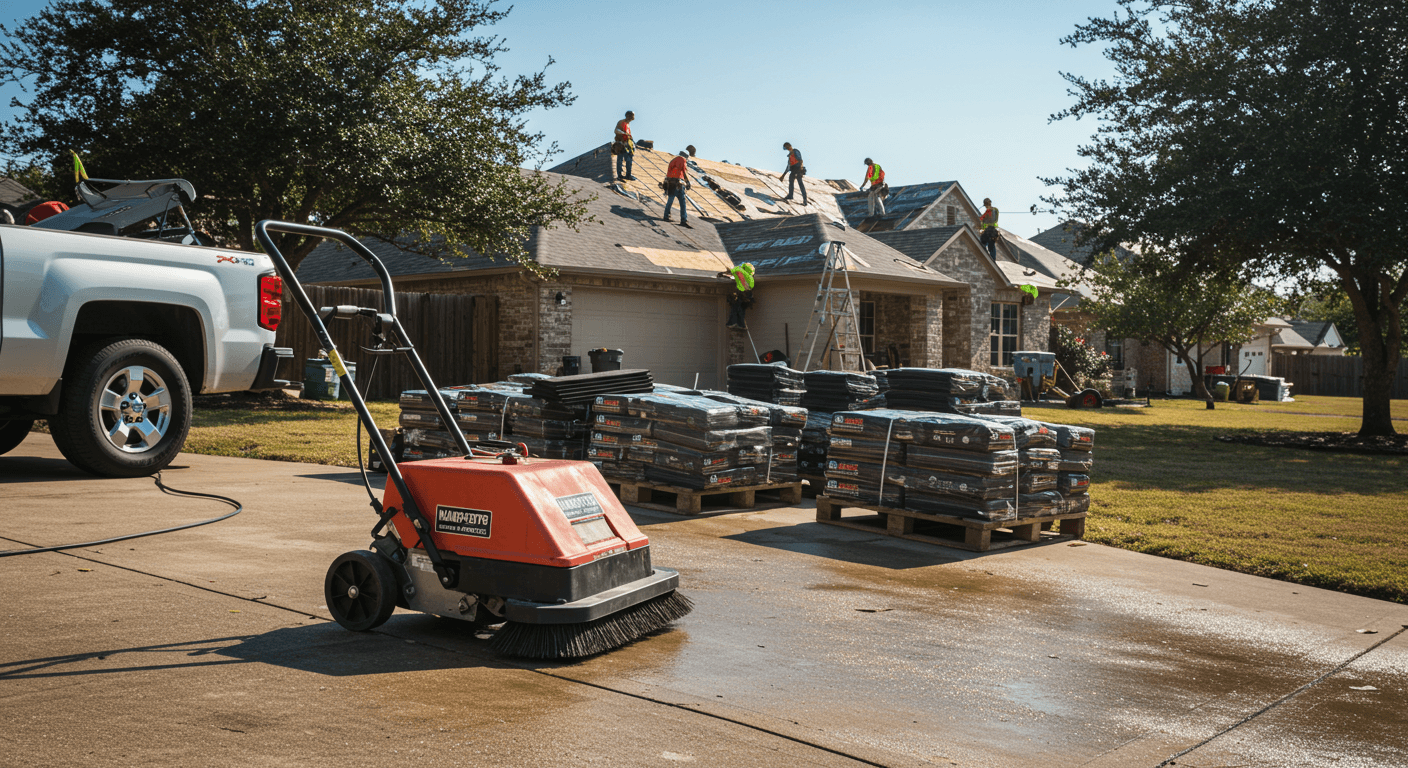
Photo-Verified Completion: No payment is processed without a standardized set of 12 photos, including a clear shot of the magnet sweep and debris removal.
The 48-Hour Review: Conduct a brief post-mortem with the crew leader on any issues found, ensuring the same mistake doesn't happen on the next roof.
Want to skip the manual work and get exclusive, verified leads instead?
Get $150 in Free CreditsWhy Technology is the New Crew Leader
In the Texas heat, nobody wants to spend more time on a roof than necessary. This is where tech becomes a tool for the sub, not just a "big brother" for the owner.
When your crews can access job details, update their status, and see their payment schedule from their phones, they feel like partners. I've seen contractors transform their entire operations just by getting their field data organized. Whether you are using specialized CRM tools or our mobile app to keep tabs on new opportunities while your crews are on-site, the goal is the same: less friction, more profit.
The 'Silent' Profit Killer
Failing to verify worker's compensation and general liability insurance for every sub on every job can lead to a single claim that wipes out three years of profit. Never let a crew step on a roof with an expired cert.
Common Questions
The roofing industry in Texas is moving away from the "wild west" era. The contractors who will be here in 7.5 years are the ones who treat subcontractor management as a core competency, not a necessary evil. By focusing on specialization, data-driven accountability, and performance incentives, you turn your labor from a variable headache into a scalable asset.