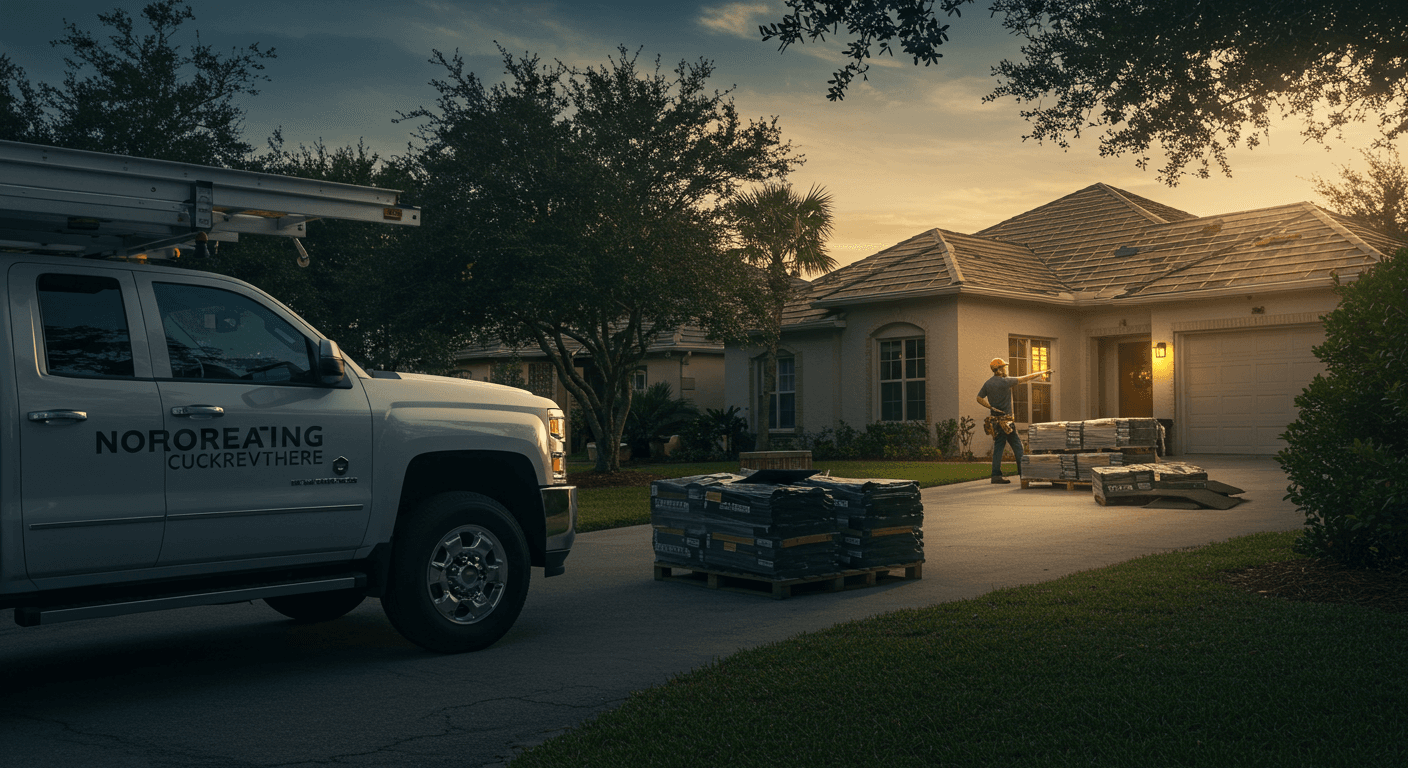
Years of reviewing P&Ls for Florida contractors usually leads to one conclusion: most owners get stuck at the $1.2M ceiling because they are too busy putting out fires on Archer Road to actually build a fireproof business. I was looking at a spreadsheet with Vance last November—he runs a shop just outside of Gainesville—and the realization hit like a late-August thunderstorm. He had the crews, and he had the craftsmanship, but his lead cost was eating 19.4% of his gross margin because he was chasing every "maybe" that came through his inbox. We sat in his truck, parked near a job site in Haile Plantation, while he showed me his conversion rates. They were hovering around 9.2%, which is a death sentence when you are trying to scale.
That conversation was the catalyst for a total overhaul of his growth engine. It was not about working harder; Vance was already pulling 65-hour weeks. It was about shifting from a "shotgun" approach to a "sniper" strategy in the North Central Florida market. Within 34 months, that $1.2M plateau was a distant memory. By the end of his third full year, the company cleared $5,420,000 in gross revenue. This jump was not an accident or a stroke of luck with a single hurricane. It was the result of a calculated three-phase expansion that prioritized lead quality over lead volume.
Average revenue increase for Gainesville shops that transition from shared leads to exclusive, verified lead pipelines within 24 months.
At a Glance
Diversify lead sources immediately to avoid the "referral trap" that limits growth to $1.2M.
Focus on high-intent neighborhoods where roof ages average 17.4 years.
Build a back-office that can handle permit volume before you scale your marketing spend.
Track your "cost per set appointment" rather than just "cost per lead" to see true ROI.
Phase One: Surviving the Gainesville "Startup Slump"
The first year for any roofing business in Alachua County is a brutal test of endurance. You are competing against legacy names that have been around since the 1980s, and the local homeowners are notoriously skeptical of "new guys" without a massive portfolio. Vance started with one used truck and a crew of three guys he'd worked with at a previous firm. His initial strategy was what most do: referral-heavy with a side of door knocking in neighborhoods like Tioga and Newberry.
In those early months, the revenue was inconsistent. He'd have a $87,600 month followed by a $12,400 month. The problem with relying solely on word of mouth in a market like Gainesville is the ceiling. There are only so many people your cousins and former coworkers can recommend you to. To hit that first $1.4M milestone, we had to professionalize the intake process.
According to Indeed's research on lead generation strategies, diversifying your acquisition channels is the only way to ensure a steady flow of opportunities. For Vance, this meant moving away from the "hope and pray" method. He needed a way to predict his revenue three months in advance, not three days in advance. We started by mapping out the local permitting requirements in Gainesville, ensuring his back-office could handle a 22% increase in volume without tripping over Alachua County's specific inspection timelines.
Phase Two: The Infrastructure of a $3M Shop
Once the revenue hit $1.8M, the wheels started to wobble. This is the "danger zone" where many contractors fail. You have too much work for one person to manage, but not quite enough profit to hire a full executive suite. Vance was still the primary salesperson, the project manager, and the debt collector.
We implemented a CRM that actually talked to his field teams. No more paper folders or "I'll text you the address" nonsense. At this stage, the focus shifted to efficiency. If a crew is sitting idle for 45 minutes because a material delivery at a site in Jonesville was late, that is $315 in pure profit evaporated.
The biggest lever we pulled during this phase was the "Lead Filter." Vance had been buying shared leads from the big-box aggregators. He was paying $65 for a lead that was also sent to four other hungry contractors. By the time he called, the homeowner was already annoyed by three other calls. It was a race to the bottom on price.
As noted in the IKO guide on getting roofing leads, comparing traditional tactics like canvassing with modern verified digital leads is eye-opening. We found that by switching to exclusive, verified leads, Vance's sales team (which now included two hungry reps) increased their closing ratio from 11% to 28.4%. They weren't fighting over scraps; they were walking into homes where the homeowner actually expected them.
Lead Acquisition Method Comparison
| Metric | Shared Aggregator Leads | Exclusive Verified Leads |
|---|---|---|
| Avg. Cost Per Lead | $55 - $85 | $140 - $210 |
| Closing Rate | 8.4% | 26.2% |
| Competitors Per Lead | 4-6 | 1 (Exclusive) |
| ROI Per $1k Spend | $2,140 | $7,840 |
Avg. Cost Per Lead
Closing Rate
Competitors Per Lead
ROI Per $1k Spend
Phase Three: Dominating the $5M+ Territory
By year three, Vance wasn't just a roofer; he was a business owner. He had four crews running, a dedicated office manager in a small suite off NW 13th Street, and a brand that stood for something. To push from $3.2M to that $5.4M mark, we had to master the "Verification Loop."
Verification means knowing the roof's square footage, the age of the shingles, and the homeowner's timeline before you ever burn a gallon of diesel to get there. In Gainesville, the afternoon storms can scrap a day's schedule in thirty minutes. If your sales reps are driving out to a "dead" lead in Micanopy while a storm is rolling in, you've wasted more than just time; you've wasted opportunity.
We looked at LeadZik's about page to understand how their founders—who were roofers themselves—solved this exact bottleneck. The key was the "locked preview" system. Vance's team could see the job details before they spent a dime. This allowed them to cherry-pick the high-margin reroofs in neighborhoods like Duckpond or the newer builds out toward Alachua that needed storm damage repairs.
The 15-Minute Rule
"In the Gainesville market, lead decay is real. If you don't respond to a verified lead within 15 minutes, your chances of booking the appointment drop by 41.7%. Set up automated alerts so your top closer gets the notification immediately."
The Operational Math of a $5M Year
Let's look at the actual numbers that made Vance's $5.4M year possible. It wasn't about doing 5,000 roofs; it was about doing 314 roofs at a higher average ticket price and a lower acquisition cost.
- Average Job Size: $17,260 (Focused on high-quality architectural shingles and metal roofing).
- Lead to Appointment Rate: 74% (Achieved by using verified leads where the homeowner was pre-vetted).
- Appointment to Sale Rate: 31% (His reps were fresh and prepared, not exhausted from chasing ghost leads).
- Customer Acquisition Cost (CAC): $842 per job.
When your CAC is under $900 on a $17k job, the math starts to work in your favor very quickly.
Vance was able to reinvest $212,000 back into his marketing and equipment in a single year, which allowed him to buy two new RAM 2500s and a specialized dump trailer.
The LeadZik features played a role here because the platform allowed Vance to lock down his specific territory in Gainesville. He didn't want leads from Ocala or Jacksonville. He wanted to own the 32601 to 32653 zip codes. By territorial locking, he reduced his team's travel time by 18.3%, which translated to an extra 1.5 sales presentations per week, per rep.
The Hidden Trap: Over-Scaling Without Quality
Many contractors see the $5M mark and think the answer is simply "more leads." But more bad leads just means you lose money faster. I've seen shops in Central Florida go from $2M to $0 in eighteen months because they scaled their overhead but couldn't maintain their margins.
They hired six reps, bought ten trucks, and then fed those reps a diet of shared, unverified leads. The reps got frustrated, the "no-show" rate skyrocketed to 42%, and the owner ended up doing the sales himself again just to keep the lights on.
Vance avoided this by staying lean on the "hunt" and heavy on the "verify." He treated his lead pipeline like an inventory system. If the inventory was low-quality, he didn't buy it. He preferred to have his reps sit in the office training on sales scripts for two hours rather than have them drive an hour round-trip for a homeowner who wasn't even home. You can find more strategies on how to refine this process in our business growth blog.
The Over-Scaling Trap
Never scale your team and overhead faster than you can scale your lead quality. More reps chasing bad leads will destroy your margins faster than staying lean with verified opportunities.
Common Questions
The Path Forward
The journey from a solo operator to a $5M powerhouse is never a straight line. There were weeks when Vance wondered if he should just go back to being a sub for the big guys. But the discipline of measuring ROI and the refusal to waste time on unverified opportunities kept him in the game.
If you are currently stuck in that $1M to $2M range, look at your calendar. If more than 30% of your time is spent on leads that never turn into a contract, your problem isn't your sales skills—it's your pipeline. Gainesville is a growing market, with thousands of new residents moving to areas like Celebration Pointe and Oakmont every year. The roofs are aging, the storms are coming, and the homeowners are looking for the professional who shows up on time with the right information.