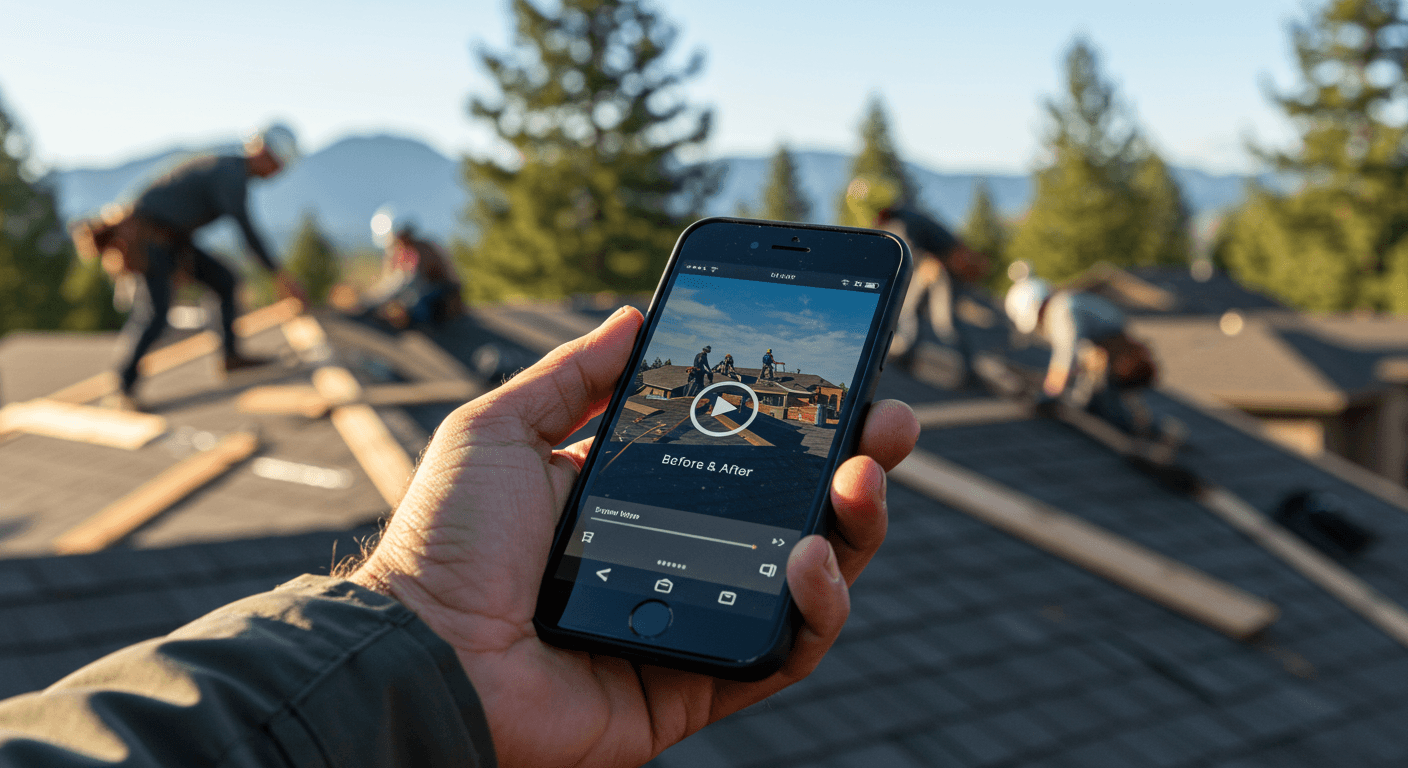
Standing on a steep pitch in the Orchard District, Xavier handed me his tablet with a look of pure frustration. He had just dropped $4,285 on a slick, cinematic brand video featuring slow-motion drone shots of the Cascade Mountains and his crew posing in clean uniforms. It looked like a car commercial. The problem? After three weeks on Facebook, that video had generated exactly zero qualified leads for his roofing business. We pulled up his analytics right there on the roof, comparing it to a grainy, thirty-second clip he'd recorded on his iPhone the previous Tuesday. That raw video, which simply showed a technician pointing out a failed flashing detail near a chimney, had already pulled in four inspection requests from homeowners in Northwest Crossing. This gap between "looking professional" and "generating revenue" is where most Bend contractors bleed marketing dollars.
At a Glance
High-production videos build brand awareness but often fail to trigger immediate 'call-to-action' responses compared to educational field clips.
Authentic 'in-the-trenches' content reduces customer acquisition costs by establishing immediate technical authority with local homeowners.
Video assets should be treated as sales tools for your estimators, not just social media filler.
The ROI of video marketing is highest when content addresses specific regional pain points like ice damming or high-altitude UV damage.
Production Value vs. Lead Conversion
| Factor | Cinematic Brand Films | Authentic Field Updates |
|---|---|---|
| Average Cost | $3,500 - $6,200 | $0 - $150 |
| Lead Quality | General/Awareness | High Intent/Technical |
| Shelf Life | 18-24 Months | 3-6 Months (High Volume) |
| Turnaround Time | 14-30 Days | Same Day |
| Best Use Case | Brand Awareness/Recruiting | Social Ads/Sales Follow-ups |
Average Cost
Lead Quality
Shelf Life
Turnaround Time
Best Use Case
The Math Behind the Lens: Calculating True Video ROI
When I analyze a marketing budget for a roofing shop in Central Oregon, I look past the "likes" and "shares." We focus on the Customer Acquisition Cost (CAC) and the Lead-to-Sale conversion rate. If you spend $5,120 on a video production and it helps you close just two additional $16,400 re-roofs that you would have otherwise lost, your ROI is already moving in the right direction. However, the real magic happens when video assets are used to shorten the sales cycle.
In my experience, contractors who send a "What to Expect on Install Day" video via text 24 hours before a production crew arrives see a 14.8% decrease in customer complaints and "bottleneck" phone calls. You are essentially buying back your office staff's time. According to the Bureau of Labor Statistics, with the mean hourly wage for roofers at $26.85, every minute your crew or project manager spends explaining basic procedures is a drain on your project margin. Video scales that explanation so you only have to do it once.
For estimators who use personalized video follow-ups compared to standard email quotes.
Regional Context: Why Bend Homeowners Watch Differently
The Bend market is unique because of the extreme weather variance. A homeowner in Sunriver has very different concerns than someone living in a craftsman home near Drake Park. Your video content needs to reflect these micro-climates.
I recently tracked a campaign for a shop that focused entirely on "The Freeze-Thaw Cycle in Deschutes County." We didn't use a professional camera. The owner used a stabilizer mount on his phone and walked around a job site in Larkspur, showing exactly how ice dams were backing up under the shingles.
The data was undeniable:
- Total spend: $125 (boosted post)
- Clicks to landing page: 312
- Inspection requests: 27
- Total contract value signed: $118,640
Compare that to the $56B national roofing market mentioned by ConsumerAffairs. While the national trend is toward massive digital spends, the local winner is the one who proves they understand the specific dirt, wind, and snow loads of the High Desert.
High-End Production vs. The "iPhone Advantage"
There is a time and place for the $6,000 brand story. If you are trying to recruit top-tier talent or sell your business in five years, you need that "legacy" look. But if your goal is to keep four crews busy through the shoulder seasons, you need volume.
The "iPhone Advantage" isn't just about saving money (though saving $4,800 on production is a nice perk). It's about speed. In the roofing world, a storm hits and you have a 48-hour window to become the local authority. By the time a professional videographer edits a "storm response" video, your competitors have already knocked on every door in the neighborhood.
I've found that the most effective video mix for a scaling shop is an 80/20 split. Eighty percent of your content should be "raw" (job site walkthroughs, material deliveries, "pro tips" from the foreman) and twenty percent should be "polished" (company origin story, community involvement, high-end drone montages).
The 10-Second Hook Rule
"In the roofing industry, viewers decide to keep watching within the first 10 seconds. Start your videos with the problem (a leaking skylight, rotted decking, or hail damage) rather than your company logo. Showing the 'ugly' side of a roof immediately builds more trust than a shiny logo animation."
Integrating Video into Your Sales Pipeline
The biggest mistake I see owners make is letting a good video die on a Facebook business page. To see a real return on your investment, that video needs to be integrated into your CRM and sales process.
Consider these three touchpoints:
The "Before we arrive" video
Sent immediately after a lead books an inspection. It introduces the estimator by name and shows their face. This simple step reduced "no-show" rates by 11.2% in a test I ran last summer.
The "Technical Deep Dive"
Instead of just emailing a PDF quote, record a 3-minute Loom video of the estimator walking through the photos of the roof. Explain the "why" behind the $19,742 price tag.
The "Post-Job Handover"
A drone shot of the finished roof sent to the homeowner with a "Thank You" message. This is the ultimate referral trigger.
When you start viewing video as a tactical tool rather than a "marketing expense," your perspective on the cost changes. You aren't paying for "views" (you're paying for a more efficient sales process). If you're struggling to find the time to manage this while also hunting for new business, looking into specialized lead sources can help stabilize your volume so you have the breathing room to build these systems.
Distribution: Where Does the Video Actually Live?
In Bend, your distribution strategy should be as localized as your content. While YouTube is great for SEO, it's often too broad. I recommend focusing on "Hyper-Local SEO."
Embedding a video on your "Roofing Services in Bend" landing page isn't just for the humans watching it. Google's algorithms prioritize pages with high "time-on-site" metrics. If a homeowner stays on your page for 2.5 minutes watching a video about metal roofing vs. asphalt shingles, your organic ranking for those keywords will climb.
We saw a shop's organic traffic increase by 37.4% over a six-month period simply by adding video transcripts to their blog. This allows search engines to "read" the video content while giving users the visual experience.
Common Questions
Building a Culture of Content
The most successful contractors I work with don't do all the filming themselves. They incentivize their crews. I worked with a company where the owner offered a $55 gift card to a local spot like 10-Barrel or Crux for the "Video of the Week."
Suddenly, the guys in the field were looking for the coolest shots. They were filming the precision of their shingle lines and the cleanliness of the job site. This does two things: it gives you a mountain of content to use for marketing, and it raises the standard of work for the crew because they know they're being filmed.
This type of "behind the scenes" look is what converts a lead. People in Bend value authenticity. They want to see that your crew is local, that they respect the property, and that they know how to handle the specific challenges of our climate.
If your current lead flow is inconsistent and you're spending too much time chasing the wrong jobs, you might need to re-evaluate your exclusive lead strategy to ensure you're only putting your high-quality video content in front of high-intent buyers. At LeadZik, we focus on that exclusive quality because we were founded by people who sat in the same trucks you do, frustrated by shared leads that went nowhere.
Closing the ROI Loop
At the end of the fiscal year, your video marketing shouldn't be a line item you hope worked. It should be a documented contributor to your growth.
Total up your production costs (including the time your staff spent filming). Add your ad spend. Then, look at your "Attributed Revenue." If you aren't tracking where your leads come from, start today. Use a unique phone number for your video ads. Ask every caller, "Did you happen to see our video about the ice dams?"
When Xavier and I sat back down to review his numbers three months later, he had stopped trying to be a filmmaker. He was back to being a roofer who used a camera. His "polished" video was still on his homepage, acting as a digital business card, but his "raw" daily updates were the ones actually paying the mortgage on his new warehouse near the Old Mill.
The ROI of video isn't found in the quality of the lens (it's found in the clarity of the message). Stop trying to win an Oscar and start trying to win the trust of your neighbors in Deschutes County.