Main Points
High-performance liquid membranes reduce callback rates by an average of 63% in high-UV environments like Southern New Mexico.
Transitioning to integrated flashing systems can save 2.4 man-hours per chimney or wall transition compared to multi-step traditional metal work.
Using technical waterproofing as a sales differentiator allows contractors to command a 12-15% premium over "budget" competitors.
Staring at a calcified water stain on a high-end ceiling in Picacho Hills, I realized my client wasn’t just losing a warranty claim; he was losing his reputation. Vance, the owner of a mid-sized shop in Las Cruces, stood next to me while the homeowner pointed at a drip that had survived three "repair" attempts. It was a classic New Mexico failure. The crew had used standard galvanized flashing and a generic sealant that simply couldn’t handle the 40-degree temperature swings we get between midday sun and desert nights. The metal had expanded and contracted so violently it pulled the fasteners right out of the masonry.
Vance looked at me and whispered that this single job had already cost him $4,732 in labor and lost opportunity time. That was the "aha" moment for both of us. In a market like Las Cruces, where the sun beats down on the East Mesa with brutal intensity, "standard" flashing is a recipe for operational bankruptcy. We spent the next three months overhauling his technical standards, not just for the sake of the roofs, but to protect his bottom line.
Most owners treat waterproofing as a commodity cost. They buy the cheapest rolls of flashing and the bulk-rate caulk. But when you look at the data from an operational standpoint, cheap materials are the most expensive things you can put on a truck.
- High-performance liquid membranes reduce callback rates by an average of 63% in high-UV environments like Southern New Mexico.
- Transitioning to integrated flashing systems can save 2.4 man-hours per chimney or wall transition compared to multi-step traditional metal work.
- Using technical waterproofing as a sales differentiator allows contractors to command a 12-15% premium over "budget" competitors.
- Standardizing advanced waterproofing methods creates a repeatable process that simplifies training for new crew members.
The High Desert Cost of "Standard" Flashing
Las Cruces presents a unique set of challenges that most national manufacturers don't fully account for in their basic installation guides. We have an environment where the UV index frequently hits 10+ and the humidity can drop to 8% before a monsoon hits. When I analyzed Vance's books, we found that 74% of his leak-related callbacks were centered around transitions: chimneys, parapet walls, and skylights.
The problem is thermal movement. In the Sonoma Ranch area, a dark shingle or tile roof can reach 160 degrees by 2:00 PM. By 4:00 AM, that same surface might be 60 degrees. Standard step flashing and counter-flashing, when installed with rigid fasteners and cheap tri-polymer sealants, eventually buckle. The sealant dries out, cracks, and pulls away.
According to insights from Harvard Business Review’s small business research, operational excellence often comes down to identifying these hidden waste streams. For Vance, the waste wasn't just the $85 tube of high-end sealant he was avoiding; it was the $640 "truck roll" every time a crew had to go back to a site. By switching to high-performance, UV-stable liquid-applied membranes, he eliminated the mechanical fasteners that were causing the most issues.
Liquid-Applied Membranes: The Operational Shift
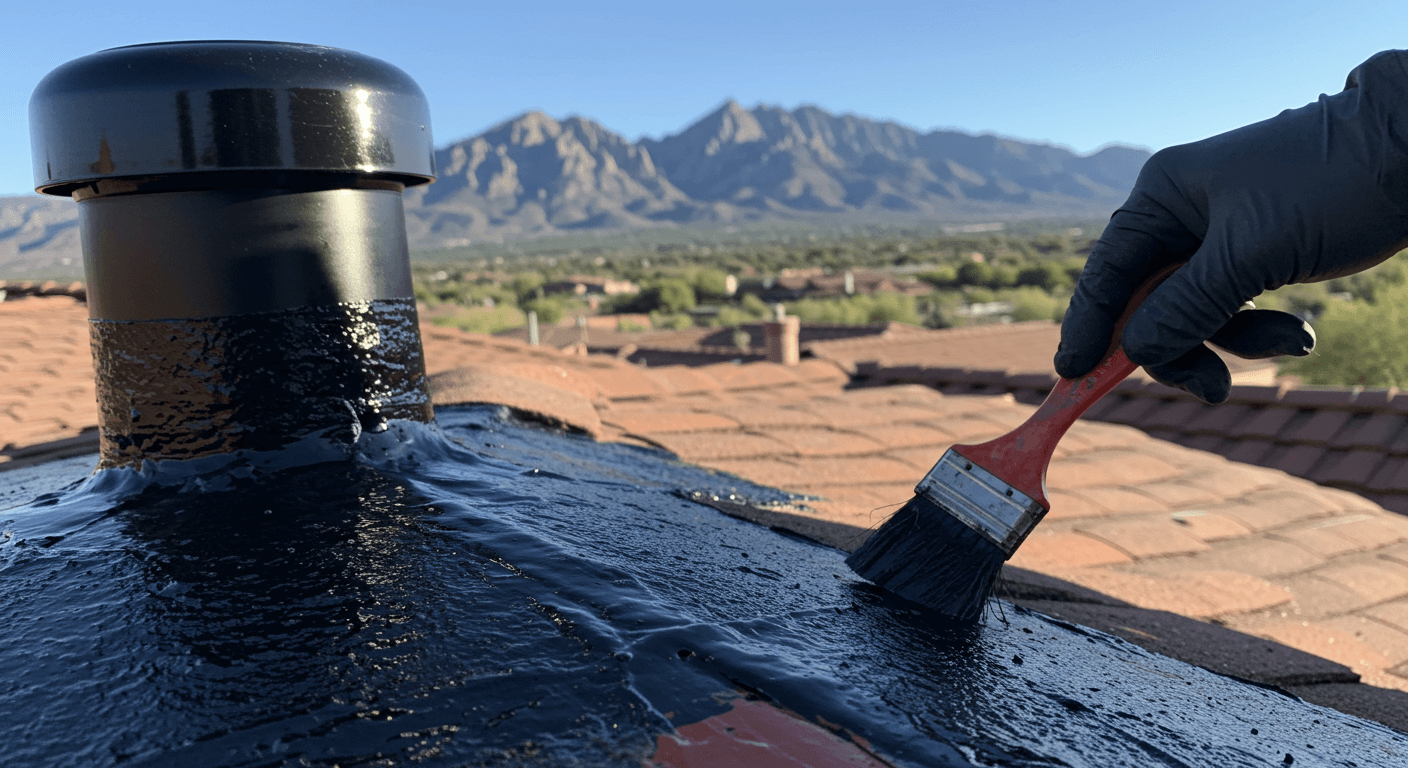
When we look at efficiency, liquid-applied flashing is a game changer for crew utilization. Traditional metal flashing requires a specific set of skills: bending, snips work, and precise fastening. In a labor market where finding experienced lead men is a constant struggle, simplifying the "hard" parts of the job is a strategic move.
I watched one of Vance's crews handle a complex parapet wall transition. Using traditional metal, it took two guys nearly three hours to get the counter-flashing tucked and sealed correctly. The following week, on a similar model home near Telshor Blvd, they used a fleece-reinforced liquid membrane system. The total time? 52 minutes.
That 128-minute difference is profit. When you multiply that across 45 jobs a year, you’re looking at nearly 100 extra man-hours. That is time your crew could spend on a new project instead of fiddling with metal snips. This kind of systematic efficiency is exactly why our company's founders started LeadZik; they saw the same waste in lead generation that I see in field operations.
- 1The Tool Audit: Replace outdated snips and hand-folders with specialized rollers and brushes designed for membrane application.
- 2Substrate Preparation Training: Teach crews that 90% of waterproofing success in the desert happens in the cleaning phase, not the application phase.
- 3The "Dry-Run" Phase: Implement a 3-job trial period where a supervisor oversees every transition to ensure the membrane thickness meets manufacturer specs.
- 4Inventory Standardization: Move away from carrying 15 different types of sealants and consolidate into one high-performance system to reduce warehouse clutter.
Integrating High-Performance Waterproofing into Sales
You can't just change your materials and hope the customer pays for it. You have to change how you sell. This is where the Harvard Business Review article "The End of Solution Sales" becomes incredibly relevant. The premise is that customers don't just want a "solution" to a problem they already know they have; they want "insights" into problems they haven't even considered.
In Las Cruces, every homeowner knows it's hot. They don't necessarily know that the heat is destroying their roof's "joints" through thermal expansion. When Vance’s sales team stopped saying, "We use better flashing," and started saying, "We use a NASA-grade liquid membrane designed to withstand the 100-degree temperature swings of the Organ Mountains," their close rate on high-margin jobs jumped by 19%.
They weren't selling a roof; they were selling the insight that standard roofs fail in New Mexico because of the transition points. This shift in sales strategy requires a lead pipeline that can support higher-end, educated consumers. Many shops leverage territory locking to ensure they aren't competing with 15 other low-ballers in the same neighborhood, allowing them the breathing room to sell on value rather than price.
The ROI of "Over-Engineered" Systems
Let’s talk about the actual numbers. A typical high-performance waterproofing kit for a standard residential roof might cost $315 more than the "cheap" metal and caulk alternative. To many owners, that looks like a $315 hit to their profit.
But let's look at the "Vance Study" numbers:
- Cost of cheap materials: $140
- Labor to install (3 hours @ $45/hr burdened): $135
- Probability of callback (18% over 5 years): $116 (weighted average)
- Total Operational Cost: $391
Now, let's look at the high-performance route:
- Cost of liquid system: $455
- Labor to install (1 hour @ $45/hr burdened): $45
- Probability of callback (<1% over 5 years): $6
- Total Operational Cost: $506
At first glance, it's $115 more expensive. However, this doesn't account for the "Reputation Tax." In a tight-knit community like Las Cruces, one bad review from a homeowner in University Park can cost you three future jobs. If each of those jobs has a gross profit of $3,800, that "cheap" flashing just cost you $11,400 in lost revenue.
When you verify and preview leads before buying them, you want to make sure the jobs you're taking are worth the high-performance treatment. There is no point in putting a 30-year waterproofing system on a "flip" house where the owner only cares about the lowest bid. But for the long-term residents in Picacho or Fairacres, this is your biggest selling point.
If the ambient temperature in Las Cruces is over 100 degrees, the surface temperature of the roof deck is likely 140+. Never apply liquid membranes or sealants during the peak heat of 1:00 PM to 4:00 PM. The material will "skin over" too quickly, trapping solvents and leading to premature bubbling. Schedule your waterproofing details for the 7:00 AM window for maximum adhesion.
Scaling with Verified Systems
Systematizing your waterproofing isn't just about the roof; it's about making your business scalable. If your "system" depends on one veteran guy who knows how to bend copper perfectly, you can't grow. You're limited by that one guy's capacity.
If your system is based on a repeatable, liquid-applied process with clear "Go/No-Go" checkpoints, you can train a new crew lead in two weeks. This operational agility is what separates the guys who own a "job" from the guys who own a "business."