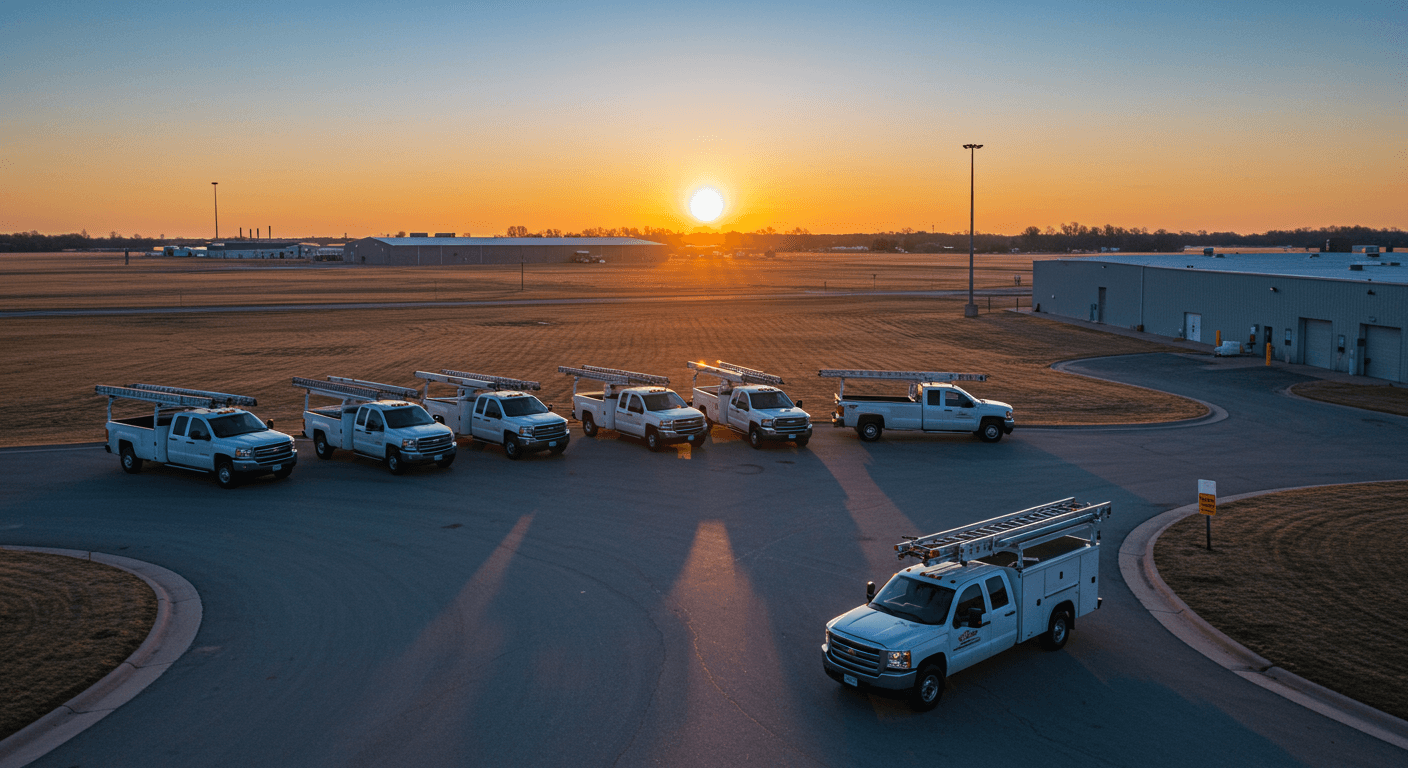
Vance, a third-generation owner out of Cedar Rapids, called me last October with a problem that wasn't about his close rate. We were looking at his overhead, specifically a fuel bill for his 12-truck fleet that had spiked 19.4% in a single quarter without a corresponding jump in job volume. We pulled his records and realized one of his veteran foremen was spending an average of 42 minutes every morning at a specific diner off I-380 while the clock was running. It wasn't just the eggs and bacon. That single habit was costing Vance roughly $482 per month in wasted labor and fuel for just one crew. Multiply that across a whole fleet, and you are looking at the difference between a profitable year and barely breaking even.
At a Glance
GPS tracking identifies 'windshield time' leaks that cost the average Midwest shop $9,430 annually
Predictive maintenance prevents major breakdowns during the critical 4.5-month Midwest peak season
Real-time location data allows for faster response times to high-intent, verified leads
Telematics can trigger insurance premium discounts of 8.6% to 14.2% for roofing contractors
Beyond Simple Dots on a Map
Most roofing owners I coach in the Midwest think fleet tracking is just a way to spy on drivers. That is a tactical error. The real value is in the data layer that sits on top of the GPS. We are seeing a massive shift toward "active telematics" where the system doesn't just show you where the truck is, it tells you how it is being treated.
For example, I worked with a shop in Indianapolis that integrated engine diagnostics. They caught a cooling system failure on a heavy-duty RAM 3500 before the engine seized. If that truck had died on a trip to a job site in Carmel during a 95-degree July humidity spike, the towing and engine replacement would have cost them $8,743. Instead, they spent $214 on a sensor and a flush.
Midwest contractors using active telematics see significant fuel savings through automated idling alerts
The "Windshield Time" Profit Killer
In the Midwest, our job sites are often spread out. You might have a crew heading from Naperville to a repair in Aurora, only to realize you have a new lead popping up in Joliet. If you are still calling foremen to ask "Where are you?" you are losing money.
The smartest owners I see are checking their platform features to sync their lead flow with truck proximity. If a verified lead comes in from a specific zip code, you can immediately see which truck is 4.2 miles away versus sending a crew from across the city. This reduces what I call "dead miles," which are the miles that burn gas and payroll but generate zero shingles on a roof.
Passive GPS vs. Active Telematics
| Feature | Passive GPS (Location only) | Active Telematics (Behavior + Diagnostics) |
|---|---|---|
| Location Tracking | Basic breadcrumb trails | Real-time location with route optimization |
| Idling Alerts | Manual review required | Real-time idling alerts after 5 minutes |
| Driver Behavior | No visibility | Aggressive braking tracking and coaching data |
| Maintenance | Reactive repairs | Engine health monitoring with predictive alerts |
| Fuel Management | Separate fuel card system | Fuel card integration with GPS verification |
Location Tracking
Idling Alerts
Driver Behavior
Maintenance
Fuel Management
Solving the "Big Brother" Cultural Hurdle
I hear this a lot from owners in Ohio and Missouri: "My guys will quit if I put trackers in the trucks." This is where sales psychology comes into play. You have to sell the system to your team, not just mandate it.
I helped a contractor in Columbus frame this as a safety and "pro-crew" move. He told his guys, "If a homeowner claims you hit their mailbox or were speeding through their neighborhood, this data is your lawyer. It proves you were doing 25 in a 25." When he showed them how it protected their reputation, the pushback dropped by 74%.
Action Plan
The 3-Step Fleet Rollout
How to implement tracking without losing your best foremen
Audit current fuel and labor leaks to set a baseline. Pull your last three months of fuel receipts and payroll records to identify patterns.
Run a 30-day 'Safety First' pilot with your most trusted lead foreman. Frame it as protecting the crew, not monitoring them.
Tie fuel savings back to a small quarterly crew bonus to create buy-in. When they see the money coming back to them, resistance disappears.
Want to skip the manual work and get exclusive, verified leads instead?
Get $150 in Free CreditsWeather-Ready Maintenance
Midwest winters are brutal on fleet longevity. According to data from the National Roofing Contractors Association (NRCA), operational efficiency drops significantly during extreme weather transitions. Fleet tracking systems now include "winterization alerts" based on actual mileage and engine hours, not just the date on the calendar.
I recently saw a shop in Madison save a transmission because the system flagged an "over-torque" event while a driver was trying to rock a stuck truck out of a snowbank. The owner got an alert, called the driver, and told him to wait for a pull rather than burning out the gears. That one alert saved a $5,400 repair bill.
The Idling Rule
"Set your alerts to trigger after 5 minutes of idling. In the Midwest, guys leave trucks running for heat or AC, but reducing this by just 12 minutes a day saves about $1,100 per truck annually."
The ROI of Integrated Logistics
Your fleet is a mobile warehouse. When you combine tracking with a streamlined lead management system, your response time drops. I've noticed that contractors who use our mobile app to manage their pipeline while monitoring fleet positions have a 12.8% higher win rate on emergency repairs. They can provide a specific ETA to the homeowner ("My tech, Casey, is 14 minutes away") which builds instant authority.
According to research from Roofing Contractor Magazine, contractors who integrate fleet data with their lead distribution workflow reduce their average response time by 23 minutes. In emergency situations after a storm, that speed advantage converts directly into closed deals.
Ghost Fueling Alert
Avoid systems that don't offer fuel card integration. Without matching GPS data to gas pump transactions, you can't stop 'ghost fueling' where employees fill up personal cans on the company dime. This costs the average Midwest shop $2,100 annually per truck.
Common Questions
The transition from a "gut-feeling" business to a data-driven operation is what separates the guys stuck at $1M from the shops scaling to $10M. If you aren't tracking your fleet, you aren't just losing fuel; you are losing the ability to manage your most expensive assets. Vance's $482 monthly leak was just one crew. When we rolled out active telematics across all 12 trucks, he found similar patterns everywhere. The system paid for itself in 47 days. More importantly, it gave him visibility into operations he never had before—the kind of visibility that turns reactive owners into proactive business leaders.