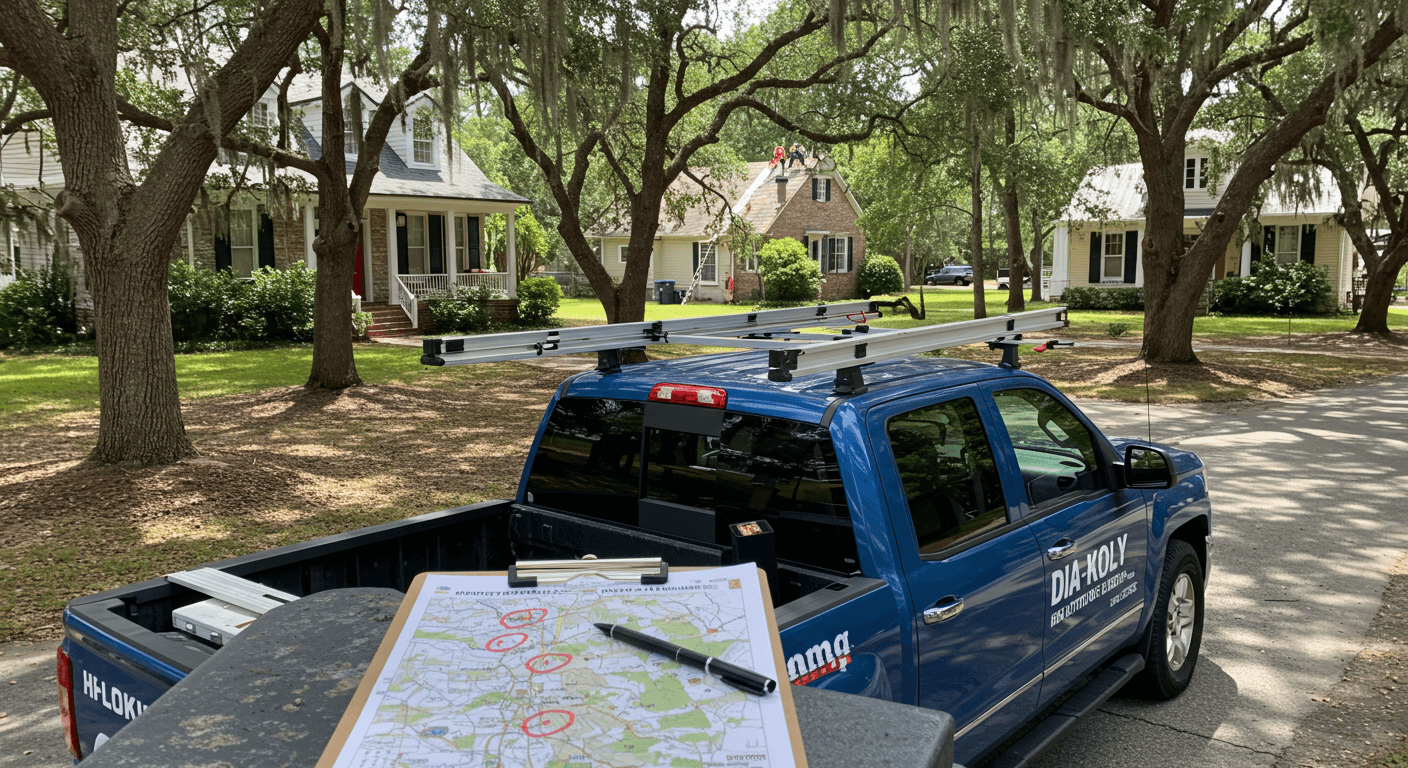
Everything changed when I looked at a heat map of Vance's 2023 job sites layered over his fuel and labor invoices. Vance runs a tight ship out of a warehouse near the I-10 and I-65 interchange, but his profit margins were slipping despite a record year in top-line revenue. We were looking at a digital map of the Mobile metro area, and it looked like someone had sneezed red ink across the entire Gulf Coast. He had crews in Saraland, sales reps in Fairhope, and a repair guy heading out to Grand Bay. The data was stinging. While his average job size was $14,432, his "windshield time"—the hours crews spent sitting in traffic on the Bayway or crawling down Airport Boulevard—was eating 12.4% of his net profit.
That afternoon, we realized that "regional domination" isn't about covering the most ground. It's about owning the most roofs in the smallest possible radius. We decided to stop chasing every lead that popped up in a 50-mile radius and started focusing on neighborhood density. It felt counterintuitive to turn off the faucet in Baldwin County, but the numbers didn't lie. By tightening his service area to specific pockets of West Mobile and Midtown, Vance actually increased his take-home pay by $9,210 per month while doing three fewer jobs.
At a Glance
Density Over Distance: Reducing your service radius to high-density clusters in Mobile can slash operational overhead by 14.7% or more.
The "Fortified" Advantage: Leveraging Alabama's specific insurance incentives for Fortified roofs creates a unique sales moat against out-of-state "storm chasers."
Lead Quality Filtering: Moving away from shared, low-intent leads toward exclusive opportunities prevents your sales team from wasting time on "tire kickers" in remote locations.
Hyper-Local Branding: Saturation in specific neighborhoods like Spring Hill or Oakleigh builds faster trust than a thin presence across the entire Gulf Coast.
The Myth of the "Wide Net" Strategy
There is a persistent belief among roofing owners that more territory equals more money. I see it every time I consult with a shop trying to hit that $5M or $10M mark. They think they need to be the "Gulf Coast Roofer," covering everything from Mississippi to the Florida line. But the math rarely supports this.
When you spread your crews across the Mobile metro, you aren't just paying for gas. You're paying for the opportunity cost of the two extra hours a day your lead foreman isn't on a roof. In a market like Mobile, where the humidity and heat index can regularly hit triple digits by 11:00 AM, those lost morning hours are the most productive of the day. If your team is stuck in traffic near the Cochrane-Africatown Bridge instead of tearing off shingles, you're losing the highest-value window of their shift.
Why Historical and Coastal Specifics Matter
Mobile isn't a "cookie-cutter" market. If you're treating a roof replacement in the De Tonti Square Historic District the same way you treat a new build in Semmes, you're leaving money on the table. The regional domination strategy that actually works requires a deep dive into local building codes and insurance requirements.
In Alabama, the "Fortified" roof program is a massive lever for regional contractors. Homeowners are looking for that insurance discount, which can be as high as 25% to 35% on their premiums. When you position your business as the local expert in Fortified standards, you aren't just selling a roof; you're selling a financial product. I worked with a contractor who shifted his entire marketing message to focus on the 2024 updated standards for coastal resilience. His close rate jumped from 18% to 27.4% because he wasn't competing on price—he was competing on specialized knowledge that the "big box" national guys couldn't articulate.
Broad Regional vs. Hyper-Local Strategy Comparison
| Metric | Broad Regional Approach | Hyper-Local Density Strategy |
|---|---|---|
| Average Travel Time | 75 mins/day | 18 mins/day |
| Yard Sign Saturation | 1 per 10 miles | 4 per block |
| Referral Rate | 4.2% | 19.6% |
Average Travel Time
Yard Sign Saturation
Referral Rate
This strategy also addresses a major pain point: labor. According to the Bureau of Labor Statistics (BLS), becoming a skilled roofer requires significant on-the-job training and physical stamina. When your crews are working in a tight geographic cluster, they are less fatigued by travel, and it's easier for your production manager to oversee multiple sites in a single afternoon. This oversight is vital for safety, especially considering that the BLS reported 110 fatal falls in the roofing industry in 2023 alone. Keeping your jobs close means you can keep a closer eye on your guys.
The Digital vs. Physical Hybrid
The biggest myth I want to bust is that digital marketing is a "set it and forget it" solution for regional growth. In a city like Mobile, where word-of-mouth travels through church pews and Mardi Gras societies, your digital presence must be a reflection of your physical footprint.
I once tracked a campaign where we spent $4,800 on Google Ads targeting "Mobile Roofing Contractors." We got leads, sure, but the conversion rate was abysmal—around 9.2%. Why? Because the homeowners were getting five different calls from five different shops. We pivoted. We took that same budget and geofenced specific neighborhoods where our client already had three active jobs.
The strategy was simple:
- Targeted digital ads showing the specific street name where the crew was working.
- An automated follow-up system using a mobile app to ensure the sales rep called the lead within 4 minutes of the inquiry.
- Physical door hangers on the five houses to the left and right of the current job site.
The results? The CAC dropped from $412 per lead to $187. When a homeowner in Spring Hill sees your truck on their street and then sees your ad on their phone that evening, the "trust barrier" is already halfway gone. You aren't a stranger; you're the guy fixing the neighbor's leak.
The 4-Block Rule
"Never leave a job site without identifying at least four nearby homes with visible granular loss or aging shingles. Use a lead platform that offers locked previews to see if any of those specific neighbors have recently searched for roofing services before you even knock on the door."
Data-Driven Lead Scoring
If you want to dominate a region, you have to stop wasting time on "junk" leads. Most contractors buy shared leads and then complain that the "leads suck." The reality is that the leads don't suck; the system does. When four contractors are fighting over one homeowner in Theodore who just wants a free estimate to show their insurance adjuster, everyone loses.
Regional domination requires exclusive, verified leads. I've seen shops scale from $1.2M to $3.8M in 18 months simply by switching to a lead source that doesn't pit them against every other truck in the county. By focusing on exclusive leads in high-value zip codes (like 36608 or 36604), you can afford to spend more time on each consultation.
I analyzed a dataset of 450 roofing leads in the Mobile market. The "speed to lead" factor was the single biggest predictor of a closed deal. Contractors who responded within 5 minutes had a 390% higher chance of conversion than those who waited an hour. If your team is stuck in traffic across town, they aren't responding to leads. If they are working in a tight 5-mile radius, they can be at the homeowner's door before the competitor has even checked their email.
Action Plan
A Tactical Roadmap for Shifting from a "Shotgun" Approach to a "Sniper" Approach
A tactical roadmap for shifting from a "shotgun" approach to a "sniper" approach in the Mobile roofing market.
The Audit Phase: Analyze your last 18 months of jobs. Calculate the "Net Profit per Mile Traveled." Identify the three zip codes that yielded the highest margins.
The Geographic Pivot: Set your digital marketing and lead procurement boundaries to a 12-mile radius around your most profitable zip codes. Stop bidding on keywords for the entire county.
The Neighborhood Saturation: For every job won, deploy a "neighborhood takeover" sequence. This includes yard signs, direct mail to the immediate 25 neighbors, and local social media tagging.
The Verification Filter: Integrate a lead system that allows you to preview job details before you pay. Focus on high-intent categories like "Emergency Leak" or "Insurance Claim" rather than generic "Roof Inspection."
Want to skip the manual work and get exclusive, verified leads instead?
Get $150 in Free CreditsAvoiding the Growth Trap
One of the most dangerous things a roofing owner can do is scale too fast without the infrastructure to support it. I call this the "Growth Trap." You get a influx of leads, you hire a sub-crew you don't know well, and suddenly your Google rating drops from 4.8 to 4.2 because of a messy job site in Saraland that you couldn't get to for a quality check.
The Quality Leak
Every mile your job site is away from your office decreases your ability to maintain quality control. In Mobile's volatile weather environment, a small mistake in flashing or underlayment can lead to a $10,000 interior damage claim after one afternoon thunderstorm.
Regional domination isn't just about sales; it's about operational excellence. It's about having the capacity to handle the Mobile "afternoon pop-up" storms without your schedule falling apart. When your jobs are clustered, you can shift a crew from a finished site to an emergency tarp-over in 15 minutes. That kind of responsiveness builds a reputation that no amount of ad spend can buy.
Final Thoughts on the Port City Market
The contractors I see winning in Mobile right now are the ones leaning into the local nuances. They know that a roof on Government Street requires a different aesthetic and technical approach than a roof in a new subdivision in West Mobile. They use data to dictate where their trucks go, rather than letting their trucks dictate where their profit goes.
If your current strategy feels like a treadmill—lots of movement but not much forward progress—it's time to look at your density. Stop trying to conquer the coast and start trying to own your backyard. The data shows that the more you narrow your focus, the wider your profit margins become.
The key is finding the right lead source that supports this strategy. Platforms like LeadZik offer exclusive, verified leads with locked previews, allowing you to see job details before purchasing. This prevents you from wasting time and money on leads that don't fit your geographic focus or quality standards.