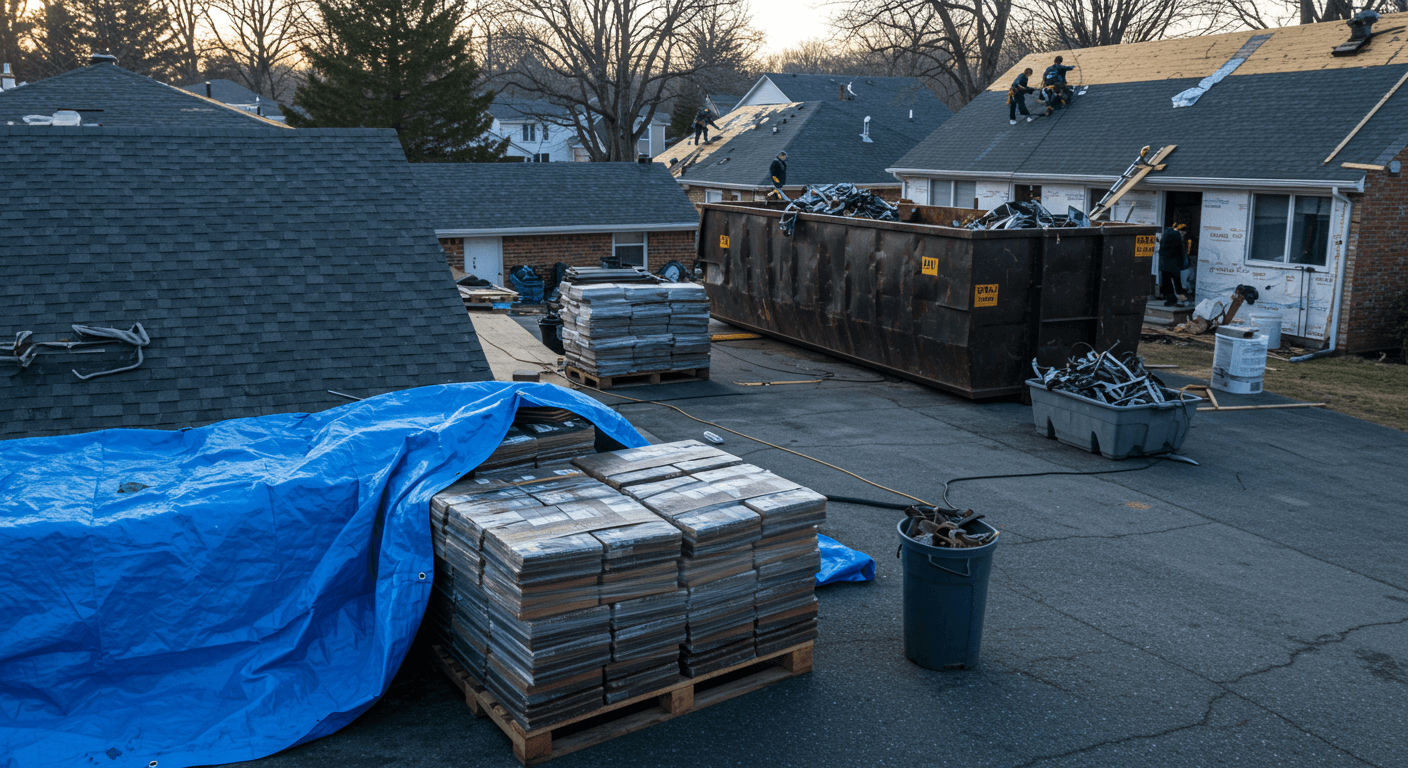
If you found a stack of fifty-dollar bills sitting in a dumpster behind a job site in Parma, would you walk away, or would you start asking who threw them there?
Last Tuesday, I stood at a teardown site in Strongsville with a production manager named Elias. We watched as his crew tossed nearly three unopened bundles of architectural shingles into the bin because they didn't want to haul them back to the warehouse. To the crew, it was just "scrap." To Elias, it was $142 in pure profit heading to the landfill. When we crunched the numbers for his 187 jobs from last year, we realized he'd basically bought a brand-new F-150 just to throw it away in the form of discarded ridge caps and over-ordered valley flashing.
The roofing market in Ohio is facing a unique squeeze right now. Between the fluctuating costs of asphalt and the tightening environmental regulations from the Ohio Environmental Protection Agency, every square inch of material matters. If your operations aren't built to track and minimize this waste, you aren't just losing pennies; you're funding your competitor's expansion.
At a Glance
The 13.2% Leak: Average material waste on Ohio residential jobs often exceeds 13%, cutting directly into your bottom line.
Precision Measurement: Moving from manual estimates to high-resolution aerial data reduces 'safety net' over-ordering by an average of 6.8%.
Disposal ROI: Ohio landfill fees are rising, making waste reduction a double-win for material costs and tipping fees.
Crew Incentives: Shifting from a 'get it done' mindset to a 'resource-efficient' culture requires a specific bonus structure for your installers.
The Rising Cost of "Close Enough" Estimates
For years, the standard operating procedure in the Miami Valley and up through Cleveland was the "10% rule." You estimate the squares, add 10% for waste, and call it a day. But I've noticed that this cushion has become a crutch. In a world where material costs have jumped nearly 24% over the last 3.5 years, a 10% waste factor is an expensive luxury.
The trend I'm seeing among the most profitable shops in Columbus and Cincinnati is a shift toward "zero-buffer" ordering. By using precision aerial measurements, these owners are getting within 1.8% of the actual material needed. They don't order for the roof they think is there; they order for the roof the data proves is there.
Why Ohio Disposal Fees are the Silent Margin Killer
It isn't just the cost of the shingles you're losing. It's the cost of getting rid of them. Landfill tipping fees in regions like Hamilton County and Franklin County have been steadily climbing. I worked with a contractor in Dayton who realized he was spending $4,830 a year just in "excess weight" fees because his crews weren't separating metal scrap from asphalt or were simply over-ordering.
When you reduce waste, you're hitting the "Profit Trifecta":
- Lower upfront material spend.
- Reduced fuel and labor for hauling.
- Lower tipping fees at the yard.
The Pallet Audit
"Once a month, visit a job site unannounced after the tear-off but before the final cleanup. Count the unopened bundles near the dumpster. If it's more than two, your estimating process or your crew's return policy is broken."
Implementation: The "Waste-to-Wallet" Strategy
How do you actually change behavior in the field? You can't just yell at your guys to be more careful. You have to make it worth their while. I helped a shop in Akron implement a simple "Material Bonus." If a crew finished a job with less than 4% waste and returned all unopened bundles in resalable condition, they split 22% of the saved material cost.
Suddenly, shingles weren't being used as knee pads or left out in the rain. The crews became the frontline of quality control.
Material Ordering Strategies: Standard vs. Precision
| Factor | Standard '10% Waste' Ordering | Data-Driven Precision Ordering |
|---|---|---|
| Measurement Method | Manual tape measurements | High-res aerial measurements |
| Waste Buffer | Flat 10-15% waste buffer | 2-4% calculated waste factor |
| Excess Materials | Excess materials often discarded | Required warehouse return policy |
| Disposal Costs | Unmanaged disposal costs | Separated recycling for metal/asphalt |
Measurement Method
Waste Buffer
Excess Materials
Disposal Costs
Technology Trends Shaping 2024 and Beyond
We are moving into an era where "Estimating 2.0" is the baseline. If you're still relying on a guy with a ladder and a tape measure to determine your material buy, you're likely over-ordering by at least 7.4%. Modern tools provide more than just squares; they provide the exact linear footage of starter strips, hip and ridge, and valley flashing.
According to the National Roofing Contractors Association (NRCA), contractors who integrate digital project management with precise measurement tools see a significant lift in operational efficiency. This data-first approach allows you to spot patterns. If one crew consistently uses 5% more material than another on the same roof pitch, you've identified a training problem, not a measurement problem.
If you find that your current lead flow is inconsistent, it makes it even harder to manage inventory. Having a steady stream of high-quality, verified roofing opportunities allows you to plan your material buys in bulk, further driving down your per-square cost.
Navigating Ohio's Seasonal Waste Challenges
Ohio's weather doesn't help. We go from 85 degrees to 35 degrees in a week. Materials that sit on a site too long get damaged. I've seen pallets of shingles sink into mud in a wet Toledo spring, ruining the bottom two layers.
A systematic approach to "Just-In-Time" (JIT) delivery is becoming the norm for high-growth companies. Instead of dropping materials three days early, they coordinate with suppliers for "morning-of" delivery. This prevents theft, weather damage, and the temptation for crews to over-use materials just because they are available.
Action Plan
The 4-Step Material Recovery Workflow
A systematic approach to minimizing waste and maximizing material recovery across your operations.
The Precision Order: Use aerial data to order within a 3% margin of error. Specify exact counts for ridge caps and starter coils.
The Staging Protocol: Require materials to be staged on high ground or boards. Use waterproof tarps for any overnight storage.
The 'Return or Report' Rule: Any unopened bundle must be scanned back into the warehouse via your CRM or reported as damaged with a photo.
Monthly Variance Analysis: Compare your 'Estimated vs. Actual' material usage across all crews to identify the top performers.
The Competitive Edge of Sustainability
There is a growing trend in the Ohio business climate toward green building practices. While "being green" sounds like marketing fluff to some, it's actually a massive efficiency play. Companies that can prove they recycle 90% of their tear-off waste and minimize new material scrap are winning commercial bids that others are locked out of.
The Ohio Department of Natural Resources and various local municipalities are increasingly looking for contractors who can demonstrate responsible waste management. According to Roofing Contractor Magazine, companies that implement systematic waste reduction programs see an average 12.4% improvement in net profit margins. It's becoming a brand differentiator that allows you to charge a premium while actually spending less on materials.
If you're looking for more ways to tighten up your shop's operations, I've shared several strategies for crew retention and efficiency that pair perfectly with these material-saving tips.
Don't Cut Too Thin
Don't cut your waste factor so thin that your crews are waiting on a single bundle to finish a ridge. Labor is still your most expensive line item. If a $40,000 crew sits for two hours waiting for a $45 bundle of shingles, you've lost the game. Aim for 'tight but realistic.'
Final Thoughts on Ohio Margin Management
The difference between a roofing company that survives and one that scales often comes down to the details that no one wants to talk about—like what's at the bottom of a dumpster. By moving away from the "10% rule" and embracing data-driven ordering and crew incentives, you can reclaim thousands of dollars that are currently leaking out of your business.
Start by auditing your next three jobs. Don't look at the finished roof; look at the scrap pile. The data you find there will tell you exactly where your next profit increase is coming from.