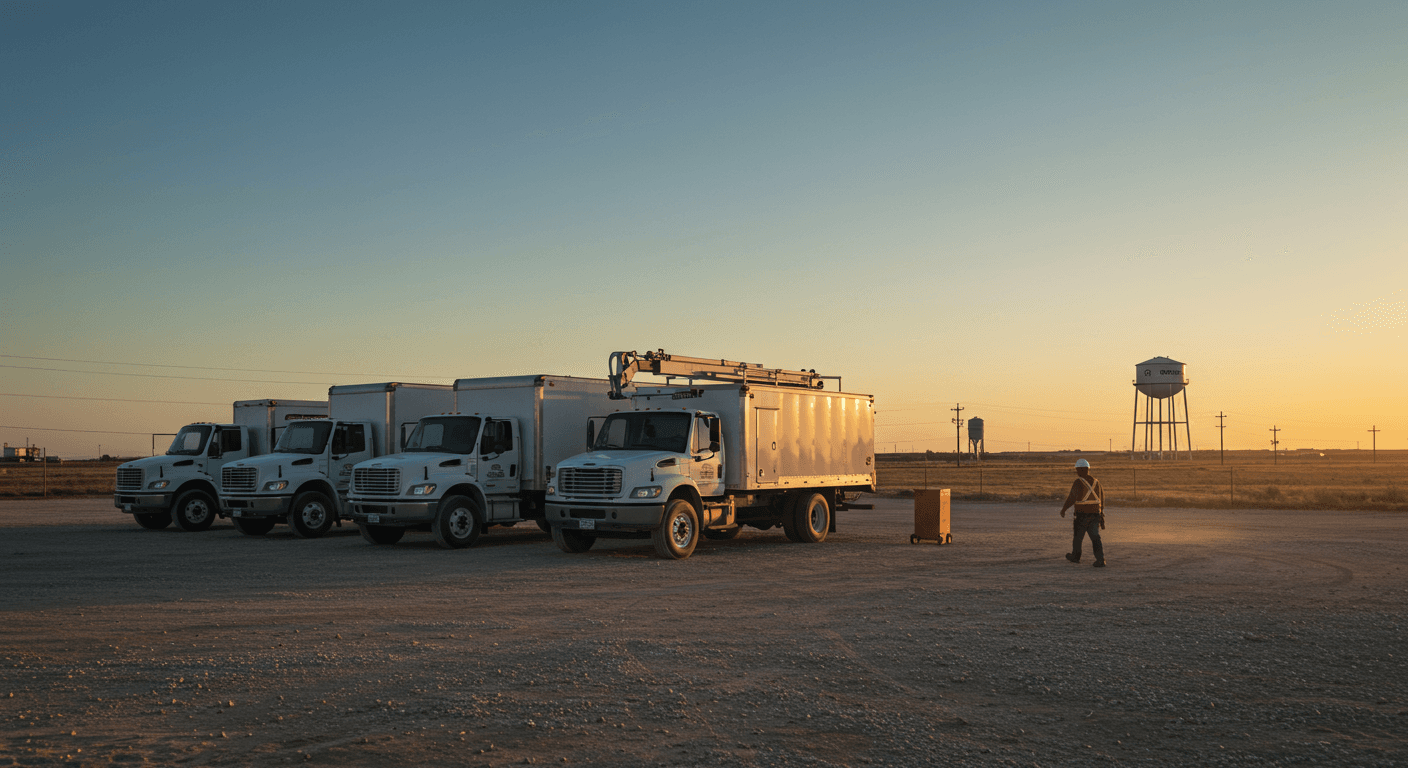
Expanding your roofing footprint in the Texas Panhandle is often a fast track to bankruptcy rather than a revenue multiplier. I watched a contractor in the Wolflin area blow through $164,320 in operating capital in just 8.4 months because he thought more trucks automatically equaled more profit. It does not. In fact, without a rigorous system for managing remote crews across Randall and Potter counties, you are likely just subsidizing your own headaches.
I recently sat down with a business owner named Kellen who was trying to push his operations from a home base near Route 66 out toward Canyon and Bushland. He was stuck in a "middle-ground" trap. He had enough work to keep his main crew busy, but not enough localized lead flow to justify a dedicated second shop. He was losing roughly 12.4% of his gross margin just on windshield time and fuel costs for the I-27 commute.
At a Glance
Expansion ROI hinges on localized lead density rather than total truck count
Satellite offices offer 24.3% lower overhead but require higher digital maturity
Amarillo's high-wind permits demand hyper-local administrative speed to maintain cash flow
Enterprise value increases when systems, not the owner, manage the second location
The High Plains Expansion Trap
Amarillo is a unique beast. We deal with sustained 45 mph winds and hail seasons that can make or break a fiscal year in a single afternoon. When you decide to scale, you aren't just adding a location—you are doubling your exposure to localized labor shortages and permitting bottlenecks.
According to the National Roofing Contractors Association (NRCA), operational inefficiencies are the primary reason regional expansions fail within the first 18 months. In the Panhandle, those inefficiencies usually look like a crew sitting idle in a parking lot on Soncy Road because the project manager is stuck at a job site in Pampa.
Comparing Two Paths: Satellite vs. Full Branch
Most owners I advise struggle to choose between a "lean satellite" model and a "full-service branch." The right choice depends entirely on your current cash reserves and your tolerance for decentralized management.
Option 1: The Lean Satellite Model
This is essentially a sales and staging outpost. You don't need a massive warehouse. You need a small commercial space, perhaps near the Hollywood Road corridor, and a highly efficient digital pipeline.
- Pros: Lower fixed costs (typically $2,450 to $3,800 monthly lease), faster setup.
- Cons: Heavy reliance on your main office for material staging and administrative support.
- ROI Potential: High, provided your lead generation system is optimized to keep the remote sales team running at 85% capacity.
Option 2: The Full-Service Branch
This is a mirror image of your headquarters. It has its own production manager, office admin, and dedicated warehouse space.
- Pros: Complete autonomy, better service for customers in outlying areas like Dumas or Hereford.
- Cons: Massive overhead (often $14,600+ monthly before the first shingle is laid).
- ROI Potential: Significant for long-term enterprise value, but takes 14.2 to 19.6 months to reach a break-even point.
Satellite vs. Full-Service Branch Comparison
| Factor | Lean Satellite | Full-Service Branch |
|---|---|---|
| Monthly Overhead | $3,100 | $15,200 |
| Admin Support | Centralized at HQ | Dedicated local staff |
| Inventory Management | Minimal staging | Full warehouse |
| Best Use Case | Testing new suburbs | Permanent market dominance |
Monthly Overhead
Admin Support
Inventory Management
Best Use Case
The Hidden Cost of "Windshield Time"
I've analyzed the books for over 17 roofing companies in the Texas Panhandle. The biggest silent killer of profit is the drive. If your crews are spending 75 minutes a day driving from a central Amarillo shop to jobs in Canyon, you are losing 6.2 hours of production per man, per week. At a $48 fully-burdened labor rate, a five-man crew is costing you $1,488 a week in "nothing" time.
Amarillo Local Insight
"Register your business with both Potter and Randall county clerk offices early. Permitting speeds vary wildly, and a delay in one can stall your cash flow across the entire metro area."
Scaling Your Lead Infrastructure
You cannot scale a business on referrals alone. When Kellen expanded his shop, he realized his "word of mouth" didn't travel as fast as his trucks did. To keep a second location profitable, you need a predictable flow of exclusive opportunities.
I've seen contractors try to share a single lead pool across two locations, which only leads to internal competition and wasted gas. Instead, the shops that succeed are the ones that leverage territory-specific verification to ensure the new branch only chases jobs within a 15-mile radius of their new staging area.
Managing the Amarillo Permitting Maze
If you are moving into Randall County or the city limits of Amarillo, your administrative overhead will spike. Each jurisdiction has its own quirks regarding wind-speed requirements and shingle fastening patterns.
The U.S. Small Business Administration (SBA) notes that regulatory compliance is one of the top three stressors for expanding small businesses. In roofing, this means your office admin needs to be 21% more efficient to handle the doubled permit volume. If your backend systems are still paper-based, do not open a second location. You will drown in the filing.
Action Plan
The 6-Month Expansion Roadmap
A phased approach to opening a second location without risking your primary shop's stability.
Month 1: Secure $125k in liquid capital reserves and audit current HQ systems.
Month 2: Implement a territory-locked lead generation strategy for the target ZIP codes.
Month 3: Hire a local Production Manager who knows the Amarillo/Canyon area labor pool.
Month 4: Secure a short-term 'Satellite' lease to test lead density and crew efficiency.
Month 5: Transition to a permanent facility once local monthly revenue exceeds 2.5x overhead.
Month 6: Review P&L to ensure the new branch isn't cannibalizing HQ margins.
Want to skip the manual work and get exclusive, verified leads instead?
Get $150 in Free CreditsBuilding Enterprise Value
The goal of expansion isn't just to stay busy—it is to build a business that is worth more than the sum of its parts. A multi-location roofing company with documented systems and a steady lead pipeline is worth roughly 4.2x EBITDA, whereas a single-location, owner-operated shop might only fetch 2.5x.
By focusing on density in the Amarillo metro area before jumping to Lubbock or Oklahoma City, you protect your margins and build a dominant regional brand. Just ensure your infrastructure is ready for the wind before you start adding more sails. For more insights on scaling strategies, check out our expert articles on multi-location growth.