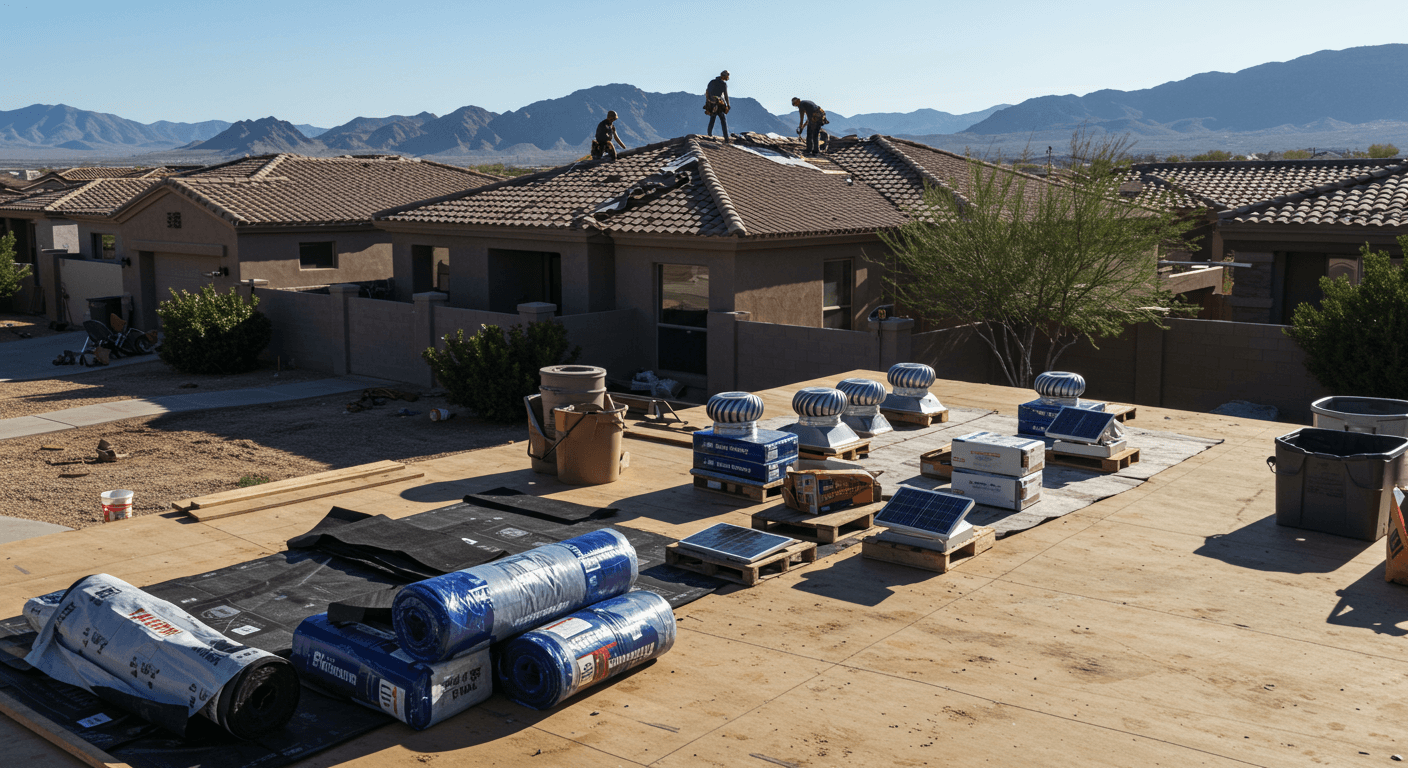
Walking through a dusty job site in Summerlin, I watched Jaxon flip through a stack of three-tab shingle bids that looked exactly like every other proposal in Clark County. He was frustrated because his margins were getting squeezed by rising material costs and a local labor market that was tighter than a new boot. We climbed into his truck, air conditioning blasting against the 108-degree heat, and I asked him a simple question: "How many of these homeowners know their attic is currently 145 degrees because their ventilation is thirty years old?" Jaxon looked at the bids, then back at me. He hadn't mentioned ventilation once. He was selling a commodity, a roof-in-a-box, while leaving nearly $2,400 in pure profit on the table for every single contract.
That moment was the catalyst for a total overhaul of his sales process. In Nevada, where the sun beats down on roofs with a specialized intensity, a roofer who only sells shingles is doing a disservice to the client and their own bank account. We spent the next 14 months transforming his sales reps from order-takers into consultants. The result wasn't just a 19.4% bump in gross revenue, it was a fundamental shift in how they approached every lead that came through their pipeline.
At a Glance
Focus on "System Selling" rather than individual components to increase average contract value by 16% to 23%.
Use Nevada's extreme climate as a consultative lever for upselling high-reflectivity underlayment and solar ventilation.
Implement a "Tiered Protection" proposal structure that anchors the price and makes the middle-tier upsell feel like the logical choice.
Train estimators to identify cross-sell opportunities like gutter guards and fascia repair during the initial inspection to avoid mid-job change orders.
The High Cost of the "Basic" Bid
When you operate in a market like Las Vegas or Reno, the competition is relentless. I've seen shops try to win on price until they've literally bid themselves out of business. The "basic" bid is a trap. It assumes the homeowner only cares about the lowest number, when in reality, they care about not having to deal with another roof for the next 24 years.
Jaxon's team was stuck in a "transactional" loop. They would arrive, measure, and drop a price. If the homeowner said it was too high, they'd look for ways to trim. This is the opposite of how high-performance sales teams operate. According to data shared by Roofing Contractor Magazine, contractors who focus on comprehensive building envelope solutions see significantly higher customer satisfaction ratings and referral rates than those who compete solely on price.
We sat down and looked at Jaxon's last 47 jobs. On 39 of them, there was visible evidence of heat-related wear on the plywood decking that hadn't been addressed in the initial quote. By ignoring the "extras" like radiant barriers or upgraded ridge vents, his team was essentially walking past $1,100 bills laying on the sidewalk. We decided to stop competing on the "shingle price" and start selling the "Nevada Heat Protection System."
The Transactional Bid vs. The Consultative Package
| Feature | The Transactional Bid | The Consultative Package |
|---|---|---|
| Average Ticket | $11,840 | $14,187 |
| Gross Margin | 24.2% | 31.7% |
| Primary Value | Lowest Price | Longevity & Energy Savings |
| Customer Perception | Commodity Vendor | Trusted Expert |
| Upsell Potential | Low (Price Sensitive) | High (Solution Oriented) |
Average Ticket
Gross Margin
Primary Value
Customer Perception
Upsell Potential
The Case Study: Transforming a Henderson Shop
Jaxon's transformation didn't happen overnight. We started with a specific pilot program for his top two reps, Logan and Aria. We gave them a new framework: every lead was an opportunity to solve three problems, not just one. The three problems were: the leak (the immediate need), the heat (the Nevada reality), and the aesthetics (the neighborhood pride).
In the first month, Logan moved his average contract from $12,102 to $14,449. He didn't do this by being pushy. He did it by changing his inspection routine. Instead of just looking for missing shingles, he started taking photos of the attic insulation and the existing vents. He would show the homeowner the photo and say, "Your shingles are the shield, but your ventilation is the lungs. Right now, your roof can't breathe, which is why your AC bill is $480 a month."
This shift in sales psychology is what separates the $2M shops from the $10M operations. It's about building value before you ever show the price. I've seen similar transformations in shops that were frustrated by shared leads and decided to focus on maximizing the value of every exclusive opportunity they touched.
After implementing the consultative sales framework, Jaxon's Henderson shop saw a significant boost in overall revenue without increasing lead spend.
Implementing the "Three-Tier" Proposal
We moved Jaxon away from providing a single price. Instead, every homeowner received three options:
- The Essential: Meets code, covers the leak, 10-year workmanship warranty.
- The Performance (The "Target"): Includes synthetic underlayment, high-profile ridge vents, and a 25-year warranty.
- The Ultimate: Includes solar-powered attic fans, radiant barrier upgrades, and a lifetime "no-leak" guarantee.
By presenting three options, you stop the homeowner from asking "Should I hire Jaxon?" and start them asking "Which of Jaxon's options is best for me?" In the first quarter of using this system, 64% of Jaxon's clients chose the Performance tier, and 12% chose the Ultimate. Only 24% stayed at the Essential level. This simple change in presentation added a massive amount of revenue without needing a single additional lead.
Nevada-Specific Upsell Opportunities
If you are roofing in Nevada, you have a unique set of challenges that are actually hidden profit centers. The Western States Roofing Contractors Association often highlights how regional climate shifts demand different material applications. In our case, the desert climate is the perfect backdrop for energy-efficient upgrades.
1. Advanced Heat Mitigation
Don't just sell shingles; sell a cooler house. Upselling to a "Cool Roof" rated shingle or adding a radiant barrier underlayment can save a homeowner 13% to 17% on their cooling costs. When you frame the upsell as an investment that pays for itself in five years of NV energy bills, the "sale" disappears and the "consultation" takes over.
2. Ventilation Overhauls
Most older homes in the Las Vegas Valley are under-ventilated. I told Jaxon to have his guys carry a digital thermometer into the attic. If the attic is more than 15 degrees hotter than the outside air, it's an automatic upsell for a solar attic fan or additional soffit venting. This isn't "selling more stuff," it's ensuring the manufacturer's warranty on the shingles actually stays valid.
3. Integrated Gutter Systems
In a state where it rarely rains, homeowners often forget about gutters until the one day it pours and their foundation starts to erode. Cross-selling a seamless gutter system during a roof replacement is a high-margin move because the crew is already there. Jaxon started including a "Gutter Health Report" with every roof inspection, which led to a 28% attachment rate for new gutters on his roofing jobs.
The "While We're Here" Script
"When closing the roof deal, use this specific talk track: "Since we're already pulling the permits and having the crew on-site with the scaffolding, we can actually install [Upsell Item] for about 35% less than it would cost as a standalone project next year. It's the most cost-effective time to do it.""
Training the Team: Role-Play and Scripting
I've watched countless sales reps choke when it comes time to ask for the extra $2,000. They feel like they're being "greedy." I had to sit down with Logan and Aria and explain that withholding a solution that saves the homeowner money in the long run is actually a form of poor service.
We ran a role-play session where Logan played a skeptical homeowner in Summerlin. Aria had to pitch him on a $1,840 skylight replacement during a $15,000 re-roof.
Aria: "Jaxon, I noticed your skylight is about 12 years old. The seals are still holding, but the acrylic is starting to yellow."
Logan: "It seems fine. Can't we just roof around it?"
Aria: "We definitely can. But in three years, when that seal finally gives out, you'll have to pay a contractor $900 just to come out, pull the new shingles back, and replace it. Since we're doing the roof now, the labor is essentially covered. I can swap it for a new, energy-efficient Velux model for $580 today. It saves you over $300 and prevents a future leak."
Logan stopped acting. "That makes total sense," he said. "I'd buy that."
That's the secret. Upselling isn't about being a "slick" salesman. It's about being a subject matter expert who cares about the homeowner's long-term budget. If you want to see more examples of how to refine your team's approach, I've written extensively about optimizing your sales operations for higher close rates.
The Operational Side of Cross-Selling
You can't just tell your reps to sell more; you have to build the infrastructure to support it. Jaxon had to update his estimating software to include these "add-ons" as standard line items that could be toggled on and off. We also had to look at his commission structure.
We shifted from a flat commission to a tiered percentage based on the gross margin of the job. If a rep sold an "Essential" package at a 24% margin, they made their base commission. If they sold a "Performance" package at a 31% margin, their commission percentage on the total job increased by 1.5%. Suddenly, the sales team was highly motivated to find every possible upgrade that added value to the client and margin to the shop.
I've seen many contractors struggle with the technical side of these transitions. If you're wondering how to handle the influx of more complex jobs, checking out the FAQ on lead and project management can help clarify the logistics of scaling up your operation.
Action Plan
Building Your Upsell Infrastructure
A systematic approach to creating the operational foundation that supports higher ticket sizes without overwhelming your team.
Update your CRM or estimating software to include standard upsell line items (ventilation, underlayment, gutters, skylights) with pre-loaded pricing.
Restructure commission to reward margin, not just volume. Create tiered commission rates that increase with the gross margin percentage of each job.
Develop inspection checklists that force estimators to document attic temperature, gutter condition, and skylight age before they can finalize a quote.
Create role-play scenarios based on real objections from your market. Practice the "while we're here" script until it feels natural, not salesy.
Want to skip the manual work and get exclusive, verified leads instead?
Get $150 in Free CreditsMeasuring the Results
After 18 months of working with Jaxon, the numbers spoke for themselves.
- Average Job Size: Increased from $11,743 to $14,090.
- Gross Profit per Job: Increased by an average of $842.
- Referral Rate: Increased by 14% (homeowners were happier with the "cooler" homes and better aesthetics).
- Sales Rep Retention: Improved significantly because the reps were making $15k to $20k more per year without working more hours.
In the Nevada market, the difference between a business that survives and one that thrives is often found in these small percentages. A roofer who adds a few thousand dollars to every job is the one who can afford the best crews, the newest trucks, and the most consistent lead flow.
Jaxon isn't worried about the "cheap guy" down the street anymore. He knows that the "cheap guy" is leaving money on the table, while Jaxon is building a sustainable, high-margin business that provides genuine value to the homeowners of the Silver State.
The Henderson shop added this amount to every contract through systematic upselling and cross-selling strategies.
Avoid the "Dump Truck" Approach
Don't overwhelm homeowners with a laundry list of 15 different upgrades. Stick to the three-tier system and focus on the 3-4 most impactful upsells for Nevada's climate. Too many options create decision paralysis and can actually reduce your close rate.