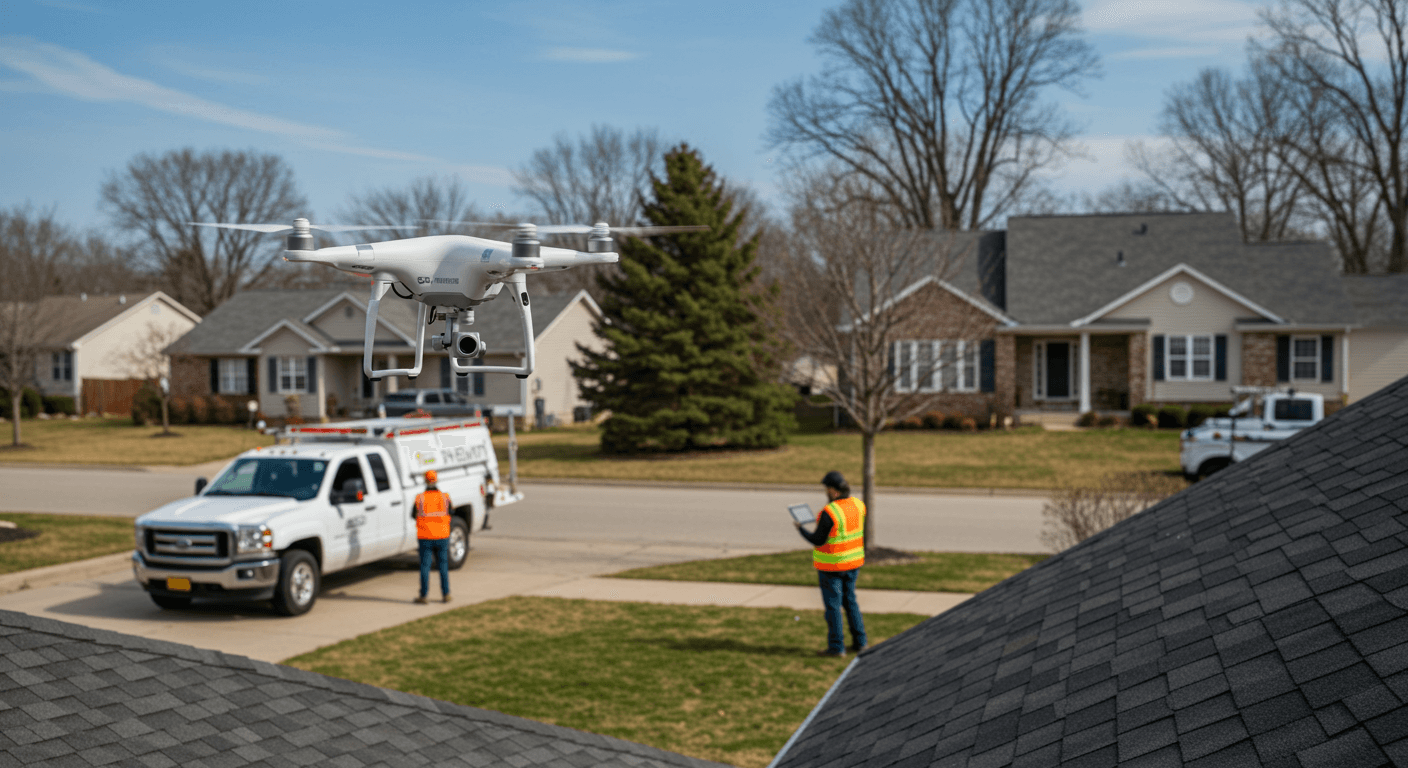
Instead of struggling through his fifth manual measurement of the day near the intersection of Hall Road and Van Dyke, Gavin watched a high-resolution 3D model of a complex gable roof populate on his tablet in under seven minutes. Six months ago, that same property would have required a 32-foot extension ladder, two crew members for safety spotting, and nearly 85 minutes of high-risk labor just to get an accurate shingle count. The contrast in Gavin's operational overhead is staggering. On one hand, his old manual process cost him roughly $187 per estimate when factoring in labor, fuel, and vehicle wear. On the other, his new drone-integrated workflow has dropped that cost to approximately $39 per site visit.
This shift isn't just about cool gadgets or following tech trends in the Detroit metro area. For a roofing business owner in Sterling Heights, it is a cold, hard calculation of revenue per hour. When your estimators are spending 60% of their day hauling ladders and navigating the heavy traffic on M-53, they aren't selling. They are performing manual labor that can be automated. By implementing a systematic drone inspection process, I've seen local shops double their daily estimate capacity without adding a single person to the payroll.
At a Glance
Reduce inspection time from 80+ minutes to under 15 minutes per property.
Lower the cost per estimate by approximately 74% through labor and fuel savings.
Improve closing rates by providing high-resolution aerial evidence of damage to homeowners.
Minimize workers' comp risks by reducing the frequency of ladder deployments.
The Hidden Drain of the "Ladder-First" Mentality
In my time auditing roofing operations across Macomb County, the biggest profit leak I see isn't in material waste, it's in the "ladder-first" mentality. When Gavin was running a traditional shop, his lead-to-contract cycle was sluggish. A homeowner in the Northpointe neighborhood would call for a quote, and Gavin would have to wait for a clear weather window and a two-man window to send a truck.
The operational cost of a "truck roll" in Sterling Heights is rising. Between rising insurance premiums and the literal cost of idling in traffic near Lakeside Mall, every minute a crew spends not installing shingles is a minute the company is losing margin. Manual inspections also carry a significant safety liability. Every time a foot touches a rung, the risk profile of the job spikes. Following OSHA roofing safety guidelines is mandatory, but the most efficient way to stay compliant is to keep your feet on the ground whenever possible.
Calculating the Real-World ROI in Michigan Markets
When we look at the numbers for a typical Sterling Heights operation, the drone investment pays for itself faster than most owners realize. Let's look at the math Gavin used to justify his hardware and software suite. He was spending about $4,930 monthly on estimator labor for a volume of 40 quotes. After switching to a drone-first model, he moved to 85 quotes a month with the same labor spend.
The ROI isn't just the time saved on the roof. It is the accuracy of the data. Drones equipped with AI-scaling software can measure slopes, ridges, and valleys within a 99.4% accuracy rate. This eliminates the "padding" many contractors add to quotes to cover measurement errors. If you can shave 4% off your material waste because your measurements are exact, that is pure profit staying in your pocket.
Furthermore, integrating this data into a mobile app allows your sales team to present a professional, transparent report to the homeowner before they even leave the driveway. In a competitive market like Southeast Michigan, that level of professionalism often justifies a higher price point than the "guy with a ladder and a yellow notepad."
Safety as an Operational Profit Center
We often view safety as a cost center, something we pay for in training and gear. However, drones flip that narrative. By reducing the number of "unnecessary climbs," you are directly protecting your EMR (Experience Modification Rate). A single fall can derail a small roofing company's finances for years.
I always point my clients toward the OSHA Stop Falls Campaign, which emphasizes planning and providing the right equipment. In this context, a drone is the ultimate safety equipment. Gavin realized that by using drones for the initial inspection, he only had to put a man on the roof when a contract was actually signed and the work was beginning. This reduced his team's total "exposure hours" by nearly 63% over the course of a single season.
The 15-Mile Wind Rule
"In Sterling Heights, wind gusts coming off Lake St. Clair can be unpredictable. Always set your drone's return-to-home altitude higher than the tallest local structure and never fly if sustained winds exceed 18 mph to protect your equipment ROI."
Overcoming the Implementation Hurdle
The most common pushback I hear from operations managers is that their teams aren't "tech people." Gavin had the same fear. He worried his veteran estimators would view the drone as a toy or a threat to their expertise. The key to his successful rollout was framing the technology as a tool to make their lives easier, not a replacement for their eyes.
We started with a "Hybrid Week." Every lead that came through our verification system was handled with both a drone and a manual check. By Wednesday, the team saw that the drone was catching marginal damage they had missed and providing better photos for insurance adjusters. By Friday, the veteran crew members were fighting over who got to take the drone out.
Manual vs. Drone-First Inspection Comparison
| Factor | Manual Inspection | Drone-First Inspection |
|---|---|---|
| Time on Site | 65-90 Minutes | 12-18 Minutes |
| Labor Requirement | 1-2 People | 1 Person |
| Safety Risk | High (Ladder/Roof) | Zero (Ground-based) |
| Data Accuracy | Subjective/Manual | AI-Verified 3D Modeling |
| Homeowner Perception | Standard | High-Tech/Professional |
| Estimated Cost | $180+ | ~$40 |
Time on Site
Labor Requirement
Safety Risk
Data Accuracy
Homeowner Perception
Estimated Cost
Marketing the Tech to Sterling Heights Homeowners
Don't underestimate the sales power of an aerial roof report. In neighborhoods like Riverland or the subdivisions near Clinton River Park, homeowners are being bombarded with roofing flyers. When you can show them a high-definition thermal map of their roof's moisture traps or a 4K video of a cracked chimney flashing, you aren't just telling them they need a new roof, you are proving it.
This transparency builds trust faster than any sales script. It also streamlines the insurance claim process. Adjusters are much less likely to argue over a clear, date-stamped aerial photo than a blurry cell phone picture taken from the top of a shaky ladder. If you find your team is struggling to integrate these reports into your sales flow, it might be time to contact our team for a strategy audit to ensure your technology is actually driving conversions.
Scaling Without Friction
The goal of every operations strategist is to create a system that works without them. Gavin's transition to drone inspections allowed him to step back from the day-to-day "estimate chase." He now spends his time analyzing the data trends in Sterling Heights, identifying which neighborhoods have the highest storm damage potential, and optimizing his crew schedules.
By removing the physical bottleneck of the ladder, he opened the door to true scalability. His business can now handle a sudden influx of leads during the Michigan storm season without his overhead exploding. That is the definition of operational efficiency.