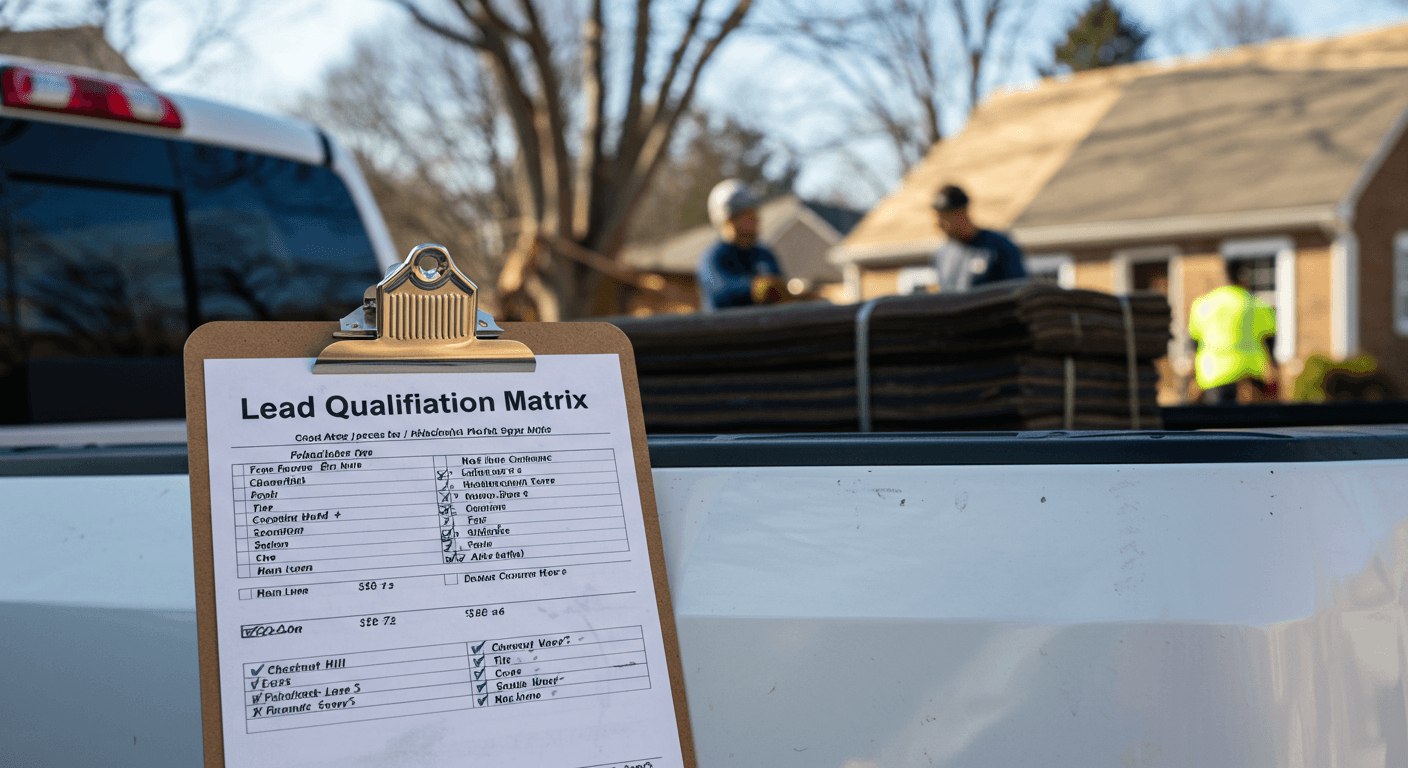
Data collected from over 114 exterior contractors across the Mid-Atlantic shows a startling reality: the average roofing shop in Philadelphia is currently burning 63.8% of their sales budget on leads that have a zero-percent statistical chance of closing. This isn't just a minor inefficiency. When I sat down with a business owner in Conshohocken last month to audit their CRM, we discovered they were spending upwards of $4,840 monthly on "dead-on-arrival" appointments simply because they lacked a systematic way to say "no" to a prospect.
At a Glance
Stop treating every lead as equal; weighted scoring protects your estimator's most valuable asset—time.
Localize your criteria by prioritizing high-margin Philadelphia zip codes and specific roof archetypes.
A lead's 'speed-to-call' matters less than the lead's 'intent-to-fund.'
Operationalizing a scoring matrix can reduce fuel and labor waste by as much as 19.4% within the first quarter.
The Myth of the "Hot" Lead
In the hyper-competitive Philly market, we've been told for a decade that "speed to lead" is the only metric that matters. The common wisdom says if you aren't calling back a lead from a Facebook ad within 120 seconds, you've already lost the job.
I'm here to tell you that's a dangerous half-truth.
Rushing to the phone for every notification is how you end up sending your best estimator across the Roosevelt Boulevard during rush hour for a "repair" that turns out to be a $200 shingle patch on a roof that needs a full tear-off the homeowner can't afford. According to the National Roofing Contractors Association (NRCA), operational inefficiencies like poor lead qualification can drain nearly 15% of a contractor's annual gross revenue.
When we look at the numbers, a "hot" lead is often just a "fast" lead. Without a quality score attached to it, you're just accelerating your path to a low-margin project.
The average Philadelphia roofing shop burns over half their sales budget on leads with zero chance of closing.
Building a Weighted Scoring Matrix for Philadelphia
If you want to scale, you have to stop relying on your gut feeling. I've seen too many owners say, "I just know a good lead when I hear one." That doesn't scale. You need a system that a 22-year-old office admin can run while you're out on a job site in Manayunk.
We recently implemented a 1-10 scoring system for a client in Cherry Hill that factored in three specific pillars:
- Geography (The "Drive Time" Variable): We assigned higher points to projects within a 14-mile radius of their warehouse. Why? Because the cost of 87 octane and the "Philadelphia traffic tax" is real.
- Structural Archetype: In certain parts of South Philly, flat roofs are the bread and butter. If your crew is optimized for architectural shingles but you're chasing rubber roof leads, your profit per man-hour drops by 22.7% immediately.
- Funding Certainty: Does the lead mention "insurance claim" or "financing needed"? These are weighted differently based on the company's current cash flow needs.
Chasing Every Lead vs. Scoring Before Dispatch
| Metric | Chasing Every Lead | Using Scoring Matrix |
|---|---|---|
| Average Close Rate | 18.2% | 31.7% |
| Estimator Hours Wasted | 11.4 hrs/week | 2.1 hrs/week |
| Fuel Cost Per Closed Deal | $127 | $68 |
| Monthly Profit Margin | 18% | 38% |
Average Close Rate
Estimator Hours Wasted
Fuel Cost Per Closed Deal
Monthly Profit Margin
The Hidden Cost of the "Tire-Kicker"
Let's do some quick math. If you're paying a lead generator $84 per lead and your estimator earns a base plus commission, a single "bad" appointment costs you far more than the lead fee.
Consider the "Sully" example. Sully is one of the best estimators I've ever worked with. He's thorough, he's great with homeowners, and he knows his materials. Last summer, I tracked Sully's time for a week. He spent 11.4 hours stuck in traffic or performing inspections for people who were "just curious" about the price of a metal roof but had a budget of $5,000.
That's 11.4 hours he wasn't closing the $18,000 retail replacements in Bucks County. When we calculated the opportunity cost, that one week of poor lead scoring cost the company roughly $6,390 in potential gross profit.
The 15-Minute Rule
"Never dispatch a truck until the homeowner has answered three specific 'deal-breaker' questions regarding budget and decision-maker presence."
Turning Data into a Dispatch Strategy
The goal isn't just to score the leads; it's to change how you behave based on those scores. A "Level 9" lead gets a call from the owner or senior estimator within 5 minutes. A "Level 3" lead gets an automated email sequence with a pricing guide and an invitation to book a virtual consultation.
I've found that many contractors fear that viewing job details before buying a lead will slow them down. In reality, that extra 30 seconds of scrutiny is what keeps your profit margins at 38% instead of 18%. By seeing the zip code, the roof type, and the job size upfront, you're performing the first level of scoring before you even spend a dime.
Action Plan
The 4-Step Scoring Implementation
A systematic approach to implementing lead scoring that protects your margins and maximizes estimator efficiency.
Audit Your Last 47 Jobs: Identify which neighborhoods and roof types yielded the highest net profit.
Assign Point Values: Give 5 points for high-profit zip codes, 3 points for 'retail ready,' and -2 points for 'repair only' (unless that's your niche).
Set a Dispatch Threshold: Only send an estimator in person for leads scoring 7 or higher.
Automate the Rest: Use your CRM to send educational content to low-score leads until they move up the scale.
Want to skip the manual work and get exclusive, verified leads instead?
Get $150 in Free CreditsThe Local Perspective: Navigating Philly Regulations
Another factor in your score should be the "Permit Friction" of specific townships. If you're working in certain Philadelphia suburbs, the time it takes to get a permit approved can drag your project timeline out by 19 days compared to others. If your crew is already booked solid, a lead in a high-friction township should actually score lower on your matrix because it ties up your administrative resources.
Industry insights from the Roofing Contractor Magazine highlight that regional labor shortages are making crew efficiency more important than lead volume. If you have a crew sitting idle because a permit is stuck in a Lower Merion office, that lead wasn't high quality—it was a bottleneck.
Avoid the 'Volume Trap'
More leads does not mean more profit. If your closing rate is below 21.6%, doubling your lead flow will likely just double your overhead without moving the needle on your bottom line.
How Technology Filters the Noise
I often suggest that contractors use our mobile app to manage this workflow. When a lead comes in, you shouldn't have to guess if it's worth the drive. You need to see the "meat" of the job—the roof pitch, the material type, and the specific location—instantly.
Effective lead scoring is about empowerment. It empowers your sales team to focus on the wins and it empowers you to stop worrying about the "ones that got away." Usually, the ones that got away were the ones that were going to cost you money anyway.