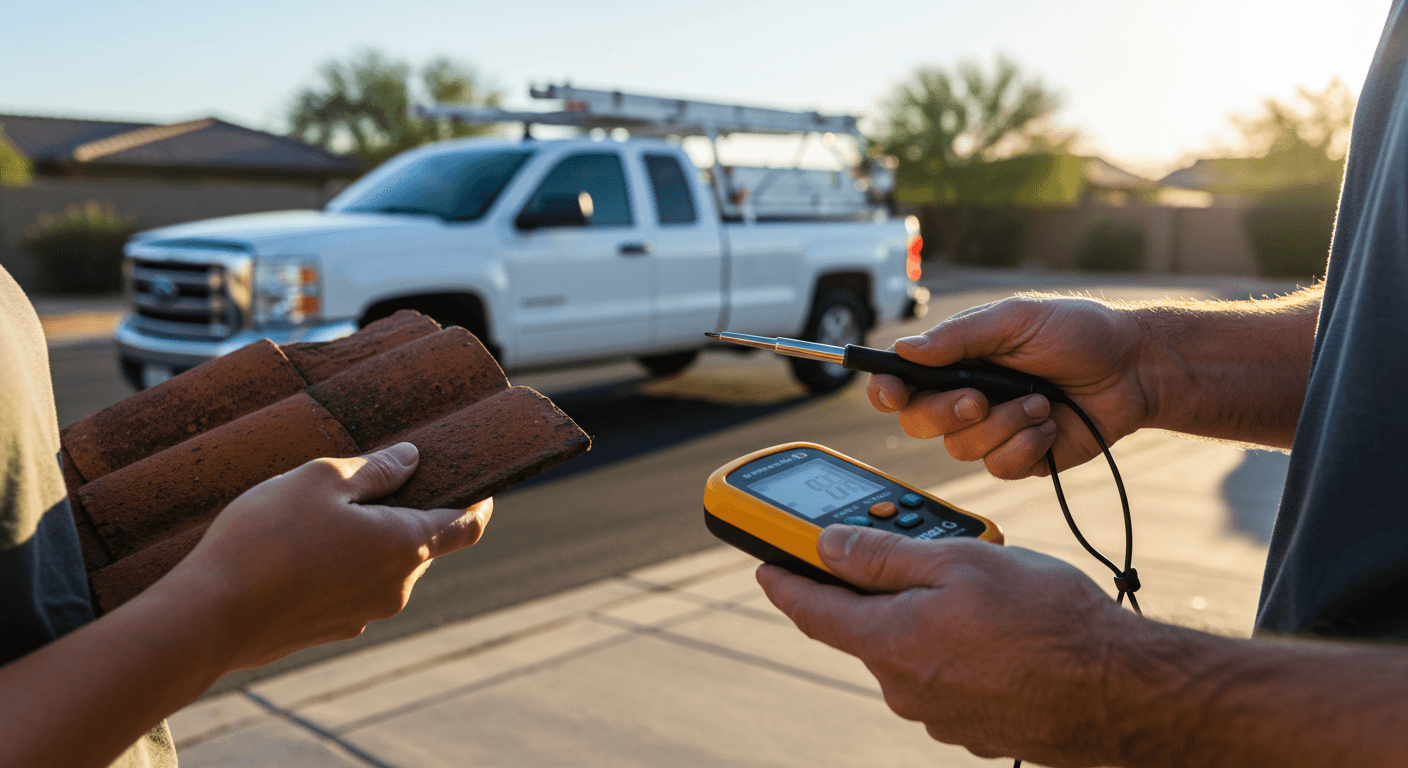
Jaxon leaned against the tailgate of his white F-150, watching a competitor's truck pull out of a sun-baked driveway in Scottsdale. He had just spent forty-seven minutes talking about shingle grades, wind ratings, and the heat-reflective properties of specific underlayments. His price was fair, $16,842 for a full tile reset and underlayment replacement, yet the homeowner's eyes had glazed over by the fifteen-minute mark. That blank stare usually means one thing: the homeowner is going to "think about it," which is almost always code for "I'm calling the guy who didn't just lecture me."
I have seen this exact scene play out in dusty driveways from Mesa to Flagstaff. We often treat roofing like a commodity transaction, a simple exchange of labor and material for a check. However, the Arizona market is currently too crowded for that "pitch-and-bid" model to survive. This isn't just a hunch. Last quarter, I worked with a crew in Tucson that saw their close rate climb from 17.4% to 32.1% simply by changing how they opened the conversation at the front door. This shift is about moving from a vendor mindset to a consultant mindset.
When transitioning from transactional to consultative sales models in high-competition regions like Phoenix.
At a Glance
The Arizona market is over-saturated, making price-based selling a direct threat to long-term business viability.
Consultative selling focuses on risk mitigation and long-term asset protection rather than just shingles and labor.
High-performing crews in Arizona use specific discovery questions to uncover homeowner pain points before ever mentioning a price.
Verified lead sources reduce the "noise" of tire-kickers, allowing your team to focus on high-intent consultative opportunities.
The Saturated State of Arizona Roofing
The Arizona Registrar of Contractors (ROC) maintains a rigorous environment, but it doesn't stop the influx of new players every monsoon season. In the Phoenix metro area alone, the density of licensed R-42 and CR-42 contractors means a homeowner often receives five or six bids for a single leak. When everyone is saying the same thing about "quality craftsmanship" and "family-owned values," the homeowner defaults to the only metric they understand: the bottom-line price.
This creates a race to the bottom that eats your profit. If you are competing solely on price, you are not running a business; you are managing a slow-motion collapse. According to data from the Western States Roofing Contractors Association (WSRCA), the cost of materials and specialized desert-grade coatings has fluctuated by nearly 14% over the last 18 months. If your sales process doesn't justify a premium, those fluctuations come directly out of your pocket.
Transactional vs. Consultative: The Revenue Gap
In a transactional sale, the roofer is a high-pressure order taker. They show up, measure, and drop a number. In a consultative sale, the roofer is a risk manager. You are there to help the property owner make a financial decision that protects their largest investment from 115-degree heat and microbursts.
Sales Model Comparison
| Factor | Transactional Pitch | Consultative Approach |
|---|---|---|
| Primary Focus | Price and Material | Problem Diagnosis and Risk |
| Customer Interaction | One-way presentation | Two-way discovery |
| Average Close Rate | 14-18% | 29-35% |
| Margin Profile | Low/Commodity | Premium/Value-based |
Primary Focus
Customer Interaction
Average Close Rate
Margin Profile
I remember a training session with a rep named Aria in Gilbert. She was struggling to close anything over $12,000. We looked at her "pitch" and realized she was talking 82% of the time. We flipped the script. Instead of leading with her company's history, she started asking about the homeowner's long-term plans for the house. Are they staying for 15 years? Are they worried about the attic's R-value affecting their $400 summer cooling bills? By the end of the month, her average ticket jumped to $15,430 because she was selling solutions to heat-related energy loss, not just a dry roof.
The Discovery Phase: Where the Money is Made
Most Arizona roofers fail because they start "selling" the moment they step off the ladder. The real sale happens before you even pull out your tape measure. You need to understand the psychological state of the Arizona buyer. They are often skeptical, bombarded by door-knockers, and worried about being scoured by a "storm chaser."
To break this, your team needs a structured discovery process. I teach a framework that focuses on three specific areas:
- Historical Pain: "How many times have you had a repair crew out here in the last 4.5 years?"
- Financial Impact: "Beyond the leak, what has this done to your insurance premiums or your cooling costs?"
- Future Certainty: "If we could guarantee that you wouldn't have to think about this roof for the next 22 years, what would that be worth to your peace of mind?"
When you ask these questions, you are no longer a guy with a ladder. You are a professional conducting an audit. This positioning allows you to command a higher price because you have identified problems the "cheap guy" didn't even notice.
The Power of the "No-Pressure" Exit
"Always give the homeowner an out. Tell them, "If I find that your roof has another 4 years of life, I'll tell you exactly that." This builds immediate trust that makes your eventual bid much harder to reject."
For more on scaling this kind of trust-based growth, check out the SBA guide on growing your business.
Analyzing the Arizona Buyer Persona
Arizona has a unique mix of retirees on fixed incomes in places like Sun City and high-earning tech professionals in Chandler. You cannot use the same sales script for both. A retiree is looking for the "last roof I'll ever buy," while the tech professional is looking for ROI, energy efficiency, and modern aesthetics.
Consultative selling requires your reps to be chameleons. They need to analyze the data of the neighborhood before they even arrive. If you are walking into a neighborhood built in 1998 with original concrete tiles, you know exactly what the failure points are. You don't need to "find" the leak; you need to explain the systemic failure of the underlayment that occurs at the 25-year mark in desert climates.
This level of expertise is what justifies the $19,000 bid when the competitor is at $15,500. You aren't selling the same thing. You are selling a specialized "Desert Defense" system, while the other guy is selling "a roof."
Scripting the Pivot: From Price to Value
If a homeowner interrupts your process to ask, "What's the bottom line?" most reps fold. They give the number and lose their power. A consultative pro handles it differently.
Rep: "I could give you a raw number right now, but it wouldn't be accurate because I haven't finished assessing the thermal damage to your decking. If I give you a 'ballpark' and it's wrong, I'm doing you a disservice. Can we spend 6 more minutes looking at the ventilation before we talk budget?"
This response does two things. First, it shows you care about accuracy. Second, it highlights a technical detail (ventilation) that the cheap competitors likely ignored. In the Arizona heat, ventilation is everything. A roof that isn't breathing is a roof that will fail in 8 years instead of 20. When you explain that a $2,000 investment in proper ridge vents can save them $150 a month in AC costs, the roof pays for itself.
Action Plan
How to Transition Your Sales Team from Transactional to Consultative Selling
Transform your sales approach in 4 strategic stages to increase margins and close rates.
Analyze your current closing data. Where are the leaks in your funnel? Are reps losing people at the door or during the final presentation?
Replace the 'Company Bio' slide in your presentation with five deep-dive discovery questions. Force reps to listen for at least 15 minutes before talking about shingles.
Stop wasting time on shared leads where you are the fifth caller. Focus on exclusive opportunities where the homeowner is actually ready for a professional consultation.
Record sales calls and role-play the 'Price Objection.' If a rep can't explain why they are $3,000 more expensive without stuttering, they aren't ready for the field.
Want to skip the manual work and get exclusive, verified leads instead?
Get $150 in Free CreditsManaging the Pipeline Efficiency
One of the biggest drains on Arizona roofing profits isn't the cost of materials; it's the cost of wasted time. If your reps are driving from Peoria to Gilbert for "free estimates" that turn into nothing, your overhead per lead is skyrocketing.
I have found that the most successful shops in the Valley use technology to filter their efforts. They use a mobile app to manage their schedule and ensure they are responding to high-priority, verified leads within minutes, not hours. In this market, speed is a form of consultation. If you are the first one there and you provide a professional, data-driven assessment, you have set the "anchor" for every other bid that follows.
When your pipeline is filled with verified prospects, your reps can afford to spend more time on the consultative process. They aren't rushing to the next "maybe" lead; they are focused on closing the "definitely" lead sitting right in front of them.
The Margin Protection Strategy
We need to talk about the "Three-Bid Fatigue." Homeowners in Arizona are tired of the process. By the time they see the third roofer, they just want the problem to go away. The consultative seller uses this fatigue to their advantage.
"Look, you've probably had a couple of guys out here already telling you different things. My goal today isn't to give you another opinion; it's to give you a definitive forensic report of what's happening under those tiles."
By framing your visit as a "forensic report," you elevate yourself above the fray. You can then justify a higher margin because you are providing a higher level of service. I've seen this approach move a company's average net profit from 9.2% to 15.6% in a single season.
If you find that your team is struggling to articulate this value, it might be time to re-evaluate your sales training and the quality of the data they are working with.
The Long-Term ROI of Expertise
At the end of the day, your roofing business is an asset. A business that relies on "cheap leads" and "low prices" is fragile. It can be wiped out by a single bad season or a competitor with a larger marketing budget.
However, a business built on consultative selling is resilient. It creates a referral engine because customers feel educated, not sold. They tell their neighbors in the HOA about the "expert" who actually explained how their attic ventilation worked, not the guy who just threw a flyer on their porch.
I've seen shops in Scottsdale and Paradise Valley scale to $10M+ annual revenue not by having the most trucks, but by having the most professional sales force. They treat every lead as a high-value consultation. When you combine that mindset with a steady stream of verified homeowners, the growth becomes predictable rather than accidental.