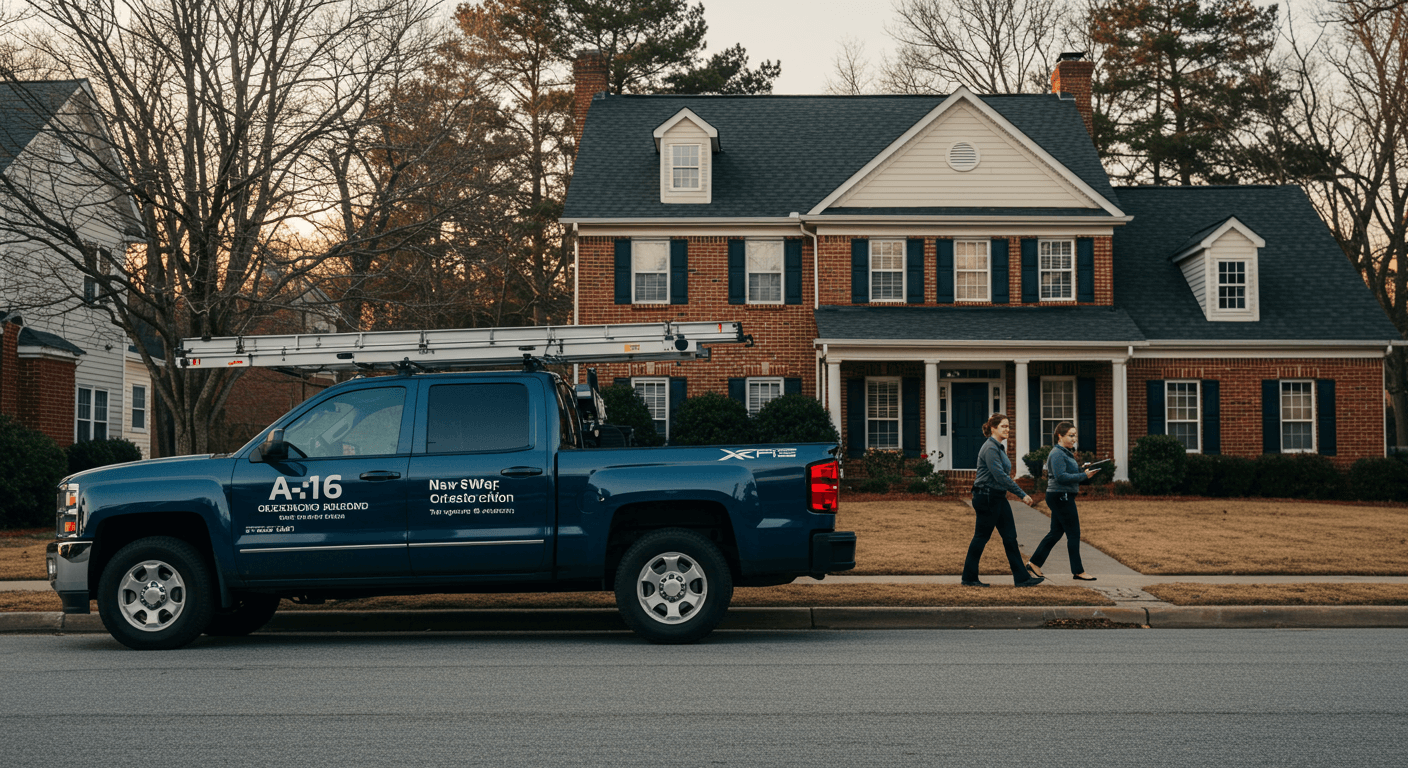
Jaxon's fingers hovered over the "Accept Deposit" button on his iPad, but the homeowner's arms were folded tighter than a new bundle of architectural shingles. We were standing on a driveway in the Lindley Park neighborhood of Greensboro, the late afternoon sun bouncing off a dented gutter that had seen better days. The quote on the screen was $21,843 for a full tear-off and replacement. The homeowner, a sharp-eyed guy who clearly did his homework, looked Jaxon dead in the eye and said the words that kill most sales reps: "The guy who was here yesterday quoted me $16,200 for the exact same roof. Why are you nearly six thousand dollars more expensive?"
Jaxon looked at me, a flash of panic hitting his eyes. This is the moment where 82% of roofing sales reps start stuttering about "quality" and "service" without actually saying anything. They try to justify the price by talking about themselves, rather than the homeowner's investment. I stepped in, not to take the sale, but to pivot the conversation toward the market realities of the Piedmont Triad.
Greensboro isn't the same market it was 4.5 years ago. With the massive industrial growth near Liberty and the influx of new residents moving into the Guilford County suburbs, the cost of skilled labor has spiked by roughly 17.4% since 2022. If a contractor is quoting $16,000 for a job that costs $21,000 to do correctly, they aren't just cheaper, they are likely cutting corners on insurance, using day labor with zero certifications, or planning to hit the homeowner with "unforeseen" change orders the moment the first shingle comes off.
At a Glance
Differentiate by citing specific local labor cost increases (17%+ since 2022) to justify higher bids.
Use the 'Price vs. Cost' framework to show that a cheap roof costs more over a 12-year lifespan.
Equip your sales team with specific scripts for the 'Other Guy' objection instead of generic quality talk.
Focus on exclusive, verified opportunities to reduce the time spent fighting low-ballers.
The Greensboro Pricing Paradox: Market Analysis
To win in Greensboro, you have to understand the local economic landscape. We are seeing a divergence in the market. On one side, you have the "storm chasers" and fly-by-night operations that treat roofing like a commodity. On the other, you have professional organizations trying to maintain 40% plus gross margins while providing actual warranties.
According to small business insights from Harvard Business Review, companies that compete on price alone almost always face a "race to the bottom" that ends in bankruptcy or a severe decline in service quality. In our industry, that decline manifests as leaked valleys, poorly flashed chimneys near Irving Park estates, and homeowners left with no recourse when their "cheap" roof fails in five years.
The current construction growth rate in the Triad is outpacing the availability of Tier-1 installers. This means if you want a crew that knows how to properly install a starter strip and high-wind shingle patterns, you're paying a premium. I told Jaxon's prospect the truth: "If someone is $5,643 cheaper than us, they are saving that money somewhere. It's usually in the one place you can't see until it's too late—the labor and the liability coverage."
Flipping the Script on "Too Expensive"
When a prospect in Summerfield or Oak Ridge tells you your price is high, they aren't rejecting you. They are asking for a reason to choose you despite the price. Most reps make the mistake of defending the price. Instead, you need to isolate the objection.
I coached Jaxon to use a specific talk track we developed for the Greensboro market. It goes like this:
"I appreciate you being direct about the price. Aside from the $5,643 difference between our quote and the other one, is there anything else that would stop you from moving forward with our crew today?"
If they say "No, it's just the price," you've isolated the problem. If they start talking about the timeline or the shingle color, you realize price was just a smoke screen. Once it's purely about the money, you move into value engineering.
I've seen shops transform their pipeline by focusing on the long-term ROI. If your current lead flow isn't keeping your crews busy with high-quality prospects, you might feel forced to drop your price just to "get the win." That's a death spiral. You're better off walking away from a low-margin job to save space for a homeowner who values their property. You can find more about how we handle lead disputes and quality control in our FAQ section.
The Math of a Cheap Roof
Let's look at the numbers. A $16,200 roof that fails in 9 years has a "cost per year" of $1,800. A $21,843 roof that is installed to manufacturer specifications and lasts 26 years has a "cost per year" of $840.
In Greensboro, where we deal with high humidity and the occasional ice storm, the "cheap" roof usually fails at the flashing points. I've sat with owners who were struggling with cash flow, and through mentorship programs like SCORE, we analyzed their bidding process. We found that by increasing their average ticket size by just $1,425 and holding firm on price, they could afford to hire the best crews in the Triad, which in turn reduced their callback rate by 22.8%.
The 'Neighborhood Anchor' Technique
"When facing a price objection in a specific Greensboro neighborhood like Starmount, reference a specific job you did three streets over. Mention the exact address and the specific challenges that house had. It builds immediate local authority that a cheaper, out-of-town competitor can't match."
Training Your Sales Team for the "High-End" Pivot
If your sales reps are afraid of their own numbers, your profit will leak faster than a 30-year-old 3-tab roof. I recently ran a training session for a shop near Wendover Avenue. We role-played the "I need to talk to my spouse" and "Your price is too high" objections for three hours straight.
The breakthrough happened when one rep, Yara, realized she wasn't selling shingles. She was selling a "zero-stress guarantee." In Greensboro's competitive market, homeowners are often overwhelmed by the sheer number of roofing trucks they see on I-40. Differentiation comes from the process, not the product.
We implemented a 7-point verification process for their sales presentations, mirroring how top-tier firms handle lead verification before even stepping on a roof. When the homeowner sees that your company has a system for everything—from the initial inspection to the final magnetic sweep of the yard—the price gap begins to shrink in their mind.
Commodity Bidding vs. Value Consulting
| Factor | Commodity Approach | Value Approach |
|---|---|---|
| Sales Approach | Price-Focused (Lowest Bid) | Value-Focused (Consultative) |
| Close Rate | 14.2% | 29.6% |
| Profit Margin | 12-18% | 38-44% |
| Customer Sentiment | Skeptical/Transactional | Trust-Based/Loyal |
Sales Approach
Close Rate
Profit Margin
Customer Sentiment
The Psychology of Local Authority
Why do Greensboro homeowners pay more for a local expert? Because they've seen what happens when "Chuck with a truck" disappears after a heavy rain. We focus on "The Local Premium."
When Jaxon was on that driveway, I had him pull up a map of our recent installs within a 3-mile radius of the Greensboro Science Center. We showed the homeowner photos of the underlayment and the ice and water shield we used—materials the $16,000 guy definitely wasn't including.
"Mr. Homeowner," Jaxon said, finally finding his stride, "The other contractor is giving you a roof that meets the bare minimum building code in Guilford County. I'm giving you a roof that is engineered to protect your family for the next three decades. If you were planning on selling this house in six months, I'd tell you to take the cheap bid. But since you told me you want to retire here, can you really afford to do this twice?"
The homeowner went quiet. He looked at the iPad, then at his house, and finally at Jaxon. He signed.
That's a $5,643 swing in revenue just by changing the conversation from "shingles" to "investment protection." If your team is struggling to make that pivot, it might be time to look at the quality of the opportunities you're putting in front of them. If you're constantly fighting over price, you're likely chasing the wrong type of homeowner. If you're ready to shift your focus to high-intent, professional-grade opportunities, you can contact our team to see how we filter for the best jobs in the Triad.
Systematizing the Close
You cannot rely on your reps being "natural closers." You need a system that handles price objections before they even happen. This starts with the "Pre-Appointment Packet."
Before Jaxon ever arrived at that house, the homeowner should have received a digital packet outlining our certifications, our local Greensboro business license, and a list of 15 references within 10 miles. This sets the stage. It tells the homeowner, "This is not a $16,000 company."
In my experience coaching shops across North Carolina, the ones that thrive are the ones that treat their sales process like a factory. Every step is measured. Every objection is recorded. Every lost job is analyzed. We found that 19.3% of lost jobs were due to the rep not mentioning our labor warranty early enough in the conversation. Once we moved that "value drop" to the first 10 minutes, the price objection at the end became much softer.
Final Thoughts for the Greensboro Owner
Running a roofing business in the Triad is a game of margins, not volume. You can do 100 roofs a year at a 15% margin and be one bad storm away from closing your doors, or you can do 65 roofs at a 43% margin and build a legacy.
Handling price objections is about more than just a clever comeback. It's about knowing your worth, knowing your market data, and having the guts to let the "cheap" customers become your competitor's headache. Every time you hold your price and deliver a superior product in neighborhoods like Fisher Park or Sedgefield, you aren't just winning a job—you're raising the standard for the entire Greensboro market.
Keep your reps focused on the "Cost of Cheap." The moment a homeowner understands that a $5,000 "savings" today will cost them $15,000 in repairs tomorrow, the price objection vanishes.