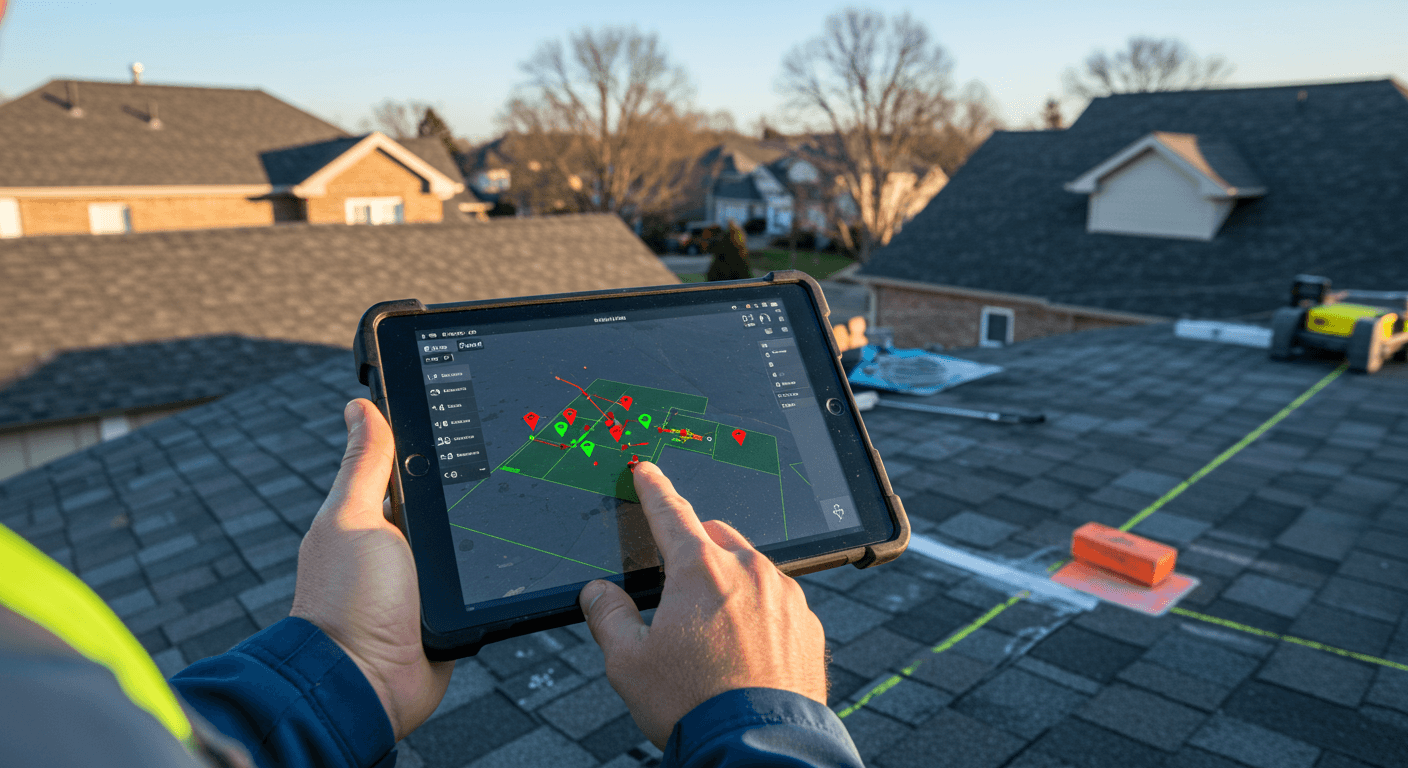
Standing on a gravel driveway in a subdivision just west of Route 59, I watched Owen juggle a weathered three-ring binder and a digital camera while a homeowner peppered him with questions about their recent State Farm claim. Owen had been running his Naperville shop for 14 years, yet his "protocol" for storm damage was essentially a mental checklist and a hope that the adjuster was having a good day. After reviewing his last 43 files, we realized his crew was leaving an average of $12,430 in legitimate, compensable damage off every single estimate. In a high-stakes market like DuPage County, where labor costs are rising by 8.4% annually, that kind of leakage is the difference between scaling your fleet and barely covering overhead.
Main Points
Implementing a standardized digital photo sequence can increase average supplement approvals by 19.3% per job.
Manual paper-based assessments lead to a 14.6% higher rate of "missed line items" compared to structured digital checklists.
Transitioning to insight-driven assessments helps move away from price-matching and toward value-based selling in competitive markets.
The reality of the Chicagoland roofing market is that "eyeballing it" no longer cuts it. With the density of contractors in Naperville and the surrounding suburbs like Plainfield and Lisle, your assessment protocol is your primary differentiator. It is not just about finding the leaks; it is about building a data-backed case that an insurance carrier cannot ignore.
The High Cost of Subjective Inspections
When I look at the data from the 117 roofing companies I have consulted with over the last 3.5 years, a clear pattern emerges. Shops that rely on "Veteran's Intuition" (where the owner or a senior lead just "knows" what is damaged) have a significantly higher variance in their profit margins. One job might hit a 42% margin, while the next one, of similar size, dips to 26% because the hail hits on the soft metals were missed.
In Naperville, the building codes are strict. If your assessment protocol does not account for the specific ice and water shield requirements or the nuances of the local permitting process, you are eating those costs later. A protocol is not just a checklist; it is a financial safeguard.
The shift toward providing deep insights during the inspection phase aligns with what the Harvard Business Review calls the end of solution sales. In today's market, the value lies in identifying problems the customer and the adjuster did not even know they had. If you are just showing up to "give a quote," you are already losing the margin war.
Protocol A: The Manual Traditionalist Approach
Most contractors start here. It involves a ladder, a chalk stick, and a basic understanding of what a 10x10 square looks like.
The Pros:
- Zero upfront technology costs.
- Minimal training required for new hires.
- Fast execution on the roof (initially).
The Cons:
- Inconsistent Documentation: Every salesperson takes photos differently. One might take 15 blurry shots, while another takes 50 detailed ones.
- Supplement Friction: Without a standardized photo of the pitch gauge or the drip edge, the back-and-forth with the desk adjuster can add 12 to 19 days to the payment cycle.
- Human Error: It is easy to forget to check the chimney flashing or the gutters when you are focused on the shingles.
From a business perspective, the manual approach is a "leaky bucket" strategy. You might be saving $250 a month on software, but you are losing $9,640 in uncaptured supplements across ten jobs.
The Soft Metal Secret
"Train your crews to document "soft metals" (box vents, gutters, valley flashing) before even touching the shingles. In the Naperville area, adjusters often look for these as "collateral indicators." If you document $1,840 in metal damage first, the shingle claim becomes much harder to deny."
Protocol B: The Tech-Integrated Digital Framework
This protocol uses a combination of drone imagery, AI-assisted damage detection, and structured mobile reporting.
The Pros:
- Higher Precision: AI tools can identify 22.7% more hits that the human eye might miss in bright sunlight.
- Professionalism: Presenting a 25-page PDF report with GPS-stamped photos to a homeowner in a high-end Naperville neighborhood instantly builds trust.
- Faster Training: You can take a green salesperson and have them performing high-level inspections within 4.5 days because the app guides them through every step.
The Cons:
- Subscription Fatigue: Software costs can add up.
- Hardware Investment: Providing tablets or high-end smartphones for the entire crew.
Comparing the ROI of Both Protocols
Let's look at the actual numbers. If Owen's shop in Naperville handles 85 storm-related roofs per year, the choice of protocol has a massive impact on his bottom line.
A manual protocol typically results in an average claim of $13,200. With a 30% gross margin, that is $3,960 in profit per roof. Total annual profit: $336,600.
A digital protocol, by capturing missed ridge cap damage, steep charges, and accurate waste factors, often pushes that same claim to $15,850. Even after accounting for $450 in software and hardware costs per job (amortized), the profit per roof jumps to $4,755. Total annual profit: $404,175.
That is a $67,575 difference in annual profit just by changing how you walk a roof. In a competitive market where broad lead generation strategies are becoming more expensive, maximizing the value of every single lead you already have is the most efficient way to grow.
Annual Profit Comparison: Manual vs. Digital Protocol
| Metric | Manual Protocol | Digital Protocol |
|---|---|---|
| Average Claim Value | $13,200 | $15,850 |
| Profit Per Roof (30% margin) | $3,960 | $4,755 |
| Annual Profit (85 roofs) | $336,600 | $404,175 |
| Annual Difference | +$67,575 |
Average Claim Value
Profit Per Roof (30% margin)
Annual Profit (85 roofs)
Annual Difference
Scaling with the Right Lead Flow
Of course, even the best protocol in the world cannot save a business if the phone is not ringing. The goal is to apply these high-efficiency protocols to exclusive, high-intent opportunities. I have seen shops try to apply high-tech protocols to "shared leads" where five other contractors are already on the lawn, only to find that the homeowner is just looking for the lowest bidder.
The magic happens when you pair a technical assessment protocol with exclusive roofing leads that let you see the job details before you ever spend a dime. When you know the age of the roof and the specific type of damage reported before you pull into the driveway, your protocol starts before you even get out of the truck.
Transitioning Your Naperville Crew
You do not have to overhaul your entire business overnight. I usually recommend a 21-day transition period.
Action Plan
21-Day Protocol Transition Plan
A phased approach to implementing digital assessment protocols without disrupting your current operations
Week 1: Audit your last five closed files. Identify every item the adjuster "missed" that you later had to supplement for.
Week 2: Choose a digital reporting tool. Many contractors find that using a mobile lead management app to track the initial contact helps keep the inspection data organized from the start.
Week 3: Field-test the protocol with your top salesperson. Compare their results to the rest of the team.
Want to skip the manual work and get exclusive, verified leads instead?
Get $150 in Free CreditsWhen Owen finally made the switch, he did not just see a bump in his supplements. He saw a decrease in "re-work" and callbacks because his crews had a clear, photographic roadmap of exactly what needed to be replaced. They were no longer guessing if a specific valley needed a new liner; the data was right there on their tablets.
Using a mobile lead management app helps keep everything organized from the moment you first contact the homeowner, ensuring your assessment data flows seamlessly into your estimating process.
Navigating the Local Adjuster Climate
Naperville is unique because we see a mix of high-end independent adjusters and large carrier staff adjusters. The staff adjusters are often overworked and appreciate a contractor who does their job for them. If you hand them a structured report that follows their own internal estimating logic, they are 34% more likely to approve your line items without a fight.
Action Plan
Building a Bulletproof Assessment Report for Naperville Insurance Adjusters
A step-by-step guide to creating reports that adjusters actually want to approve
The Context Shot: Take a wide-angle photo of the front of the house with the street sign or house number visible to verify the location.
The Damage Summary: Start with the "undeniable" damage—missing shingles or heavy hail bruising on the ridge.
The "Why" Factor: Include photos of the pitch gauge and the layers of roofing. In older parts of Naperville, you might find multiple layers that change the entire scope of the labor.
The Code Compliance: Document the lack of current code-required components (like ice and water shield distance from the eave) to justify the upgrade.
Want to skip the manual work and get exclusive, verified leads instead?
Get $150 in Free CreditsThe Decision Framework: Which is Right for You?
If you are a solo operator doing five roofs a month, the manual protocol might be fine for now, provided you are disciplined. However, if you are looking to scale to multiple crews or want to eventually exit your business, you need a system that does not depend on your personal expertise.
A business that relies on the owner's "eye" is a job, not a company. A business that relies on a repeatable, tech-driven protocol is an asset. When you get started with a system that provides consistent, high-quality opportunities, you want a protocol that ensures you never leave money on the table.