Main Points
Focus on Labor Acquisition Cost (LAC) to understand the true impact of turnover on project margins.
Challenge the "wage is king" myth by emphasizing equipment quality and lead consistency to attract top-tier talent.
Use localized referral loops and technical training to build a self-sustaining talent pipeline in the Lowcountry.
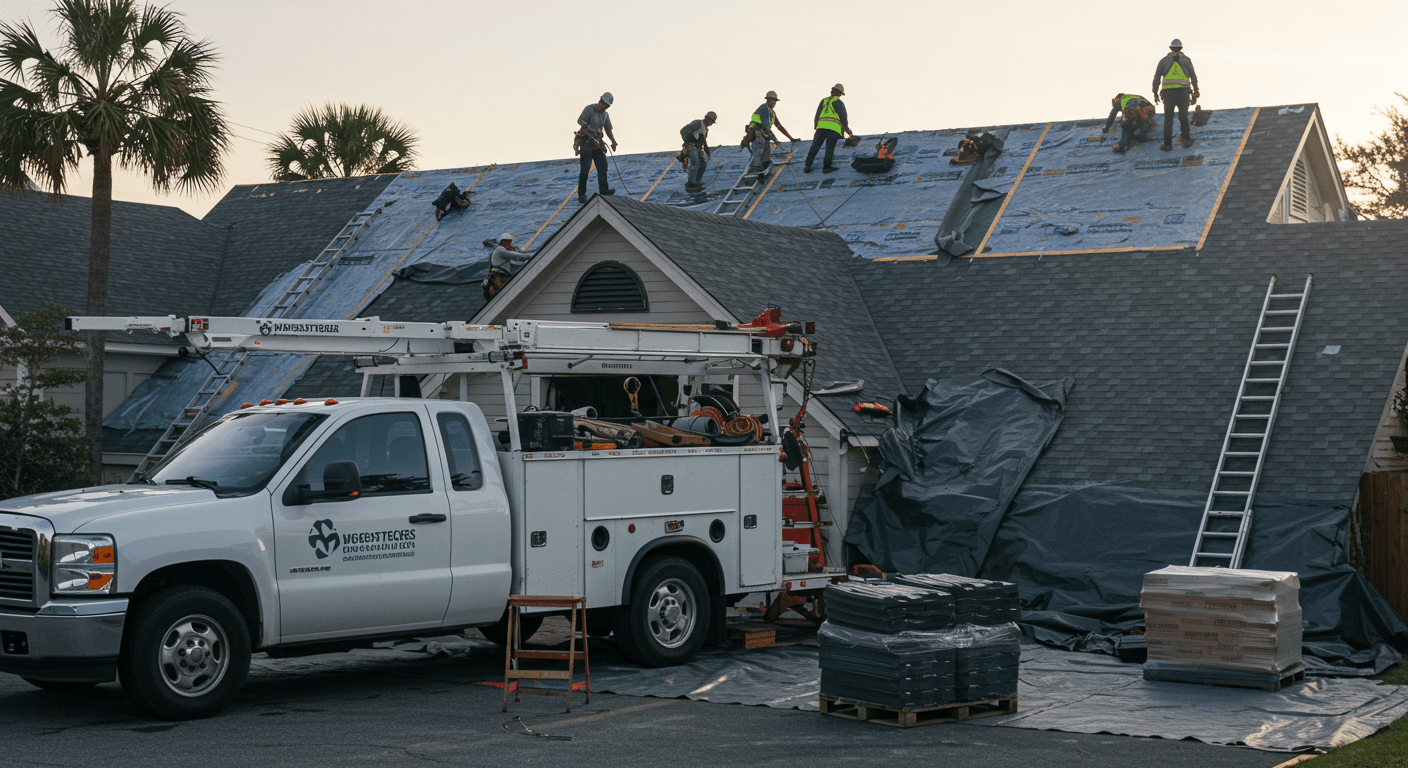
Xavier slammed the tailgate of his F-150 when the third text notification buzzed, another "can't make it" from a lead installer he had just onboarded for the Daniel Island project. It was 6:42 AM, and the humidity in West Ashley was already thick enough to wear. He had spent $3,485 on Indeed and ZipRecruiter over the last six weeks, yet his staging area was half-empty. The problem was not a lack of applicants; it was a fundamental breakdown in his Labor Acquisition Cost (LAC) strategy.
Most roofing business owners in the Charleston metro area treat recruiting like a desperate reaction to a fire rather than a calculated marketing funnel. When a crew walks off to join a competitor for an extra dollar an hour, the immediate instinct is to outbid the market. This reactive cycle is why turnover in the South Carolina roofing sector often hovers around 28.4%, significantly higher than other specialty trades in the region.
I have spent years analyzing the metrics behind scaling home service businesses, and the data is clear. Recruiting is not about HR; it is about conversion rate optimization. If you are struggling to keep trucks on the road from Summerville to Mount Pleasant, your "myth-based" hiring process is likely burning through your profit margins before the first shingle is even stripped.
- Focus on Labor Acquisition Cost (LAC) to understand the true impact of turnover on project margins.
- Challenge the "wage is king" myth by emphasizing equipment quality and lead consistency to attract top-tier talent.
- Use localized referral loops and technical training to build a self-sustaining talent pipeline in the Lowcountry.
- Leverage tech-literacy as a primary screening metric to ensure crews can handle modern project management and lead verification systems.
The Mathematical Reality of the Charleston Labor Shortage
The labor market for skilled trades in the Lowcountry is tighter than a starter course of architectural shingles. According to the BLS Occupational Outlook Handbook, the industry is eyeing a 6% growth rate through 2034, which sounds manageable until you factor in the specific localized competition. In Charleston, you are not just competing with other roofers; you are competing with the massive industrial expansion in North Charleston and the high-demand custom home builds in Kiawah.
When Xavier and I sat down to look at his numbers, we found his cost to replace a single skilled installer was $5,182. This included ad spend, the time he spent interviewing (which took him away from sales), and the "ramp-up" period where the new hire operated at 64% efficiency. For a small shop running three crews, losing just four people a year represents a $20,728 leak in the bottom line.
To fix this, we have to stop believing the common industry myths that keep contractors in a state of perpetual hiring panic.
Myth #1: The Highest Hourly Wage Always Wins
The most persistent lie in the Charleston roofing market is that crews only care about the hourly rate. While pay must be competitive, I have seen contractors paying $34 an hour lose guys to shops paying $31. Why? Because the $31 shop had better organization, newer equipment, and a consistent flow of high-quality jobs.
Top-tier roofers are tired of "dead time." If they show up at a job site in Goose Creek and the materials are not there, or the lead details were wrong, they are losing money. Skilled installers want to move. They want to know that when they pull up, the job is ready, the scope is clear, and the paycheck is guaranteed because the company has a steady pipeline of exclusive, verified leads that do not fall through at the last minute.
In my experience, providing a crew with a high-functioning environment—think moisture-wicking uniforms for the SC heat, top-of-the-line pneumatic tools, and clear digital project briefs—creates more loyalty than a $1.50 raise ever will.
Myth #2: Experience is the Only Metric That Matters
We all want the guy who has been on a roof for 22 years. But in today's market, "experience" can sometimes be a mask for "unwilling to adapt." I have watched Charleston firms struggle because their "experienced" foremen refused to use photo-documentation apps or digital measurement tools, leading to estimating errors that cost the company 12.7% in material waste.
The BLS guide on becoming a roofer emphasizes on-the-job training and apprenticeships for a reason. Often, the best move for a scaling business is to hire for "climb-ability" and tech-literacy, then train for skill. A younger worker who understands how to preview job details and navigate verification steps can often be more valuable to your long-term ROI than a veteran who refuses to change his 1994 workflow.
Building a "Charleston-Proof" Referral Engine
If you are relying solely on digital job boards, you are fighting for the leftovers. The most elite crews in the Lowcountry operate through word-of-mouth networks. Xavier realized that his best hires always came from his current top performers.
We implemented a tiered referral system. If an installer brought in a new hire who stayed for 90 days, the referring employee got a $450 bonus. If that new hire made it to 180 days, another $650 was paid out. This turned his existing crew into a vetting machine. They were not going to refer someone who was lazy because it would make their own job harder on a hot July afternoon in Summerville.
This strategy shifted his focus from "finding bodies" to "cultivating a culture." When your crew feels like they are part of an elite team, they become your best recruiters.
The Retention-Recruitment Loop
You cannot recruit your way out of a retention problem. If your "bucket" is leaking, pouring more water in just wastes resources. I recommend auditing your "First 100 Days" experience. In Charleston's climate, the first two weeks are where you lose most people. The physical toll of a 98-degree day with 90% humidity is real.
I have seen companies reduce their 30-day turnover by 19.3% simply by implementing "Heat Safety Protocols" that include mandatory hydration breaks and providing chilled electrolyte drinks on-site. It sounds like a small detail, but to a skilled roofer who has worked for shops that treat them like machines, it is a massive differentiator.
When you treat your labor as a capital asset rather than a variable expense, your recruitment needs naturally diminish. You stop looking for "anyone with a hammer" and start looking for "the right fit for the fleet."
- 1Phase 1: Digital Onboarding (Days 1-7) - Train new hires on your lead verification and documentation systems. Ensure they understand how to read project previews to minimize site errors.
- 2Phase 2: The Mentorship Shadow (Days 8-30) - Pair the new hire with a 'Veteran Advocate' who earns a small incentive for the new hire's success. Focus on Charleston-specific challenges like high-wind zone requirements.
- 3Phase 3: The Efficiency Audit (Days 31-60) - Review the new hire's performance metrics. Are they maintaining your target margin? Provide tactical feedback based on real job data.
- 4Phase 4: Retention Conversion (Days 61-90) - Formal check-in to discuss long-term career pathing. At this stage, the hire should be fully integrated into your referral network.
Why Consistency of Work is the Ultimate Recruiting Tool
The final piece of the puzzle is the stability of your lead pipeline. Skilled roofers want to work. They have bills in North Charleston and rent in West Ashley. If your sales team is not closing, or if your lead source is inconsistent, your best guys will look for a shop that can keep them busy 40+ hours a week.
This is where the synergy between marketing and recruitment becomes undeniable. By using a platform that allows you to see the details of a job before you buy the lead, you can ensure your crews are always assigned to high-probability, high-margin projects. This consistency eliminates the "seasonal lulls" that often drive skilled labor toward more stable industries.
- How much should I spend on roofing recruitment ads in Charleston? I recommend budgeting 2.5% to 4% of your projected quarterly revenue for labor acquisition if you are in a high-growth phase. In a maintenance phase, this can drop to 1.2%.
- What is the most effective platform for finding roofers in South Carolina? While Facebook Groups for local trades can be useful, the most consistent results come from localized referral programs and maintaining a visible presence at local supply houses like ABC Supply or Suncoast.
- How do I handle a competitor poaching my crew? Conduct an immediate exit interview. Often, the move is about more than just money—it is about a perceived lack of growth or frustration with internal bottlenecks like poor scheduling or bad lead quality.
- Should I hire sub-crews or W2 employees for a scaling business? In the Charleston market, a hybrid model often works best. Keep a core W2 crew for high-complexity custom builds and use vetted sub-crews for high-volume residential replacements to maintain flexibility.
The path to a stable, profitable roofing business in the Lowcountry is paved with data, not just shingles. When you stop chasing the myths and start measuring your Labor Acquisition Cost with the same rigor you measure your lead costs, you will find that the "labor shortage" is a problem you can solve with the right systems in place.
- /blog/maximizing-roofing-profit-margins-charleston
- /blog/the-data-driven-roofer-scaling-in-sc
- /blog/retention-strategies-for-high-growth-contractors