Main Points
Focus your marketing spend on specific zip code clusters to reduce travel time by at least 19%.
Navigate the Savannah Metropolitan Planning Commission (MPC) requirements by specializing in historic-grade materials.
Transition from shared, low-intent leads to exclusive regional opportunities to protect your closing ratios.
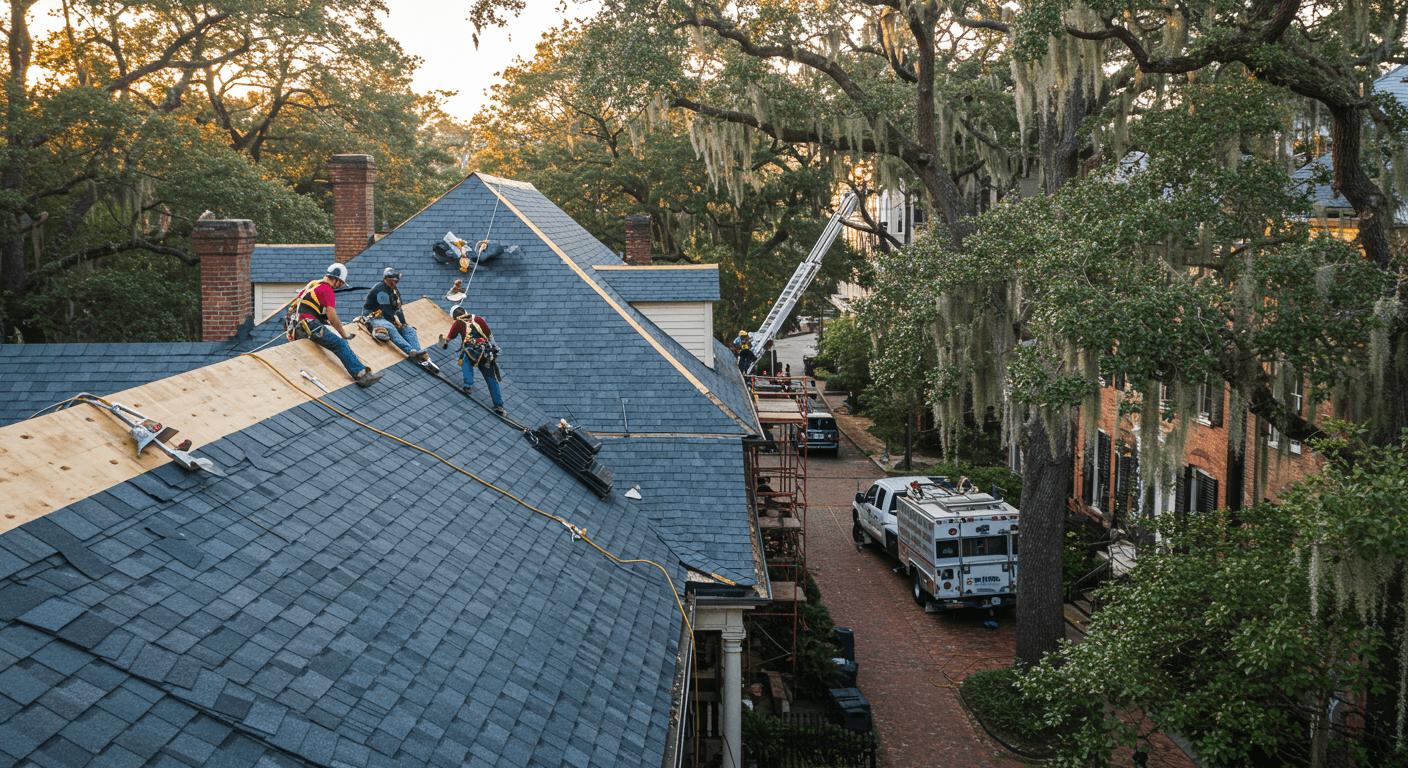
Jaxon pointed at the digital heat map on his tablet, where the pins for his last 38 jobs were clustered tightly around the fast-growing subdivisions in Pooler, yet the 31401 zip code—Savannah’s high-margin historic district—remained a total ghost town. We were standing on a renovation site near Forsyth Park, the humid Georgia air already thick at 8:15 AM, watching his crew struggle with the logistical nightmare of a steep-slope slate repair on a 130-year-old Victorian.
"Every time we send a truck down these narrow one-way streets, I lose three hours of production just to parking and permitting," Jaxon told me, wiping sweat from his forehead. He wasn't failing because he lacked leads. He was failing because his leads were scattered across the entire Coastal Empire, forcing his teams to bounce from Richmond Hill to Wilmington Island in a single afternoon. This fragmentation was eating 14.6% of his net profit in windshield time and fuel alone.
If you’re running a roofing shop in the Savannah metro area, you know the market is currently split between the industrial boom near the Port of Savannah and the meticulous preservation requirements of the downtown core. Trying to dominate both simultaneously without a hyper-local tactical plan is a recipe for a bloated overhead and a burnt-out sales team.
- Focus your marketing spend on specific zip code clusters to reduce travel time by at least 19%.
- Navigate the Savannah Metropolitan Planning Commission (MPC) requirements by specializing in historic-grade materials.
- Transition from shared, low-intent leads to exclusive regional opportunities to protect your closing ratios.
- Use regional industrial growth near the Hyundai Metaplant to bridge the gap between residential storm cycles.
The Geography of Margin: Why Proximity Equals Profit
I recently audited a roofing company that spent $11,432 a month on broad-spectrum digital ads covering everything from Hilton Head to Hinesville. Their cost per lead looked decent on paper, hovering around $54. However, when we looked at the cost per acquisition (CPA), the number skyrocketed to $842. The reason was simple: their sales reps were spending 4.5 hours a day in traffic on I-16 and I-95.
In a market like Savannah, regional domination isn't about being everywhere. It’s about being "the guy" in a five-mile radius. When you cluster your jobs, your yard signs become a force multiplier. If a homeowner in Ardsley Park sees your truck at three different houses on their morning walk, your brand authority is established before you even knock on the door.
This strategy also simplifies your supply chain. If you’re working six jobs in the Landings, you can coordinate material drops with a single local distributor, often negotiating better delivery windows because you're providing a high-volume stop for their drivers. It sounds like a small win, but over a 12-month period, these efficiencies can add $22,814 to your bottom line just by reducing "gofer" runs for missing flashing or ridge caps.
Mastering the Savannah Historic District Permit Gauntlet
For many contractors, the 31401 and 31404 zip codes are "no-go" zones because of the paperwork. The Savannah Metropolitan Planning Commission has strict guidelines on everything from shingle color to the specific gauge of copper used in valleys. However, for the shop that masters this, the competition vanishes.
While your competitors are fighting over $9,500 asphalt shingle swaps in Georgetown, you could be closing $34,700 historic restorations. The key is to treat the permit process as a sales tool, not a hurdle. Show the homeowner the specific National Roofing Contractors Association (NRCA) standards you follow for historic preservation.
I’ve seen shops fix their pipeline issues by becoming the "permitted specialist" that other contractors refer out when they realize a job is too complex for their basic crews. This requires a different level of training for your estimators. They need to be as comfortable talking about R-value and moisture barriers as they are about architectural aesthetics.
The Shift to Exclusive High-Intent Leads
The biggest mistake I see Savannah owners make is buying the same leads that five other guys in Effingham County are chasing. By the time you call the homeowner, they’ve already had three "free inspections" and are looking for the lowest bidder. This race to the bottom is how shops go out of business during a dry spell.
Instead, look for platforms that offer exclusive access. When you can lock a territory, you aren't just buying a name and a phone number; you're buying the right to be the only professional voice in that homeowner's ear. This is especially critical when dealing with the luxury market in Palmetto Bluff or Sea Island, where high-net-worth clients value discretion and speed over a $500 discount.
- Weeks 1-2: Audit your last 12 months of jobs to identify the top 3 highest-margin zip codes.
- Weeks 3-4: Reallocate 65% of your ad spend to those specific clusters using geo-fencing.
- Weeks 5-8: Implement a 'Neighbor-to-Neighbor' referral program with a $250 incentive for existing clients in the target zone.
- Weeks 9-12: Hire a dedicated permit runner to handle MPC and city hall filings to keep your lead sales reps in the field.
Logistics, Safety, and the Coastal Climate
Working in the Lowcountry presents unique physical risks. The extreme humidity isn't just a comfort issue; it's a safety and quality control issue. Roof surfaces in Savannah can reach 155 degrees by noon in July, increasing the risk of heat exhaustion and material scuffing.
According to a recent Bureau of Labor Statistics (BLS) report, roofing contractors had 110 fatal falls in 2023, the highest in the construction industry. When your crews are rushing to finish a job before a 3:00 PM thunderstorm hits—a daily occurrence in a Georgia summer—the risk of a slip or a mistake increases exponentially.
By narrowing your service area, you allow your foremen more time to set up proper fall protection systems rather than rushing the setup to make up for time lost in traffic. A safer crew is a more efficient crew. I once watched a shop in Garden City lose an entire week of production because a lead installer took a non-fatal tumble, resulting in an OSHA inspection that ground everything to a halt. The cost of that accident was $12,482 in fines and lost revenue.
Leveraging the Port and Industrial Expansion
The massive investment in the Port of Savannah and the nearby Hyundai Metaplant is creating a secondary boom for roofing contractors: light commercial and industrial support buildings. Many residential shops overlook these 5,000 to 15,000 square foot metal roof opportunities.
If your residential lead flow is seasonal, these industrial leads can provide the stability your cash flow needs. I worked with a contractor named Theo who shifted just 18% of his focus toward the port-adjacent warehouses. Within 11 months, his average ticket size jumped from $11,300 to $19,450. He wasn't doing more work; he was doing more profitable work by following the local economic trend.
When you're ready to scale, you need a system that filters for these types of high-value opportunities. Our platform capabilities allow you to see the details of a lead before you commit, ensuring your crews aren't wasting time on jobs that don't fit your new regional focus.
Building a Moat Around Your Savannah Territory
Ultimately, regional domination is about building a "moat" of reputation and efficiency that no out-of-town "storm chaser" can cross. When you know the specific inspectors at the City of Savannah building department by their first names, and you know which neighborhoods have brittle 20-year-old 3-tab shingles ready for replacement, you have an unfair advantage.
I remember talking to a shop owner near Hunter Army Airfield who was frustrated with his $9,000 monthly lead bill. We looked at his data and realized he was closing 42% of leads within 4 miles of his office, but only 9% of leads that required a drive over the Talmadge Bridge. By cutting the bridge-crossing leads entirely and doubling down on his local radius, he actually increased his net profit while spending $3,200 less on marketing.
This is the "Ethan Brooks" approach: stop obsessing over lead volume and start obsessing over lead density. If your crews are spending more time on a roof and less time on the Truman Parkway, you’re winning.
- How do I choose which Savannah neighborhood to target first? Look for areas with a high concentration of homes built between 15 and 22 years ago. Neighborhoods like Georgetown or parts of Wilmington Island are currently in a "replacement window" where the original builder-grade shingles are reaching end-of-life.
- Is the Savannah historic district worth the headache? Yes, if you charge for it. Add a "Historic Compliance Fee" of 8-12% to your estimates to cover the additional administrative time and specialized labor required for these projects.
- What is the best way to handle the 3:00 PM summer rain? Schedule your tear-offs for 7:00 AM and ensure the roof is dried in by 1:30 PM. In Savannah, you aren't just fighting the clock; you're fighting the dew point.
- How can I compete with the big national franchises moving into Georgia? Your advantage is local knowledge. A franchise rep from out of state won't know the specific drainage issues common in Lowcountry architecture. Use that expertise to build trust that a "big box" roofer can't match.