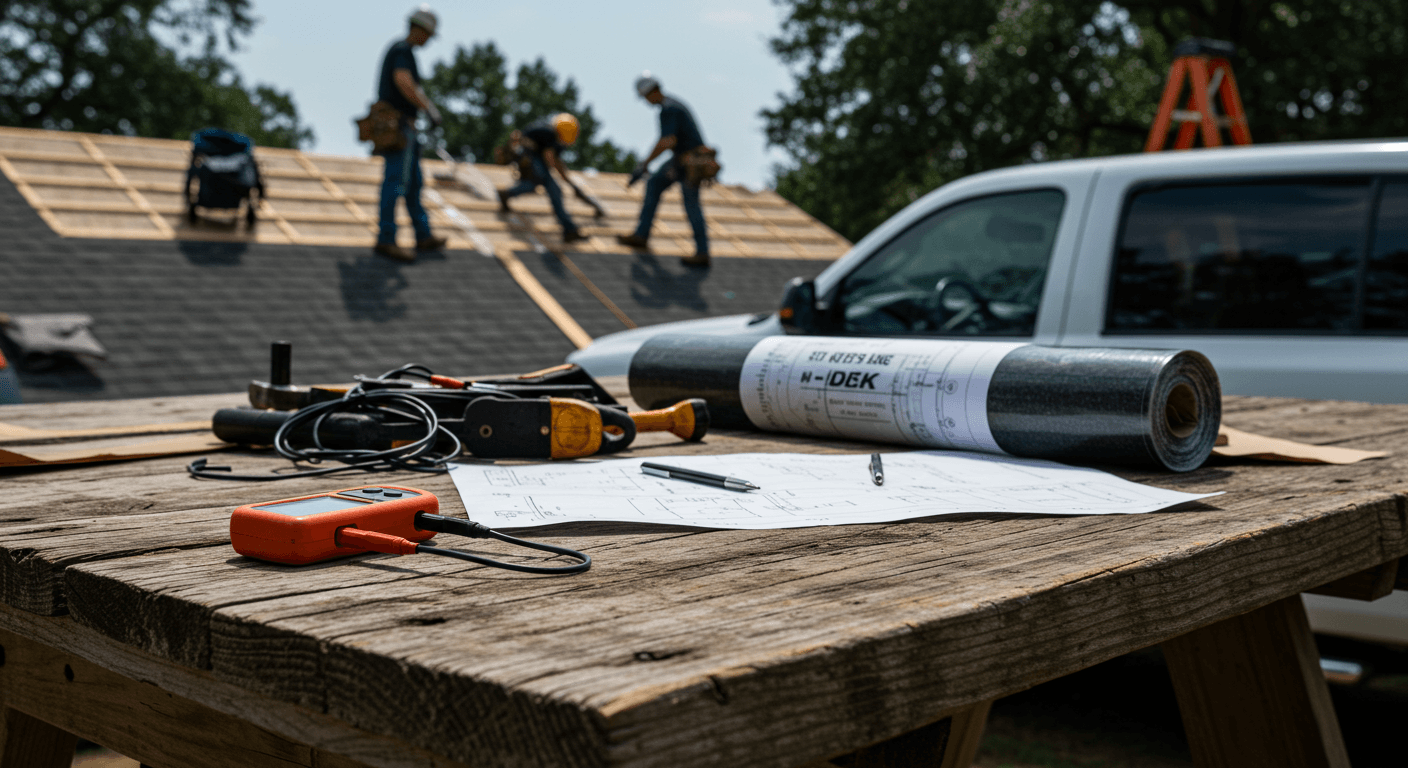
Your quality control program is likely a glorified checklist that does more to annoy your crews than it does to protect your bottom line. I recently stood on a driveway near Spring Hill watching a contractor, Jaxon, vent about his "QC guy" costing him $942 a week just to take pictures of shingles after the crew had already packed up. He thought he was doing the right thing by having a dedicated inspector, but he was missing the point entirely. Real quality control happens in the workflow, not in the rearview mirror. In the humid, fast-paced Mobile market, waiting until the end of the day to find a flashing error isn't a process. It is an expensive hobby.
When we look at the operations of high-growth roofing firms, the myth that "more inspections equals better quality" is consistently debunked by the data. I have seen shops in Midtown and Saraland burn through 14.6% of their net profit on callbacks that could have been caught in the first ninety minutes of the job. Quality isn't a department. It is a systematic reduction of variance. If you are sending a manager to "check" a roof after the crew has left, you aren't managing quality. You are managing failure.
At a Glance
Post-job inspections are "autopsies" that identify problems too late to save labor costs.
Integrating QC into the first 22% of the workday reduces major rework by 41.3% on average.
Mobile's specific humidity and rain patterns require unique mid-day moisture checks to prevent long-term decking failures.
True profitability comes from reducing the "Cycle of Correction" where crews return to the same site twice.
The Financial Black Hole of the "Checklist Mentality"
Most owners I talk to in Mobile County believe that a long checklist makes a good roof. It doesn't. A checklist is a passive document. I worked with a firm last year that had a 42-point inspection list. Their callback rate was still hovering around 11.4%. Why? Because the crew viewed the checklist as the inspector's job, not theirs. This creates a psychological hand-off where the installers stop being responsible for the outcome.
Let's look at the actual math of a callback in the Alabama market. If a crew has to return to a site in West Mobile to fix a small leak around a chimney, you aren't just losing the two hours of labor. You are losing the fuel, the truck wear, and the opportunity cost of a $12,400 new install that didn't start that morning. When I calculated this for Jaxon's shop, we found that a single "minor" callback cost him $847.22 in total enterprise value.
The "Inspector" Trap
Hiring a dedicated QC inspector often backfires by signaling to your crews that they are no longer responsible for catching their own mistakes. This creates a "someone else will find it" culture that increases defect rates by as much as 18.7%.
Shifting to In-Process Verification
The solution isn't more people watching the work. It is changing when the watching happens. I advocate for a "Critical Point Inspection" system. This means your lead installer or project manager must verify the most vulnerable 15% of the roof before the shingles even start going down. In Mobile, this usually means the valley liners, the drip edge transition, and the ice and water shield application.
If those are wrong, nothing that happens in the afternoon matters. I've helped companies rebuild their operational workflows based on these exact frustrations. The founders of LeadZik started the platform because they were tired of the "shared lead" chaos that led to rushed, low-quality work. They realized that when you have exclusive, verified leads, you have the breathing room to actually execute a quality process.
According to a study by the Harvard Business Review: The End of Solution Sales, the most successful organizations are moving away from reactive fixes and toward insight-driven prevention. In roofing, that insight is knowing exactly where your crew usually fails and putting a hard stop in the schedule to check that specific point.
Mobile's Environmental QC Challenges
We can't talk about quality in South Alabama without talking about the 89% humidity mornings and the 2:00 PM thunderstorms. A quality process that works in Arizona will fail here. I've seen crews in Prichard try to dry-in a roof while the decking was still holding 19% moisture from the morning dew. That is a recipe for buckled shingles and a phone call from an angry homeowner three months later.
Your QC process must include a "Go/No-Go" moisture reading at 8:30 AM. It takes forty seconds. If the moisture is too high, the crew pivots to site prep or gutter cleaning until the sun does its job. Forcing a roof down on wet plywood is a deliberate choice to lose money later. You also need to ensure your team is strictly following OSHA: Roofing Safety protocols, not just for compliance, but because a safe crew is a methodical crew. When people are rushing and cutting corners on tie-offs, they are cutting corners on the flashing, too.
Mobile-area roofing companies lose significant profit margins to preventable callbacks when quality control happens too late in the process.
Action Plan
How to implement a "Stop-Gate" Quality System in 30 days without hiring new staff
A systematic approach to moving quality control from post-job inspection to in-process verification, reducing callbacks and protecting margins.
Identify the Top 3 Profit Killers: Analyze your last 24 months of callbacks. Is it always the chimney? Is it the valleys? Identify the specific technical failure that repeats.
Implement the "Flash-Point" Photo Rule: Before any shingles cover the valleys or flashing, the lead must upload a photo to your CRM.
The 10:00 AM Pivot: Schedule a 5-minute call between the office and the field lead to verify that the "critical points" are cleared before the crew proceeds to high-speed installation.
Link QC to Incentives: Pay a small "Performance Retention" bonus (e.g., $115 per job) that is only released if no callbacks occur within the first 6.5 months.
Want to skip the manual work and get exclusive, verified leads instead?
Get $150 in Free CreditsThe ROI of Verifiable Excellence
When you move to a systematic QC model, your sales team gets a massive upgrade. Imagine a salesperson sitting in a living room in Daphne and being able to show the homeowner a live feed of the moisture readings and the triple-checked valley liners from a job down the street. It shifts the conversation from price to proof.
This level of transparency is exactly why we focus on exclusive, verified job opportunities for our partners. When your pipeline is filled with leads that haven't been shopped to six other guys, you don't have to cut corners to win the bid. You can price in the time it takes to do a 10:00 AM moisture check.
I worked with a woman named Brielle who ran a small crew in Theodore. She was terrified that stopping for "process checks" would slow her down. We ran a time study over 14 days. We found that while her "speed" decreased by about 7%, her "completion accuracy" improved so much that she gained back 11 hours of crew time per month that used to be spent on punch-list items. That is nearly a full day of production she bought back by moving slightly slower during the critical phases.
Pro Tip
"Track your callback costs for 30 days. Most Mobile contractors are shocked to discover that a single callback costs $800+ when you factor in lost production time, fuel, and opportunity cost. That number makes the case for preventive QC checks."
Quality as a Scalability Tool
If you want to grow from three crews to ten, you cannot be the one inspecting every roof. You need a system that enforces itself. This is where platform features like real-time lead scoring and territory locking come into play for your marketing, and where systematic photo-documentation comes into play for your production.
You need to be able to look at a dashboard and see that 98% of your critical point photos were uploaded on time. If a crew lead isn't uploading the valley photos, they aren't just "forgetting paperwork." They are exposing your company to a $1,200 liability. In a business where net margins often sit between 12% and 18%, you cannot afford to be casual about variance.
The Bottom Line
Stop looking at quality control as an expense you have to manage. It is the most effective profit-retention tool in your arsenal. By moving your "checkpoints" to the beginning of the day and focusing on the 15% of the roof that causes 85% of the leaks, you'll find that your crews are more productive, your customers are happier, and your bank account is significantly heavier.