Paper contracts are a liability that your roofing business can no longer afford to carry. If you are still relying on "wet ink" signatures or clunky, non-integrated PDFs to close deals in the Valley, you are voluntarily handing your market share to more agile competitors.
I was at a mid-sized shop near Sky Harbor last month, watching a foreman named Elias scramble. He was digging through a cluttered glove box for a physical change order while monsoon clouds were visibly stacking up over the Superstition Mountains. The homeowner was at work in North Scottsdale, and Elias couldn't move forward without a signature. By the time he tracked the client down and got the paper signed, the storm hit. That crew sat idle for four hours, costing the company approximately $642 in wasted labor and overhead for just that one afternoon.
This isn't just a "convenience" issue. It is a fundamental drain on your net profit. In an environment like Phoenix, where the heat dictates tight morning windows and monsoon season creates scheduling chaos, administrative friction is the silent killer of your margins.
At a Glance
Speed to Lead: Digital contracts allow you to move from a verified lead to a signed project in under 12 minutes.
Change Order Agility: Eliminate crew downtime by getting instant digital approvals on-site for unforeseen deck rot or flashing issues.
Legal & Financial Security: Digital trails provide ironclad evidence for insurance adjusters and Maricopa County permitting offices.
Cash Flow Acceleration: Reduce the 'contract-to-deposit' gap by an average of 3.4 days, putting capital back into your accounts faster.
The Hidden "Paper Tax" on Phoenix Roofers
When I audit roofing operations, I look for "friction points." A friction point is anything that stops a crew from laying shingles. Paper contracts are a massive friction point. If your sales rep has to drive from a job site in Mesa back to a home in Glendale just to get a forgotten signature, you aren't just losing gas money. You are losing the opportunity to bid on the next project.
I've calculated that the average Phoenix contractor using traditional paper-based systems loses roughly $7,420 per month in "hidden administrative drag." This includes the cost of manual data entry, physical storage, and the inevitable 8.3% of contracts that contain errors requiring a second trip to the homeowner.
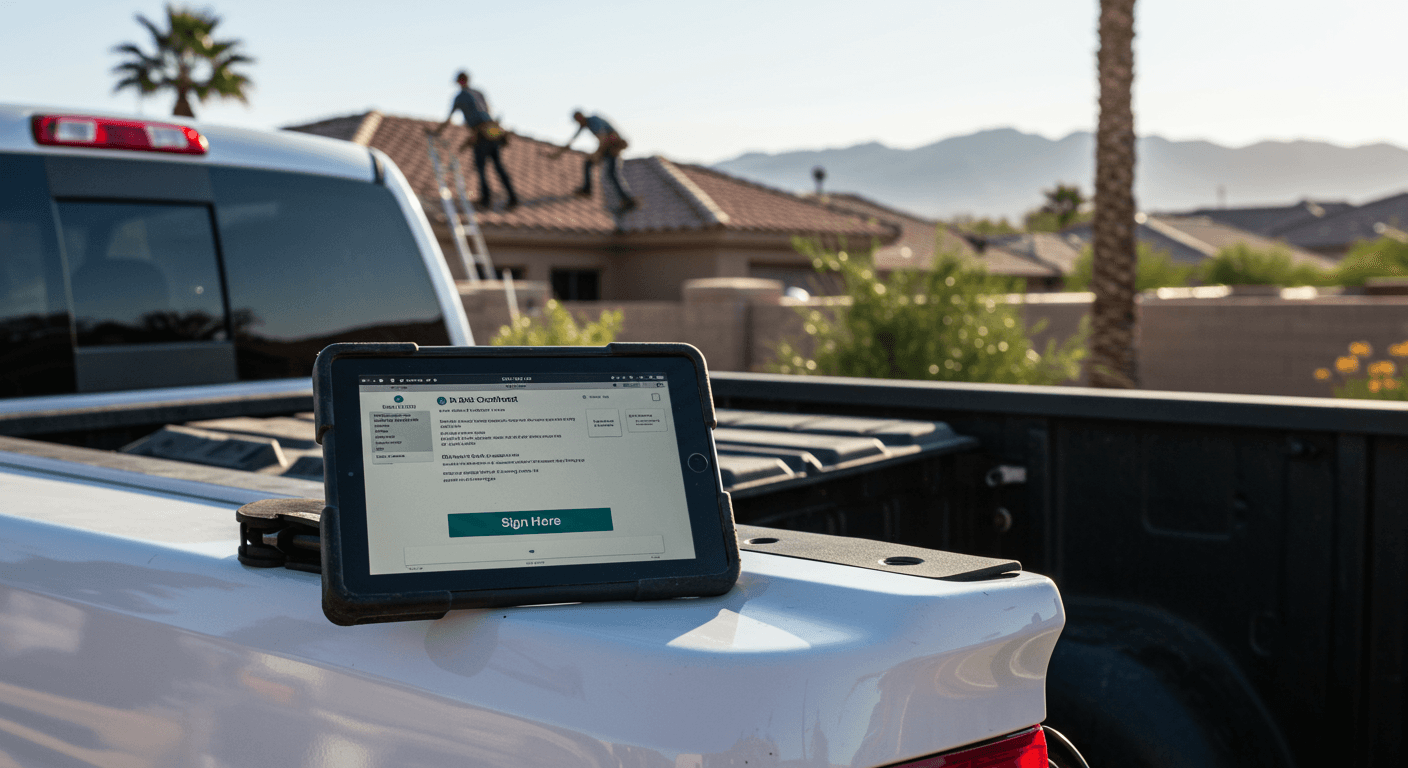
Digital contract systems eliminate administrative delays that prevent crews from starting work immediately.
Why PDFs Aren't Enough
Many owners tell me, "Mia, we use email. We're digital." Sending a PDF that a homeowner has to download, print, sign, scan, and email back is not a digital strategy—it's an obstacle course. According to research published by Harvard Business Review, small businesses that reduce "customer effort" in the transaction phase see significantly higher retention and referral rates.
In the roofing world, "effort" is asking a busy homeowner to find their printer's ink cartridge at 7:00 PM. True digital contract management happens on a mobile device, with a "tap-to-sign" interface that works as well on a roof deck as it does in a living room. When your field teams can manage opportunities on-the-go without returning to the office, you're not just saving time—you're closing deals that would otherwise slip away.
Paper vs. Digital Contract Management
| Factor | Paper/Static PDF | Integrated Digital Contracts |
|---|---|---|
| Data Entry | Manual entry required | Auto-populates from lead data |
| Storage | Physical storage needed | Cloud-based accessibility |
| Turnaround Time | 48-72 hour turnaround | Instant signing |
| Error Prevention | High risk of missing initials | Mandatory fields prevent errors |
Data Entry
Storage
Turnaround Time
Error Prevention
Managing Change Orders During Monsoon Season
We all know the scenario: the old shingles come off, and you find three sheets of delaminated plywood that weren't in the original bid. In Phoenix, you can't leave a roof open while you wait for a homeowner to get home from work.
I recently worked with a shop owner named Sloan who implemented a mobile-first signature system. Now, when her crews find dry rot, they snap a photo, attach it to a digital change order, and text it to the homeowner. I watched a project manager in Chandler handle four of these approvals from his truck using a mobile-first management interface before lunch. The crews never stopped working. They saved an estimated 14.2 man-hours that week alone simply by removing the "signature chase."
Pro Tip
"Store your digital contracts in a cloud folder synced by project address. When applying for permits in the City of Phoenix or Scottsdale, you can instantly attach the signed agreement to the online portal, shaving hours off your administrative lead time."
The ROI Calculation: Is the Tech Worth It?
Let's look at the numbers for a shop running three crews. If you reduce your sales cycle by just 2.4 days and eliminate one "re-visit" per week for missing signatures, the math is staggering:
- Labor Savings: 5 hours/week of sales rep time @ $45/hr = $225
- Fuel/Vehicle Savings: 60 miles/week @ $0.67/mile = $40.20
- Interest/Cash Flow: Getting a $12,840 deposit 3 days sooner (calculated at 8% cost of capital) = $8.44
- Close Rate Boost: Catching just one extra job per month because you signed them before the "other guy" left the driveway = $3,650 (avg. net profit)
Total monthly gain: $3,923.64
This doesn't even account for the reduction in legal risk. Digital contracts include timestamps, IP addresses, and audit trails that protect you if a homeowner tries to claim they didn't authorize a specific repair.
The 'Signature Gap' Trap
Never allow a crew to begin work on an oral 'okay.' In Maricopa County, disputes over unauthorized work can lead to heavy fines and mechanics lien complications. If it isn't digitally signed and timestamped, it didn't happen.
Implementation: Moving Your Shop to the Cloud
You don't need to overhaul your entire business in a weekend. Start with your highest-volume service—likely Reroofs or Storm Repair.
According to the National Roofing Contractors Association (NRCA), contractors who digitize their core processes see measurable improvements in both operational efficiency and customer satisfaction. The key is starting with one workflow and expanding from there.
Action Plan
4-Step Digital Migration
A practical roadmap for transitioning from paper contracts to a streamlined digital system.
Audit Your Current Forms: Take your existing paper contract and highlight mandatory fields. These will become 'required' in your digital tool to prevent incomplete filings.
Select a Mobile-First Tool: Choose a platform that works on tablets and phones. Field reps need to be able to manage opportunities on-the-go without returning to the office.
Train the Field Sales Team: Run a 'mock close.' Have your reps practice signing a contract on their phone while standing in the sun. If they can't do it in 60 seconds, the template is too complex.
Sync with Invoicing: Ensure your signed contract automatically triggers your initial deposit invoice. This removes the 'I'll send the bill when I get to the office' delay.
Final Operational Insights
Efficiency isn't about working harder; it's about removing the hurdles that prevent your crews from performing. When I see a Phoenix roofing company struggling to scale, it's rarely because they lack talent on the roof. It's because their "back office" is still living in 1998.
Digital contract management is the bridge between being a "guy with a truck" and a scalable roofing enterprise. By moving to a tap-to-sign system, you aren't just saving paper—you're buying back the time your team needs to dominate the Phoenix market. When you're ready to streamline your entire lead-to-close workflow, explore how modern roofing platforms integrate contract management with your lead generation and project tracking systems.