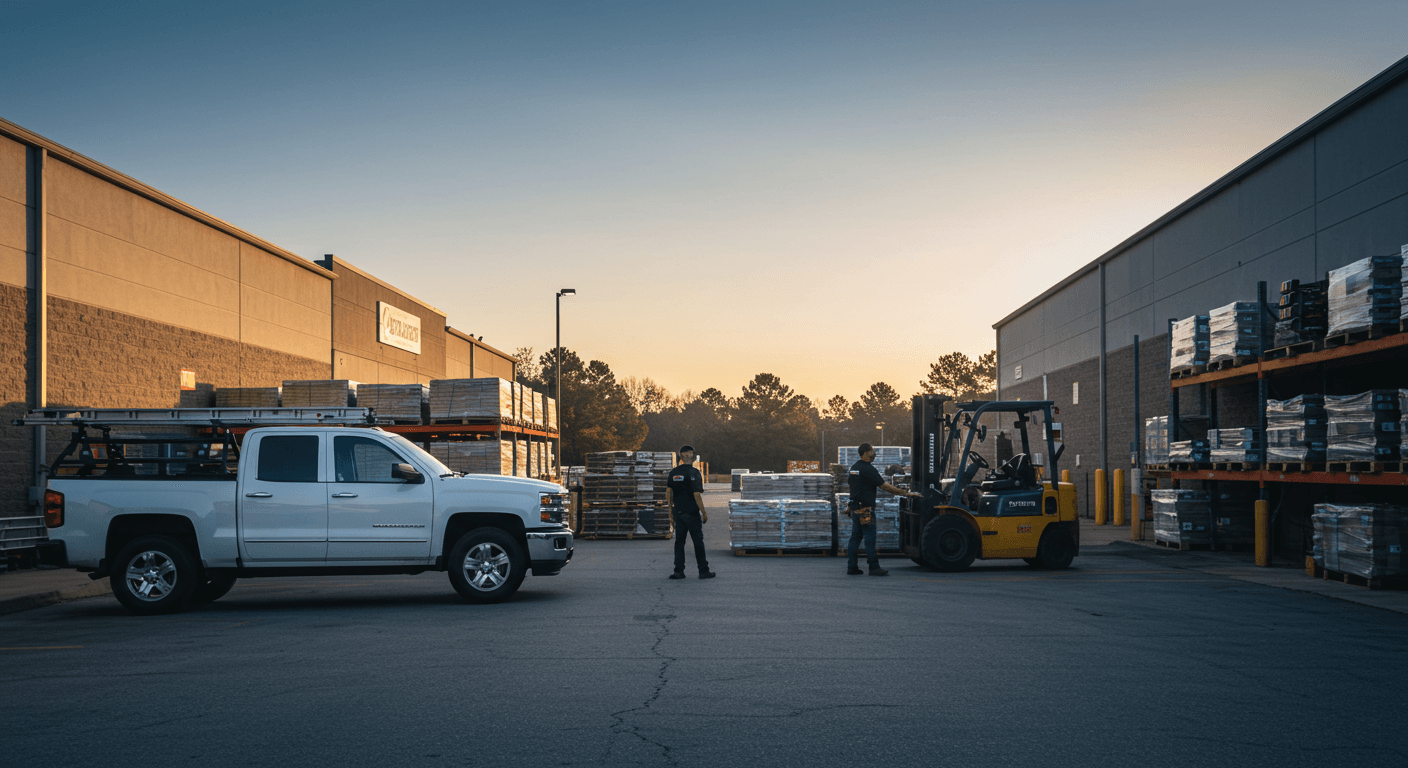
The clipboard skidded across the dusty hood of the white F-150 and clattered onto the asphalt. Sloan, a contractor I had been coaching for three months, didn't even reach for it. He was staring at a stack of invoices from a supplier on 10th Avenue in Columbus, his face a shade of pale that didn't match the humid Georgia afternoon. He had just hit $1.27M in top-line revenue for the year, yet his operating account was sitting at a measly $4,382.
"Noah, I am busier than I have ever been," he told me, gesturing toward the line of trucks waiting to fuel up. "We are pulling permits at the City of Columbus Building Department every single morning. We are winning jobs in Green Island Hills and Midland. Why does it feel like I am losing money every time we nail a shingle?"
Sloan had fallen into the $1M trap. It is a dangerous plateau where your business is too big to be a "guy in a truck" but too small to have the systems that protect your margins. Scaling to $10M is not about doing ten times more of what you are doing now. In fact, if Sloan kept doing what he was doing, he would be bankrupt by $3M. To move the needle in the Muscogee County market, we had to dismantle the myths he had been told about growth.
At a Glance
Transitioning from $1M to $10M requires shifting focus from 'lead volume' to 'contract velocity' and margin protection
Operational drag in Columbus, Georgia, usually stems from inefficient crew routing and permit delays
Building enterprise value means creating a sales system that functions independently of the owner's personal involvement
High-growth shops prioritize exclusive, verified opportunities over the 'shared lead' race to the bottom
The "More Leads" Fallacy in the Chattahoochee Valley
The most common advice Sloan heard from "gurus" was to buy more leads. He was already spending $6,450 a month on shared lead platforms where he was competing with six other contractors for the same roof in North Columbus. By the time his rep pulled into the driveway, the homeowner was already frustrated by five other phone calls.
According to the National Roofing Contractors Association (NRCA), the average roofing company loses roughly 14.2% of its potential revenue to operational friction and poor lead conversion. When you are at $1M, you can muscle through that friction. When you aim for $10M, that 14.2% becomes a multi-million dollar leak that sinks the ship.
Instead of more leads, Sloan needed better leads. We looked at his data and realized his close rate on shared leads was 11.4%, while his close rate on referrals and exclusive inquiries was 38.7%. The math was simple: he didn't need more noise, he needed a locked-down perimeter. When you're ready to scale, having access to verified, territory-locked opportunities eliminates the race-to-the-bottom competition that kills margins.
Sloan's close rate on referrals and exclusive inquiries versus just 11.4% on shared leads
Solving the Operational Drag of Muscogee County
Scaling requires a deep understanding of local logistics. In Columbus, the sprawl from Fort Moore up to Harris County can kill your profit margins in fuel and man-hours if your crews are bouncing around. Sloan had one crew finishing a repair near Lake Oliver while another was starting a tear-off in Phenix City.
We implemented a "Zone Dominance" strategy. Instead of taking every job that pinged his phone, we focused on high-density clusters. If we had a job in the 31909 zip code, his sales team was tasked with securing three more within a four-mile radius. This reduced their travel time by 22.6% over a six-month period.
Pro Tip
"In a market like Columbus, do not let your crews travel more than 20 minutes between job sites. If you are scaling to $10M, logistics are your biggest hidden cost. Route density is the difference between a 10% net profit and a 20% net profit."
The Sales Psychology of the $10M Shop
The biggest hurdle Sloan faced was himself. Like many owners, he was his best salesman. He could walk onto a porch in Wynnton and close a deal on a handshake because of his 16 years of experience. But Sloan cannot be on 50 porches a week.
To reach $10M, we had to build a "Sales Factory." This meant moving away from "I'll give you a quote" to a consultative, psychological approach. We started using a specific script for every initial call.
The Script Shift:
- Old Way: "Hey, this is Sloan, I'm calling about your roof estimate. When can I come by?"
- New Way: "Hi, I'm calling from Sloan's Roofing. We just finished a project for your neighbor on Hilton Avenue. I noticed your property might have the same wind lift issues we found there. I have a gap at 2:15 PM on Tuesday to do a visual assessment for your insurance records. Does that work, or is 4:45 PM better?"
This subtle shift moves the contractor from a "solicitor" to an "expert advisor." It also relies on verified data. If your sales reps are walking into appointments with pre-verified job details from our system, they aren't wasting time on tire-kickers. They are focusing on homeowners who are ready to sign.
Owner-Led Sales vs. Systemized Sales
| Factor | Owner-Led Sales (The $1M Ceiling) | Systemized Sales (The $10M Engine) |
|---|---|---|
| Lead Source | Shared leads and cold knocking | Exclusive, verified opportunities |
| Pricing | Race to the bottom to win | Value-based with 35%+ gross margins |
| Follow-up | Manual and 'when I have time' | Automated CRM triggers and 5-touch minimum |
| Documentation | Paper folders and scribbled notes | Digital job folders with real-time photo uploads |
Lead Source
Pricing
Follow-up
Documentation
Building Long-Term Enterprise Value
If you want to sell your roofing business one day, or even just take a vacation without your phone vibrating off the nightstand, you need enterprise value. A business that depends on the owner to find, sell, and manage every job is just a high-paying, high-stress job.
I told Sloan we needed to focus on "The Three Pillars of Scalability":
- Lead Predictability: Knowing exactly where your next 50 jobs are coming from.
- Labor Stability: Having a pipeline of 1099s or W2 crews who know your quality standards.
- Capital Efficiency: Not being the "bank" for your customers or insurance companies.
We looked at a report from a local business journal that noted residential construction in the Columbus-Phenix City metro area was projected to grow by 7.4% annually. To capture that, Sloan couldn't be bogged down in the minutiae. He needed a dashboard that showed him his customer acquisition cost (CAC) in real-time.
If your CAC is $450 and your average job size in Midland is $12,400, you have a winning formula. If you don't know those numbers, you are just gambling with shingles. I have seen shops transform their pipeline by switching to verified lead sources that eliminate the "junk" data that clogs up the sales funnel. According to the Small Business Administration, businesses that track key metrics like CAC see 30% higher growth rates than those that don't.
Action Plan
The $10M Roadmap
A tactical framework for scaling from $1M to $10M in the Columbus roofing market
Audit Your Margins: Identify which Columbus neighborhoods have the highest profit-per-hour. Stop servicing low-margin outliers.
Systemize the Sale: Create a 7-step sales process that a 22-year-old rookie can follow.
Lock Your Territory: Secure exclusive lead flows so you aren't fighting five other contractors for every Columbus roof.
Incentivize Production: Move your project managers to a 'performance-plus' model where they get a bonus for every job completed under budget.
Want to skip the manual work and get exclusive, verified leads instead?
Get $150 in Free CreditsCommon Pitfalls on the Road to $10M
Scaling is an exercise in saying "no." Sloan had a habit of taking on commercial repair work for small storefronts downtown just because he "needed the work." These jobs were killing his schedule. They required different insurance, different equipment, and his crews hated them.
The Volume Trap
Beware of 'Top-Line Vanity.' Adding $2M in revenue that only yields $50k in profit is a recipe for burnout. If a job doesn't hit your target gross margin (usually 30-40% depending on overhead), walk away. Growing a $10M business requires the discipline to stay in your lane.
We cut the commercial repairs and focused entirely on residential replacements in Muscogee and Harris County. Within four months, his net profit margin jumped by 9.7%. He was doing fewer jobs but keeping more money.
I recently sat down with another rep I'm training who was struggling to hit his numbers. He was frustrated because he felt like he was "bothering" people. We looked at his lead quality. He was chasing aged leads that had been sold to twelve other people. Once we shifted him to verified, territory-locked opportunities, his confidence soared. He wasn't a telemarketer anymore, he was a solution provider.
Common Questions
The path from $1M to $10M is paved with better data, not just more work. Six months after Sloan slammed his tailgate in frustration, he called me. He wasn't at the BBQ joint this time. He was in his new office off Bradley Park Drive. His revenue was up to $4.2M, but more importantly, his bank balance had five digits instead of four. He had stopped being a roofer and started being a business owner.