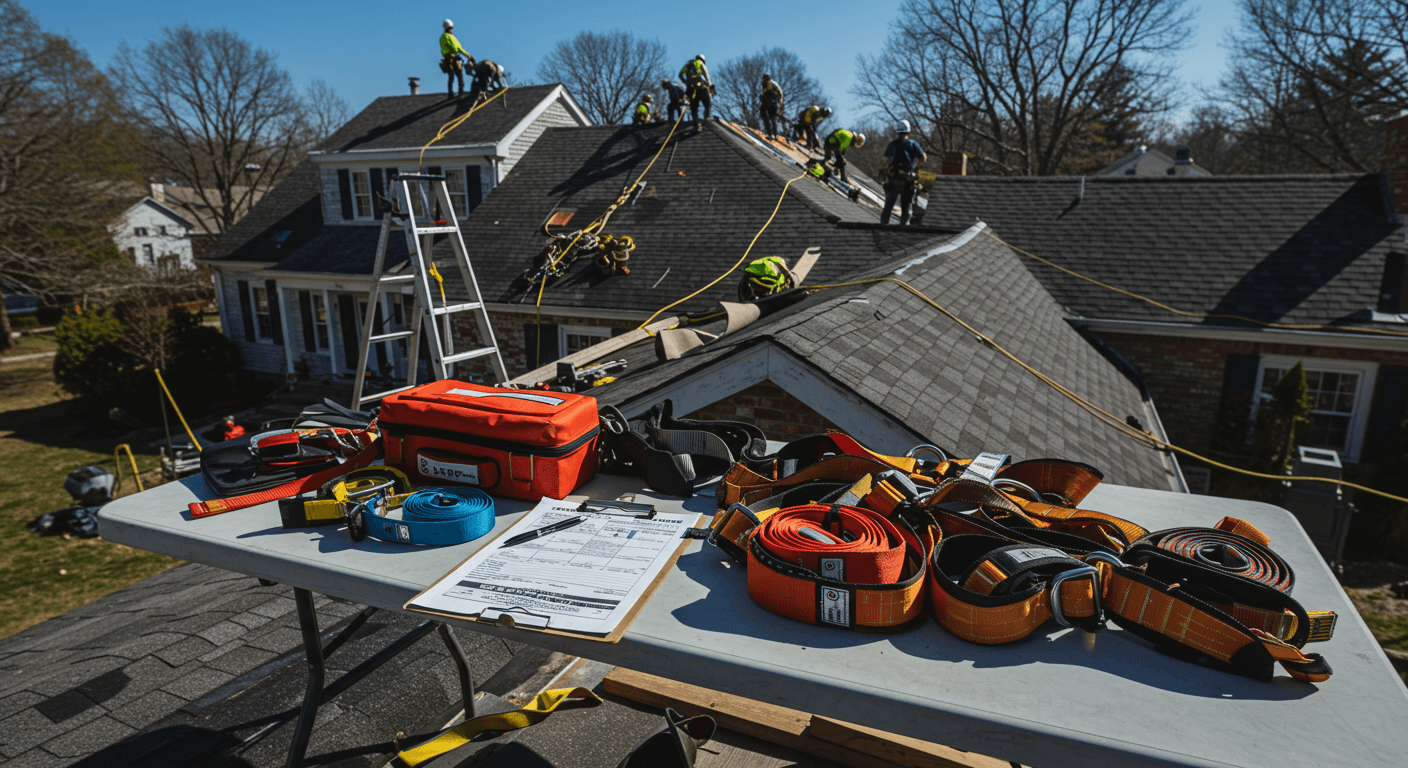
A shop owner I worked with near Stamford, let's call him Silas, recently showed me two different job cost reports from the same month. On the first project, a residential tear-off in Norwalk, a crew member stepped through a weakened deck because they skipped the pre-climb inspection. The resulting OSHA fine, stop-work delay, and subsequent insurance hike cost Silas exactly $28,412 over the next twelve months. On the second project, a similar steep-slope job in Greenwich, his team spent 45 minutes extra on setup and specialized fall arrest anchors. That project finished three hours early because the crew felt secure enough to move at full speed rather than hesitating at the gutter line. The contrast was stark: one job bled cash through "unforeseen" costs, while the other yielded a 14.3% higher net profit than estimated.
At a Glance
Why systematic safety reduces insurance premiums by an average of 18.4% in high-cost states like Connecticut.
The tactical 4-step framework for implementing a safety culture that crews actually follow.
How to use your safety record as a sales closing tool for high-end residential leads.
The specific math behind EMR (Experience Modification Rate) and its impact on your bottom line.
The Hidden Math of Connecticut Workers' Comp
In Connecticut, the cost of doing business is notoriously high, and workers' compensation insurance is often the heaviest anchor on a roofing company's P&L. Many owners treat their insurance premium as a fixed cost, like truck payments or rent. It isn't. Your Experience Modification Rate (EMR) is a variable that you can actively manipulate through operational discipline.
When I analyze a shop's efficiency, the first thing I look at is their EMR. A "1.0" is the industry average. If you've implemented a rigorous safety program, I've seen contractors drop to a 0.82. In a market like Hartford or Bridgeport, where payroll for a mid-sized crew can easily hit $450,000 a year, that 0.18 difference isn't just a number—it's roughly $12,600 back in your pocket every single year.
A single major fall incident can trigger a significant EMR spike, costing Connecticut contractors tens of thousands in increased premiums over multiple years.
According to the National Roofing Contractors Association (NRCA), safety training isn't just about avoiding the "big fall." It's about the micro-efficiencies. A crew that knows exactly where the debris drop zone is and has clear, documented pathways on a roof moves with a level of confidence that "winging it" shops can't match.
Building the "Connecticut Standard" Safety Workflow
Implementing a safety program isn't about handing out a 200-page manual that sits under a truck seat. It's about creating a sequence of actions that become as natural as swinging a hammer. I recently helped a New Haven-based contractor transition from "verbal warnings" to a digital-first documentation system.
We focused on the three highest-risk moments: the morning load-out, the initial roof access, and the end-of-day site securement. By standardizing these, he reduced his "near-miss" incidents by 34% in the first six months.
The 5-Gallon Rule
"In CT, OSHA inspectors are increasingly looking at heat stress and hydration. Require your foremen to photo-document a dedicated water station and shade area on every job site over 85 degrees to avoid 'easy' citations."
Step 1: The Pre-Job Hazard Assessment (PJHA)
Before a single bundle of shingles is hoisted, the lead tech must complete a PJHA. In Connecticut's varied architecture—from historic West Hartford homes to modern commercial builds in Danbury—the hazards change daily.
- Identify overhead power lines (especially in tight residential lots).
- Check for soft spots in the decking from the attic side if possible.
- Locate the optimal anchor points.
Step 2: The Equipment ROI Check
If your guys are fighting with tangled, 6-year-old lanyards, they won't use them. I tell owners to look at equipment as a retention tool. Buying high-quality, breathable Class A harnesses might cost you $2,400 more upfront for a 10-man crew, but the reduction in fatigue means they are laying 1.5 more squares per day in the July heat.
Action Plan
The 4-Week Safety Rollout
A systematic timeline to transition your crew from 'loose' operations to a documented safety culture without losing momentum.
Week 1: Inventory audit. Replace any frayed ropes or damaged ladders immediately. No exceptions.
Week 2: The 'Why' Meeting. Show the crew the EMR math. Explain how safety leads to year-end bonuses.
Week 3: Morning Huddle Implementation. Foremen lead a 5-minute safety focus every single day.
Week 4: Documentation Audit. Review PJHAs weekly and reward the crew with the most consistent reporting.
Turning Safety Into a Sales Advantage
In affluent Connecticut markets like Fairfield County, homeowners are hyper-aware of liability. If a sub-contractor falls on their property and the prime contractor isn't properly insured or following OSHA guidelines, the homeowner feels the heat.
I've coached sales teams to use their safety program as a "value-add" in their pitch. Instead of just talking about shingle quality, show the prospect your safety certification and your EMR score. Explain that your crews are trained to protect not just themselves, but the homeowner's property and peace of mind. When you are bidding against a "trunk slammer" who doesn't use harnesses, this becomes your most powerful closing tool.
Often, the ability to focus on these high-level operational improvements comes down to lead quality. If you're constantly chasing low-margin "tire kickers," you don't have the mental bandwidth to fix your safety culture. Using a platform to preview verified leads before you buy allows you to cherry-pick the jobs where safety and quality are valued, giving you the margin to do things right.
Safety Approach Comparison
| Factor | Safety as a 'Tax' | Safety as a 'Profit Center' |
|---|---|---|
| Response to Incidents | Reactive to accidents | Proactive hazard assessment |
| Insurance Costs | High insurance premiums | Minimized EMR (0.85 or lower) |
| Crew Retention | High crew turnover | Crews feel valued and stay longer |
| Sales Positioning | OSHA fine anxiety | Sales tool for premium clients |
Response to Incidents
Insurance Costs
Crew Retention
Sales Positioning
Documentation: The Legal Shield
In Connecticut, the Department of Labor doesn't play around. If an inspector rolls up to your site in Middletown and sees a guy unhooked, your verbal excuse of "he was just doing a quick repair" won't save you a $5,000 fine.
Documentation is your only defense. If you can show a signed PJHA for that morning and a training log showing that the employee was trained on fall protection three weeks ago, you move from "willful violation" to "unpreventable employee misconduct." That distinction can save you tens of thousands of dollars.
If you're looking for more ways to tighten your operations, start by auditing your last three months of "indirect costs." You'll likely find that a lack of systematic safety is costing you more than your marketing budget.
Understanding OSHA roofing safety requirements is essential, but Connecticut contractors should exceed these federal standards given the state's rigorous enforcement and high-cost environment.
Conclusion: The Operational Pivot
Safety is not a checkbox; it is a discipline. In the Connecticut market, where the margin for error is razor-thin due to high overhead, the contractors who treat safety as a core operational process are the ones who scale. Stop looking at harnesses as an expense and start looking at them as the equipment that protects your most valuable asset: your crew's ability to show up and produce tomorrow.
When you build a culture where safety documentation is as routine as clocking in, you're not just avoiding fines—you're building a competitive moat that lower-tier contractors can't replicate. For companies ready to invest in systematic operations, exploring how structured processes improve outcomes can help you apply the same discipline across all areas of your business.