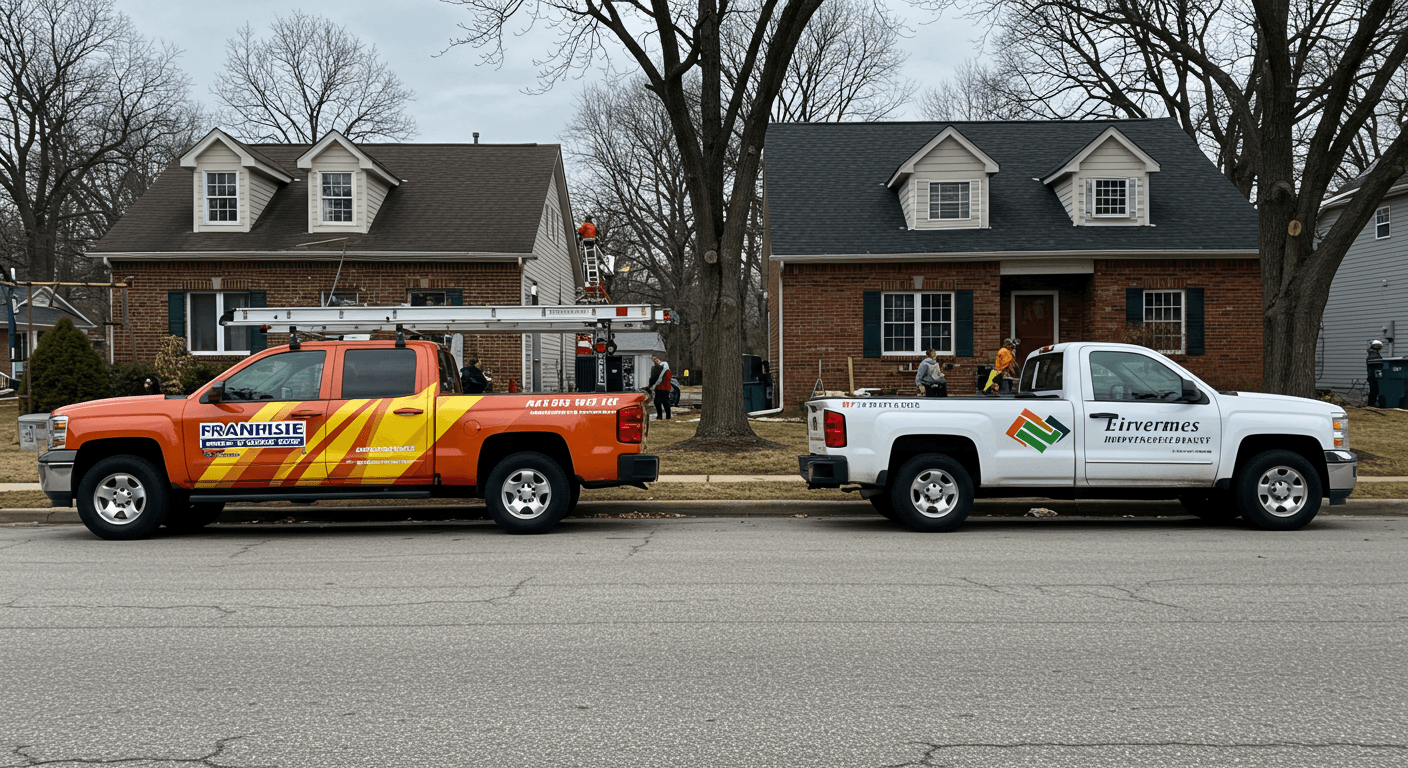
Last October, I sat down with two owners in an Arlington Heights coffee shop who were at polar opposite ends of the growth spectrum. Arlo had spent 11.4 years building a localized brand from his garage, reaching a respectable $2.17M in annual revenue, yet he felt like he was constantly reinventing the wheel. Across the table, Elena was just finishing her second year with a national roofing franchise, already hitting $3.42M in volume but frustrated by the $280,400 she'd paid out in royalties and marketing fees that year. Arlo had the freedom to pivot his services during a slow season, while Elena was bound by a rigid corporate playbook that didn't always account for the specific labor nuances of the Chicagoland market.
The contrast between these two paths isn't just about a logo on a truck. It is a fundamental choice about how you want to spend your days and what kind of asset you want to own in the next 6.5 years. In Illinois, where the licensing requirements through the Illinois Department of Financial and Professional Regulation (IDFPR) add a layer of complexity to every new location, the decision to scale via franchise or independent growth determines your ceiling and your stress levels.
At a Glance
Franchise models offer rapid systemization but demand 6.4% to 8.2% of top-line revenue in ongoing royalties.
Independent shops retain 100% of equity and brand control but face higher costs for initial process development and tech stacks.
Illinois regulatory compliance (IDFPR) is often easier to manage with a franchise's pre-built legal and safety frameworks.
Exit multiples vary significantly, with franchises often trading on brand recognition and independent shops trading on local market dominance.
The Financial Reality of the Franchise "Fast Track"
Buying a franchise is essentially buying a shortcut. For many Illinois contractors who are great at the trade but struggle with the "business of the business," the appeal is obvious. You get a tech stack, a brand that people might recognize, and a set of operational manuals that tell you exactly how to handle a crew in Peoria versus a crew in Naperville.
However, that shortcut comes with a persistent toll. Most roofing franchises require an initial investment between $147,000 and $295,000, followed by monthly royalties. When I looked at Elena's books, we found that after paying her 7.5% royalty and the 2% national brand fund fee, her net profit margin was squeezed down to 11.2%. She was doing more volume than Arlo, but her take-home pay wasn't significantly higher because she was essentially "renting" her business systems.
Independent roofing contractors typically retain higher margins by avoiding franchise royalty fees.
The Independent Struggle: Building the Machine from Scratch
Arlo's path was different. He didn't have a corporate office sending him leads or a pre-negotiated discount with material suppliers. Every time he wanted to implement a new CRM or update his safety protocols to meet Occupational Safety and Health Administration (OSHA) standards, he had to do the research himself.
The "Independent Tax" is paid in time and trial-and-error. Arlo spent roughly $14,600 on a marketing consultant who ultimately failed to deliver, a mistake a franchise likely would have helped him avoid. But because he owns his brand outright, his 19.4% net margins stay in his pocket. He isn't restricted by territory lines, meaning if a massive hailstorm hits Rockford, he can send crews there without asking permission or worrying about stepping on another franchisee's toes.
Franchise vs. Independent Growth Models
| Factor | Franchise Growth Model | Independent Growth Model |
|---|---|---|
| System Dependencies | System-dependent, faster initial scale | Equity-heavy, total brand control |
| Royalty Fees | 7-9% royalty fees | 0% royalties |
| Territory Restrictions | Restricted territory | Unlimited geographic reach |
| Initial Investment | $147K - $295K upfront | Lower upfront, higher time investment |
System Dependencies
Royalty Fees
Territory Restrictions
Initial Investment
Illinois-Specific Scaling Hurdles
Whether you choose the franchise route or go solo, Illinois presents unique challenges. The state's strict roofing license classifications (Limited vs. Unlimited) mean that scaling your service offerings requires specific certifications. Franchises often provide the "legal paperwork in a box" to help with this, but an independent owner has the flexibility to niche down into high-margin historic restorations in places like Galena or Oak Park without corporate pushback.
Labor is the other side of the coin. In the Chicago metro area, union influence and a competitive prevailing wage environment can make the "one-size-fits-all" labor models of national franchises difficult to implement. I've seen independent shops in Joliet outperform franchises simply because they could offer more flexible compensation packages that attracted the best local crews.
According to research from the National Roofing Contractors Association (NRCA), contractors who adapt their operations to local market conditions—whether through flexible labor arrangements or specialized service offerings—tend to achieve better long-term profitability than those following rigid corporate templates.
The Hybrid Approach
"If you stay independent, don't ignore the franchise 'spirit.' Document your processes as if you were going to franchise them. This creates a turnkey business that is far more valuable during an exit."
The Exit Strategy: What Are You Actually Building?
At the end of the day, you have to ask what happens when you want to hang up the tool belt. A franchise is often easier to sell because the buyer is purchasing a proven system and a brand. The pool of potential buyers is larger because the person buying it doesn't necessarily need to be a roofing expert; they just need to be a good manager of the system.
Arlo's independent shop, however, is a "lifestyle business" until he turns it into an enterprise. If the business relies on his personal relationships with local builders, it's worth much less to a buyer. For those looking to maximize their exit value, the goal is to build an independent brand that operates with the discipline of a franchise. Many contractors find that using a reliable source of verified leads helps stabilize their revenue, making the business more attractive to potential buyers by removing the "feast or famine" cycle.
The Small Business Administration (SBA) notes that businesses with documented systems and predictable revenue streams command significantly higher valuations than those dependent on owner relationships or seasonal fluctuations.
Action Plan
4-Step Scaling Audit
Evaluate your growth path with this systematic approach to choosing between franchise and independent models.
Analyze your current net margins after all overhead and owner salary.
Evaluate your 'Bus Factor'—if you got hit by a bus, would the business run for 30 days?
Calculate the true cost of a franchise (Initial fee + 10 years of royalties) vs. the cost of hiring a COO.
Assess your geographic goals—do you want to dominate one county or own 15 locations across the Midwest?
Making the Decision: Your Personality and Your Numbers
The choice between Elena's franchise path and Arlo's independent journey comes down to your personality. Do you want to be the pilot of a proven aircraft, or do you want to build the plane while you're flying it? If you're looking for more ways to professionalize your independent operations, you might find our business growth guides helpful for implementing systems without the franchise price tag.
For contractors who value autonomy and are willing to invest the time upfront, the independent route offers greater long-term equity. But if you need structure and support systems immediately, a franchise can accelerate your growth—at a cost. The key is understanding that both paths require discipline, but they demand different kinds of discipline. Franchises demand adherence to systems; independents demand the creation of systems.
The Hidden Cost of Territory Restrictions
Franchise territory limitations can be devastating during storm seasons. While independent contractors can chase storms across state lines, franchisees are often locked into specific ZIP codes. This means watching competitors from neighboring territories capture high-margin storm work that you're contractually prohibited from pursuing.