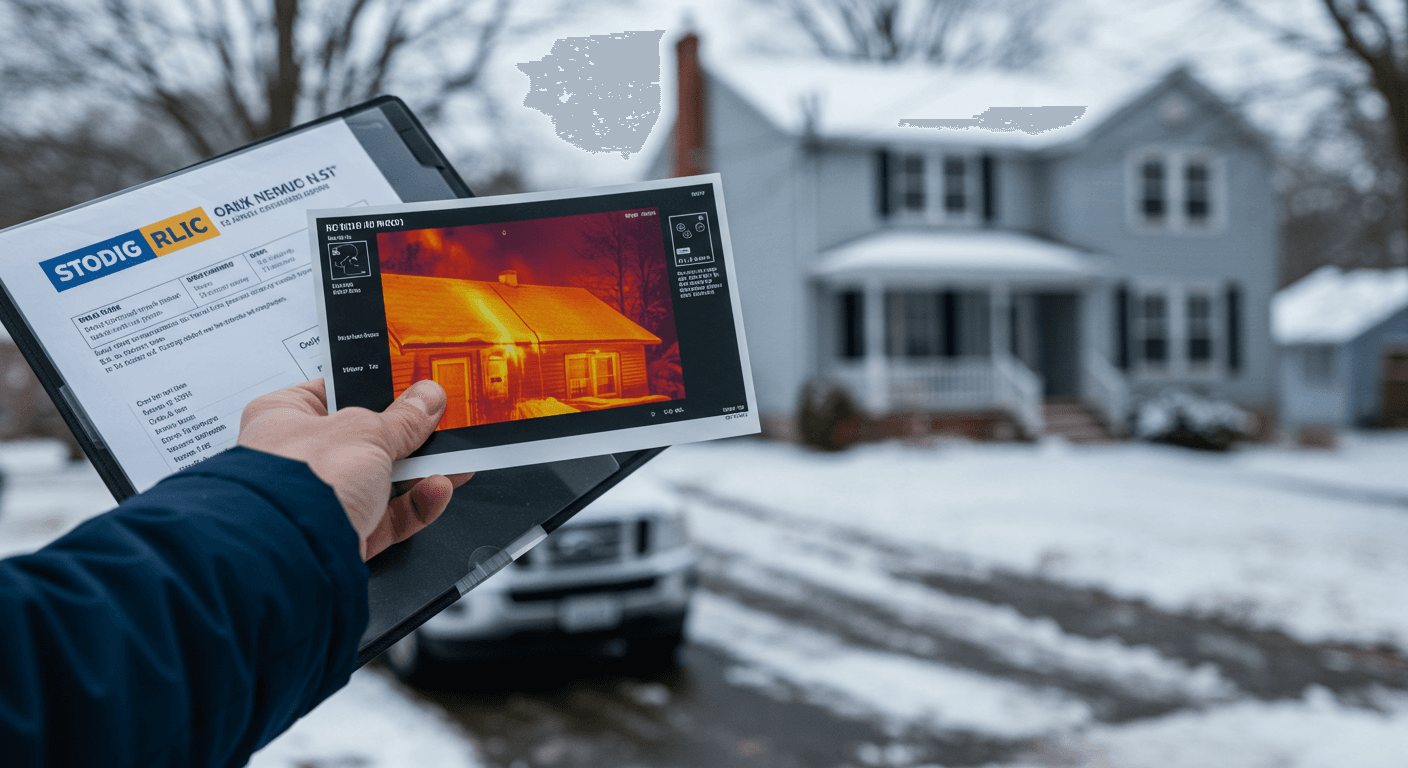
Elena stood by her truck in a driveway off James Street, staring at a competitor's quote that was exactly $3,842 lower than hers. She had two choices: cut her margin to the bone to win the "Salt Springs" project or walk away from a lead she'd already spent three hours measuring. On the other side of town, in a Manlius office, I watched Silas review a similar scenario. He was facing a $4,120 price gap on a steep-slope Victorian.
The difference? Elena focused on the $18,650 price tag and lost the deal. Silas focused on the $143 monthly "protection dividend" and closed at $22,770 with a 38% gross margin. While Elena was debating the cost of shingles, Silas was selling a 14-year maintenance-free lifecycle. In the Central New York market, where lake-effect snow and rapid freeze-thaw cycles chew through cheap materials, selling on "price" is a fast track to bankruptcy.
At a Glance
Shift the conversation from 'Total Cost' to 'Total Cost of Ownership' (TCO) to justify higher bids.
Use Syracuse-specific climate data (ice dams and humidity) to prove the ROI of premium ventilation.
Calculate the 'Failure Gap'—the real-world cost a homeowner pays when a $14,000 roof fails in year seven.
Focus sales training on the 'Protection Dividend' rather than material lists.
The Mathematical Fallacy of the "Lower Bid"
When a prospect in Liverpool or Dewitt tells you that your bid is "too high," they are usually comparing two numbers that shouldn't be on the same page. I recently audited a crew's sales process and found they were losing nearly a quarter of their pipeline because they didn't know how to explain the "Failure Gap."
In Syracuse, a "cheap" roof often skips the heavy-duty ice and water shield required for our winters. If a homeowner saves $3,400 today but faces a $9,200 interior remediation bill from ice damming in 2028, their "savings" actually cost them $5,800. We have to train our reps to put those numbers in front of the customer immediately.
According to the National Roofing Contractors Association (NRCA), a properly installed, high-quality roofing system can last 25 to 30 years, whereas a cut-rate installation often requires significant repairs within the first decade. When you break that down into an annual cost, the "expensive" roof is actually $412 cheaper per year.
Breaking Down the ROI: The 15-Year Syracuse Outlook
To handle the price objection, you need a systematic way to show the return on investment. I've implemented a "Lifecycle Comparison" tool with several CNY shops that changed their closing rates overnight.
Imagine a standard 2,800-square-foot roof.
Budget Bid vs. ROI-Optimized Bid
| Component | The 'Budget' Bid | The ROI-Optimized Bid |
|---|---|---|
| Initial Investment | $15,100 | $19,845 |
| Underlayment | Standard | Enhanced ice/water shield |
| Shingles | 3-tab | Architectural |
| Ventilation | Basic | Ridge-vent system |
| Cleanup | 1-man | Full property protection |
Initial Investment
Underlayment
Shingles
Ventilation
Cleanup
The price gap is $4,745. To the homeowner, that feels like a vacation or a used car. But when we analyze the ROI over 15 years, the math shifts.
The ROI-Optimized bid includes superior ventilation. In Syracuse's humid summers and frigid winters, this can reduce attic temperatures by 18 degrees, potentially shaving $34 to $52 off monthly cooling and heating costs. Over 15 years, that's over $7,200 in energy savings alone—more than covering the initial price difference.
Dealing with the "Chuck in a Truck" Competition
We all know the guy. He's running a crew out of a 2012 Silverado with no workers' comp and a "tailgate warranty." When a Syracuse business owner or homeowner brings up his bid, don't trash him. Instead, pivot to the ROI of risk mitigation.
I always tell my consulting clients to keep a copy of current Occupational Safety and Health Administration (OSHA) fall protection requirements in their sales folder. Explain that your $21,300 bid includes the $1,200 cost of proper rigging, scaffolding, and insurance that protects the property owner from a six-figure lawsuit.
The Liability Lever
"Ask the prospect: 'If a worker falls on your property and the contractor isn't fully insured, are you prepared to let your homeowners insurance handle a $450,000 claim?' This recontextualizes the $3,000 price gap as a very cheap insurance policy."
How Lead Quality Dictates Price Resistance
One thing I've noticed after analyzing thousands of operational workflows is that price objections are often a symptom of bad lead sourcing. If you are buying "shared" leads, you are walking into a knife fight where the homeowner has already been conditioned to look for the lowest number.
I prefer a system where the prospect has already seen a verified preview of the job. It changes the dynamic from a cold pitch to a professional consultation. When you use our verification process to ensure you're talking to someone with a legitimate, urgent need, the "price" becomes secondary to the "solution."
Action Plan
The 3-Step ROI Pivot
A systematic approach to reframing price objections into value conversations.
Acknowledge and Validate: 'I understand $19,500 is a significant investment. Most of my best clients felt the same way until they saw the energy data.'
Isolate the Variable: 'Aside from the initial $4,000 difference, is there anything about the system itself you're concerned about?'
Calculate the Payback: Show the 10-year savings on repairs, energy, and property value increases.
The Syracuse Resale Value Factor
Don't forget the real estate market. In neighborhoods like Strathmore or Westcott, a certified roof installation with a transferable warranty adds a specific, quantifiable amount to the home's appraisal.
I recently spoke with a local appraiser who noted that a documented, high-performance roof installation can increase a home's closing price by 6.8% to 8.2% in the CNY market. For a $250,000 home, that's a $17,000 to $20,500 bump. If your prospect is planning to move in the next 5.5 years, the roof isn't an expense—it's an escrow strategy.
The Margin Trap
Never drop your price on the spot. If you can drop $1,500 in thirty seconds, you just told the customer your initial price was a lie. Instead, offer to 'value-engineer' the project by changing materials, but keep your margins intact.
Conclusion: Stop Racing to the Bottom
If your crews are struggling to maintain margins, the problem is rarely the market. It's usually the script. By shifting to an ROI-focused strategy, you stop being a commodity and start being a consultant.
The foundation of this approach starts with quality leads. When you're working with verified prospects who understand the value of professional work, price objections become opportunities to demonstrate expertise rather than reasons to walk away.