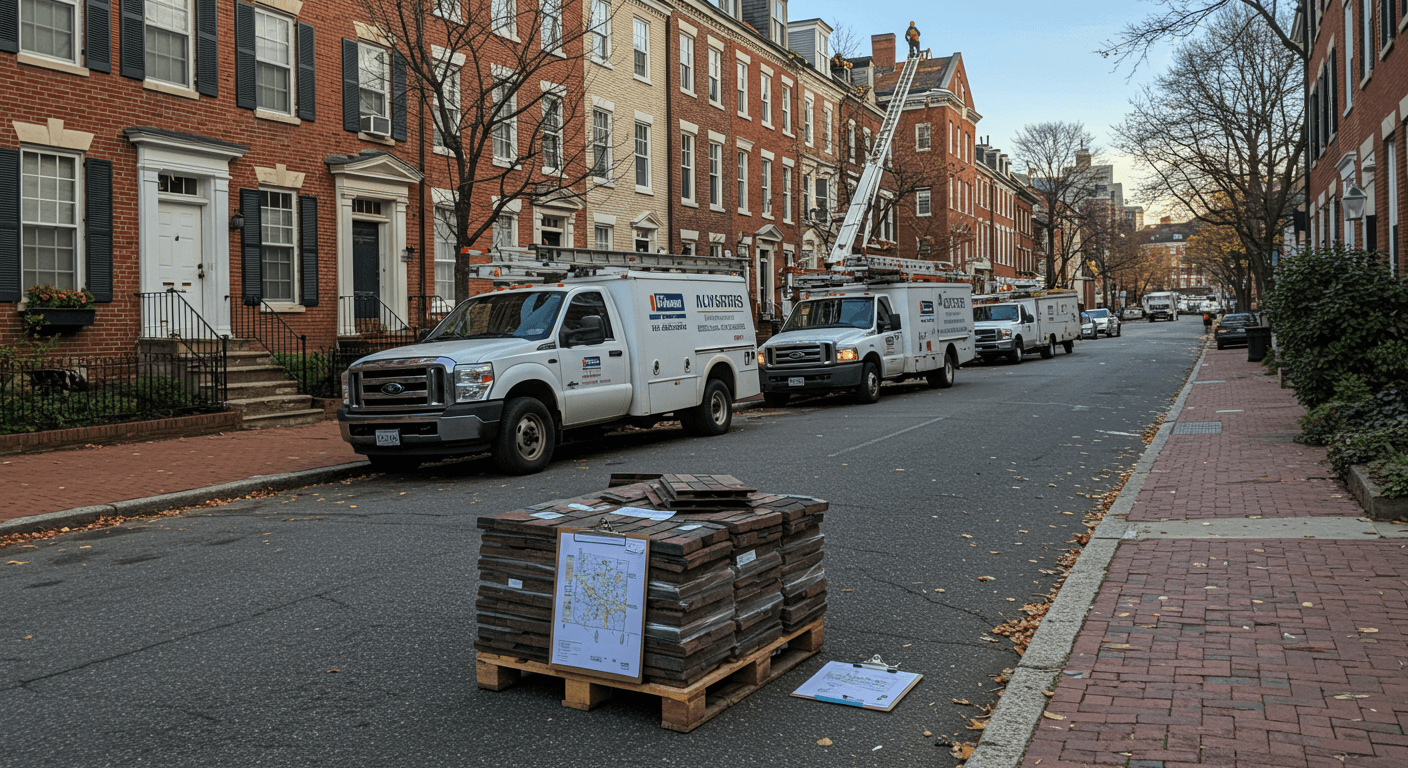
Standing on a sagging porch in South Philly, Parker pointed a calloused finger at a competitor's wrap-around sign three houses down. He didn't look angry, just exhausted. We were looking at a neighborhood he used to own, a zip code where his trucks were once a permanent fixture. But in the last 14 months, a venture-backed regional giant had moved in, outspending him on digital ads and flooding the local permits office with high-volume filings. Parker's revenue had dipped by 12.7%, and for a shop doing $4.2 million annually, that wasn't just a rounding error. It was the difference between upgrading his fleet and laying off a veteran crew leader.
I spent the next three hours in his office, digging into the local permit data and his lead acquisition costs. We realized that while the "big guys" were winning on sheer volume, they were leaving massive gaps in specialized segments like historic slate restoration and high-efficiency attic venting systems. Parker wasn't losing because he was a bad roofer. He was losing because he was playing a 2018 game in a 2024 market. We had to pivot his strategy from "defending his turf" to "systematic expansion" into underserved pockets of the Tri-State area.
At a Glance
Market consolidation by private equity firms requires local owners to build "brand moats" through specialized expertise and superior customer experience.
Dominating a specific zip code is 22.3% more profitable than spreading marketing spend across a wide, shallow geographic area.
Real-time data integration between your lead source and CRM is no longer optional for maintaining a competitive close rate in the Northeast.
High-intent, verified lead streams allow smaller shops to compete with massive marketing budgets by focusing on conversion over volume.
The Consolidation Wave: Why Local Shops are Losing Ground
The Northeast roofing market is currently undergoing a massive shift. I've seen it from Boston down to Baltimore. Private equity is pouring capital into the home services sector, rolling up smaller mom-and-pop shops into regional powerhouses. These conglomerates aren't necessarily better at installing shingles, but they are masters of the "back office." They use sophisticated algorithms to bid on jobs and have massive budgets for Google Local Services Ads that can drown out a local operator.
When I looked at Parker's books, we saw his cost per lead (CPL) had spiked from $64 to over $118 in just under two years. The reason? He was bidding against companies with $500,000 monthly ad spends. For a local contractor, trying to outbid these giants is a losing battle. Instead, we focused on "Market Share Density." By narrowing his focus to four specific high-value zip codes and emphasizing his team's 16 years of experience with historic Philadelphia architecture, we started to see a shift.
It's about understanding that market share isn't just about how many roofs you do. It's about the percentage of a specific neighborhood you own. If you have five signs on one street, you aren't just a roofer; you are the neighborhood's trusted authority. That kind of social proof is something a faceless regional corporation struggles to replicate.
Average market share increase for Northeast contractors who specialize in niche material types over generalists.
Digital Real Estate: The New Battleground for Zip Code Supremacy
In the old days, you'd buy a yellow pages ad or sponsor a Little League team and wait for the phone to ring. Today, the battle for the Northeast is fought in the milliseconds it takes for a homeowner to search "roof leak repair" during a Nor'easter. But here is the problem: most contractors are buying "junk" leads that have been sold to six other guys. By the time you call, the homeowner is already annoyed.
I've worked with shops that were burning $8,500 a month on shared leads only to close less than 4% of them. That is a recipe for bankruptcy. The shift we're seeing now is toward exclusivity. Contractors who succeed in 2024 are the ones who understand how the lead verification process works and refuse to settle for shared "chaff." When you have a locked preview of a lead before you buy it, you're not just buying a name; you're buying a strategic advantage.
The Western States Roofing Contractors Association has often highlighted how operational efficiency is the true differentiator in tight markets. While they focus on the West, the principle holds true in the Northeast. If your sales team is chasing 50 bad leads, they don't have time to properly nurture the 5 good ones. We cut Parker's lead volume in half but doubled his quality by focusing on verified, exclusive opportunities. His sales reps stopped feeling like telemarketers and started feeling like consultants again.
The Infrastructure Moat: Scaling Beyond the Owner-Operator Trap
One of the biggest hurdles to market domination is the "Owner-Operator Ceiling." I see this constantly. A contractor hits $2.8 million or $3.1 million and then plateaus. Why? Because the owner is still the one measuring every roof, ordering every bundle of GAF Timberline, and handling every customer complaint. You can't dominate a market if you are the bottleneck.
To scale, you need a tech stack that works while you sleep. This means a CRM that triggers automated follow-ups and a lead source that integrates directly with your existing systems. I remember a client in North Jersey, let's call her Yara. She was terrified of "losing the personal touch" as she scaled. We implemented a system where her leads were scored and routed based on the estimator's current location. If a high-intent lead came in within 4.5 miles of a sales rep, they got an instant alert.
This decreased their "speed to lead" from 4 hours to 12 minutes. In a competitive market like the Northeast, that 12-minute window is the difference between a $19,000 contract and a "we went with someone else" email. Market share is won by the fast and the organized, not just the best with a nail gun.
The Neighborhood Saturation Hack
"When you finish a job, don't just pull the sign. Offer the three immediate neighbors a "Professional Attic Inspection" for free. It builds a physical presence that digital ads can't touch, often leading to a 14.2% higher referral rate in that specific block."
Data-Driven Expansion: Predicting the Next High-Value Neighborhood
Dominating a market requires looking ahead, not just at your current pipeline. In the Northeast, we have the benefit of predictable weather patterns but the challenge of aging infrastructure. I've started advising my clients to look at "housing stock age" data. If a subdivision was built 19 to 22 years ago, every single house in that neighborhood is a ticking clock.
According to recent analysis in Roofing Contractor Magazine, companies that use predictive data to target their canvassing see a 26.7% higher ROI on their marketing spend. We used this for Parker. We identified a suburban pocket outside of Cherry Hill where the homes were built in the late 90s. We didn't just send mailers; we tailored the messaging to the specific architectural styles of those homes and the common failures we knew those 20-year-old roofs were experiencing.
This is where the story of LeadZik's founders resonates. They were roofers who got tired of the "shotgun approach" to marketing. They knew that if you could see the details of a job before committing your budget, you could dominate a territory with surgical precision. By focusing Parker's efforts on these high-probability "clusters," his close rate jumped from 19.4% to 31.8% in just under five months.
Action Plan
How to Systematically Enter and Dominate a New Northeast Territory
A four-phase approach to expanding market share through data-driven targeting and strategic positioning.
Identify zip codes with housing stock between 18 and 25 years old. Use municipal permit data to see which competitors are currently active and where the "gaps" are.
Develop a "Specialist Offer" for that neighborhood. Don't just be a roofer; be the "Colonial Style Slate Expert" or the "Storm Damage Restoration Specialist for [County Name]."
Switch from broad-spectrum branding to high-intent, verified lead sources. Ensure your sales team is ready to respond within 15 minutes of a lead being delivered.
Once you land the first three jobs in a cluster, pivot all local marketing to showcase those specific projects. Use door hangers that mention the neighbor by name (with permission) to build instant trust.
Want to skip the manual work and get exclusive, verified leads instead?
Get $150 in Free CreditsOvercoming the Northeast Labor Constraint
You can have all the leads in the world, but if you don't have the crews to install them, you aren't dominating anything. You're just building a backlog that will eventually turn into bad reviews. The labor market in the Northeast is notoriously tight, with many skilled tradespeople retiring faster than they can be replaced.
To maintain market share, you have to treat your crews as well as you treat your customers. I've seen contractors lose 9.3% of their annual revenue simply because of "crew churn." When a crew leaves in the middle of a busy season, your lead-to-install time blows out from 3 weeks to 9 weeks. Customers cancel. Your reputation takes a hit.
The most successful shops I work with are implementing "efficiency bonuses" and investing in equipment like the Equipter to make the job site cleaner and the physical labor less taxing. When your crews are efficient, your margins improve. When your margins improve, you have more "dry powder" to spend on capturing more market share. It's a virtuous cycle.